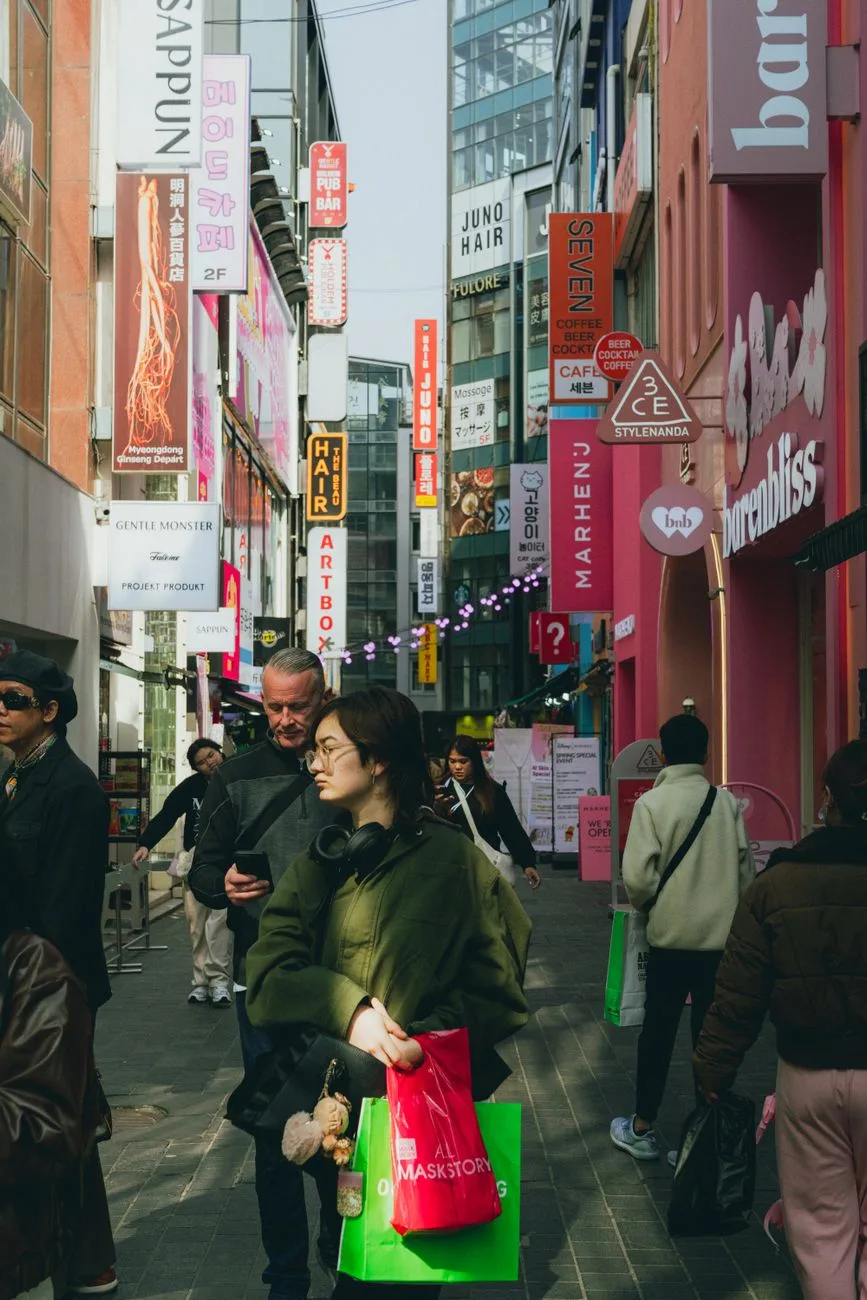
A search for Korean makeup near you returns two shops that have almost nothing in common: a Korean-owned beauty store carrying forty cushion shades and a wall of lip tints, and a mainstream chain carrying the four or five K-beauty labels that cleared national distribution. The gap between those two catalogues is the entire shopping problem.
Go in person for base makeup and lip color. Cushion foundation, concealer and tint shades cannot be judged from a screen, and Korean shade codes do not convert cleanly from Western foundation numbers. Order eyeshadow palettes, brow products, mascara and skincare online, where the range runs far deeper and the price sits closer to Korean retail.
The short version
- Korean base shades run on a number code (13, 17, 21, 23, 25) plus a letter for undertone (N, C, W), and the codes are not standardized between brands.
- Cushion formulas oxidize. A swatch that matches instantly and a swatch that matches after 15 minutes are often two different shades.
- Mainstream retailers stock a curated slice of each brand. The label's actual Korean range is usually three to ten times larger.
- Since 29 August 2025 the US no longer grants duty-free de minimis treatment to commercial parcels, which changed the math on ordering direct from Seoul.
What "Korean makeup near me" actually returns
Three store types show up in local results, and they behave differently enough that walking into the wrong one wastes the trip. If you are still working out which shops exist in your city, the companion piece on how to find a Korean makeup store near you covers the search side; this article is about what happens once you are standing at the counter.
| Store type | Makeup range on the floor | Testers | Base shade codes stocked | Price vs Korean shelf |
|---|---|---|---|---|
| Korean-owned beauty shop (Koreatown districts: Western Ave in LA, Flushing NY, Annandale VA, Palisades Park NJ) | Deepest overseas selection; cushions, tints, brow, palettes | Common, often with disposable applicators | Frequently the full 13 to 25 range in popular lines | Moderate markup, closest to Korean pricing |
| Mainstream beauty chain (Sephora, Ulta, Boots) | Narrow curated set, heavy on hero products | Yes, but only for stocked shades | Two to four shades per line is common | Highest markup, plus loyalty perks and easy returns |
| Korean grocery with a beauty aisle (H Mart and similar) | Skincare-led, thin on color cosmetics | Rare | Limited, often only 21 and 23 | Variable, sometimes the best value on sheet masks and sunscreen |
The practical read: the Koreatown shop is where shade matching succeeds, the chain retailer is where a painless exchange succeeds, and the grocery aisle is a skincare stop that occasionally hides a bargain. For a broader map of where each product category lives, see the guide to buying K-beauty products near you.
How to shade-match a Korean cushion foundation in the store
Korean base makeup uses a numeric depth code with an undertone letter appended. Lower numbers are fairer. The rough ladder runs 13 (very fair), 17, 19, 21, 23, 25, with the letter marking undertone: N for neutral, C for cool or pink, W for warm or yellow. Some brands substitute descriptive names (Vanilla, Sand, Ginger) on top of the same logic.
The trap is assuming the code is an industry standard. It is not. One brand's 21N can sit visibly lighter and pinker than another brand's 21N, because each label calibrates against its own base pigment. Conversion charts that map a Western foundation number to a Korean code are a starting hypothesis, never an answer.
A method that works in a real store, in order:
- Take the two adjacent codes your chart suggests, not one. If a chart says 23, swatch 23 and 25.
- Swatch along the jawline running onto the neck, never on the back of the hand. Hand skin is a different depth from face skin on most people.
- Walk to the shop door or window. Retail lighting is warm and forgiving; daylight is the only honest referee.
- Wait 10 to 15 minutes. Cushion formulas carry high water content and many darken as they set. This is the single step people skip and the single most common cause of a wrong purchase.
- Check the neck line last. The correct shade is the one that stops being visible.
Coverage is a separate axis from shade. A dewy "glow" cushion delivers light to medium coverage and shifts more as it oxidizes; a high-coverage line marketed as long-wear or mask-proof sits heavier and drifts less. Choosing the wrong coverage tier is why a perfectly matched shade can still look wrong in photos.
Worked example, including the case where in-person shopping fails
Say someone matches to a medium-tan foundation with an olive cast in a Western line. At the Koreatown counter they pull 23N and 25N. After 15 minutes, 23N has deepened and now reads slightly pink at the jaw; 25N has settled neutral and disappears. The buy is 25N, and they take the refill rather than a second compact if they already own the case.
Now the exception. Below roughly shade 25, many Korean lines simply stop. A small shop stocking a two-shade lineup has nothing to match a deep skin tone, and no amount of in-person testing fixes an absent shade. In that situation the store visit is the wrong strategy and the extended-range brands are the answer: Tirtir expanded its Mask Fit Red Cushion to 30 shades in 2023 after sustained feedback from darker-skinned buyers, and several labels have widened ranges since. Check the brand's current shade chart directly, because these ranges keep changing and overseas distributors carry only part of them.
Buy in person or order online: a category-by-category rule
| Product | Buy in person? | Reason |
|---|---|---|
| Cushion foundation, BB cushion | Yes | Shade code plus oxidation; unfixable from a screen |
| Concealer | Yes | Same shade problem, narrower margin for error |
| Lip tint | Yes | Tints stain and pull differently on pigmented lips; screen swatches mislead badly |
| Cream blush | Worth it if testers exist | Payoff varies hugely between formulas |
| Eyeshadow palette | Order online | Overseas shops stock a fraction of the colorways |
| Brow pencil, mascara, liner | Order online | Shade risk is low, selection online is much wider |
| Sunscreen with SPF | Depends on your market | Regulatory status differs by country, see below |
The verdict for most shoppers: make one in-person trip for base and lips, then build the rest of the routine online. Two categories justify the travel time. The others do not.
Reading the date code and the label before you pay
Korean cosmetics are regulated by the Ministry of Food and Drug Safety (식품의약품안전처, MFDS), which requires manufacturing and use-by information on the packaging. On Korean-market packaging this appears as 제조 (manufactured) followed by a date, or a date followed by 까지 (until). Imported stock destined for other markets carries a translated sticker, and the original Korean code is often still printed underneath.
This matters at the discount shelf. Overseas Korean shops move date-sensitive stock at a markdown, which is a genuine bargain on a lip tint and a bad idea on a cushion. A cushion holds liquid product in a sponge that you press with a puff; once opened, the sensible working life is months, not years. Check the open-jar symbol on the box, which prints a period-after-opening figure such as 12M.
The regulatory point that surprises most shoppers abroad concerns sun protection. In Korea, SPF and PA claims fall under 기능성화장품 (functional cosmetics), a category the MFDS reviews and approves, which is why Korean cushions routinely carry SPF 50+ PA+++ as a matter of course. In the United States, sunscreen is regulated as an over-the-counter drug by the Food and Drug Administration, and a Korean SPF filter that is not on the US monograph cannot be marketed there as sunscreen. That single difference explains why the SPF product you saw in Seoul is missing from your local mainstream retailer while a Korean-market shop three miles away has a shelf of it. The FDA's cosmetics authority also expanded under the Modernization of Cosmetics Regulation Act signed in December 2022, which added facility registration and product listing requirements for cosmetics sold in the US.
Authenticity is worth thirty seconds of attention. Physical Korean-owned shops sourcing through normal distribution are low risk. The higher-risk channel is a third-party marketplace listing a hero product, especially a refill-only cushion, at a price far under everyone else. Compare the packaging generation against the brand's own site before buying a suspiciously cheap parcel.
What ordering from Korea costs now that de minimis is gone
For years the default advice was to skip the local markup and order direct from a Korean retailer. That advice is out of date for US buyers. On 29 August 2025 the United States ended duty-free de minimis treatment for commercial shipments from all countries, closing the low-value exemption that had made small parcels from Korean sellers effectively duty-free. Duty, carrier handling fees and brokerage charges now apply to parcels that previously arrived clean. Confirm the current treatment and rates with U.S. Customs and Border Protection before you assume a figure, because carrier practice has been moving. Readers in the UK, EU, Canada and Australia face their own separate thresholds, each set nationally.
The arithmetic to run is simple and worth doing before you check out. Take the online subtotal, add shipping, add the duty and handling estimate the carrier quotes, then divide the total add-on by the number of items in the basket. Compare that per-item add-on against the markup at your local shop. A single cushion almost never survives this comparison. A basket of eight to twelve items usually does, because shipping and fixed handling charges spread out.
If you are shopping inside Korea rather than at home, the relevant lever is different: Korean VAT is 10%, and stores displaying Tax Free signage can process a refund for eligible foreign visitors, either immediately at the register or at an airport kiosk. Per-transaction and per-person limits apply and have been revised more than once in recent years, so check the current thresholds with the Korea Customs Service rather than a travel blog. Bring your passport; the immediate refund cannot be processed without it.
Warehouse-club multipacks are the third option and behave differently again. The Costco Korean skincare selection skews to sheet masks and cleansers rather than color cosmetics, so it rarely solves a shade problem, but it can undercut both channels on volume basics.
Mistakes that send people home with the wrong product
The pattern behind most returns is treating Korean color cosmetics like Western ones. Four specific errors account for the bulk of it.
Buying by conversion chart alone. Charts are built from averages and cannot account for undertone letters or a brand's own calibration. Use one to narrow to two candidates, then test.
Buying the compact when a refill would do. Most cushion lines sell a refill at a lower price than the full compact and the case is reusable. Shoppers pay for the same plastic shell repeatedly without noticing.
Judging a lip tint by the swatch on the cap. Water and jelly tints deposit stain, and stain interacts with your own lip pigment. A shade that reads coral on a promotional image can pull noticeably more red or brown on pigmented lips.
Assuming the retailer's selection reflects the brand. A chain carrying three shades of a cushion is showing you its buying decision, not the brand's range.
One more, less obvious: matching your base in a shop with strong warm lighting and never rechecking. Store lighting is designed to flatter, and this quietly causes more mismatches than any chart.
If your reason for the trip is skincare rather than color, the selection logic is different and shade never enters into it. The guide to choosing a Korean skincare brand for your skin type covers that decision separately.
General shopping and labeling information, not dermatological advice. Patch-test new products and read ingredient lists if your skin is reactive or you have known allergies.
Questions shoppers ask next
Is Korean makeup cheaper in Koreatown than ordering online?
On a single item, almost always yes, once shipping and post-2025 import charges are counted. Online wins on multi-item baskets, where fixed costs spread across ten or twelve products, and it wins on anything a local shop does not stock at all.
Can I return Korean makeup if the shade is wrong?
Policy depends entirely on the retailer. Mainstream chains with generous beauty return policies will usually take back an opened base product; independent Korean-owned shops often sell opened cosmetics as final. Ask before you pay, not after.
Do Korean cushion foundations come in deeper shades?
Some lines do now. Tirtir's Mask Fit Red Cushion expanded to 30 shades in 2023, and other labels have widened their ranges since, but overseas distributors frequently import only the middle of the range. Check the brand's own shade chart and expect to order deep shades direct rather than find them on a local shelf.
Why can't I find Korean sunscreen at mainstream US retailers?
Because the FDA regulates sunscreen as an over-the-counter drug, and several UV filters approved in Korea are not on the US monograph. Products carrying SPF and PA claims therefore cannot be marketed as sunscreen in the US through normal retail channels, which pushes them into Korean-market stores and direct import.
What is the difference between a cushion and a regular foundation?
A cushion is liquid base held in a saturated sponge inside a compact, applied with a puff. It builds in thin layers, dries faster, and is easy to reapply, and Korean versions almost always include SPF. Coverage runs lighter than a bottled foundation unless the line is specifically formulated for high coverage.
Are in-store testers safe to use?
Use the disposable applicators and swatch on the jaw, not the lips or eye area. Many shops have moved to sealed sample sachets for base products since 2020. If a cushion tester looks dry, cracked or discolored, it tells you nothing useful about the fresh product anyway.