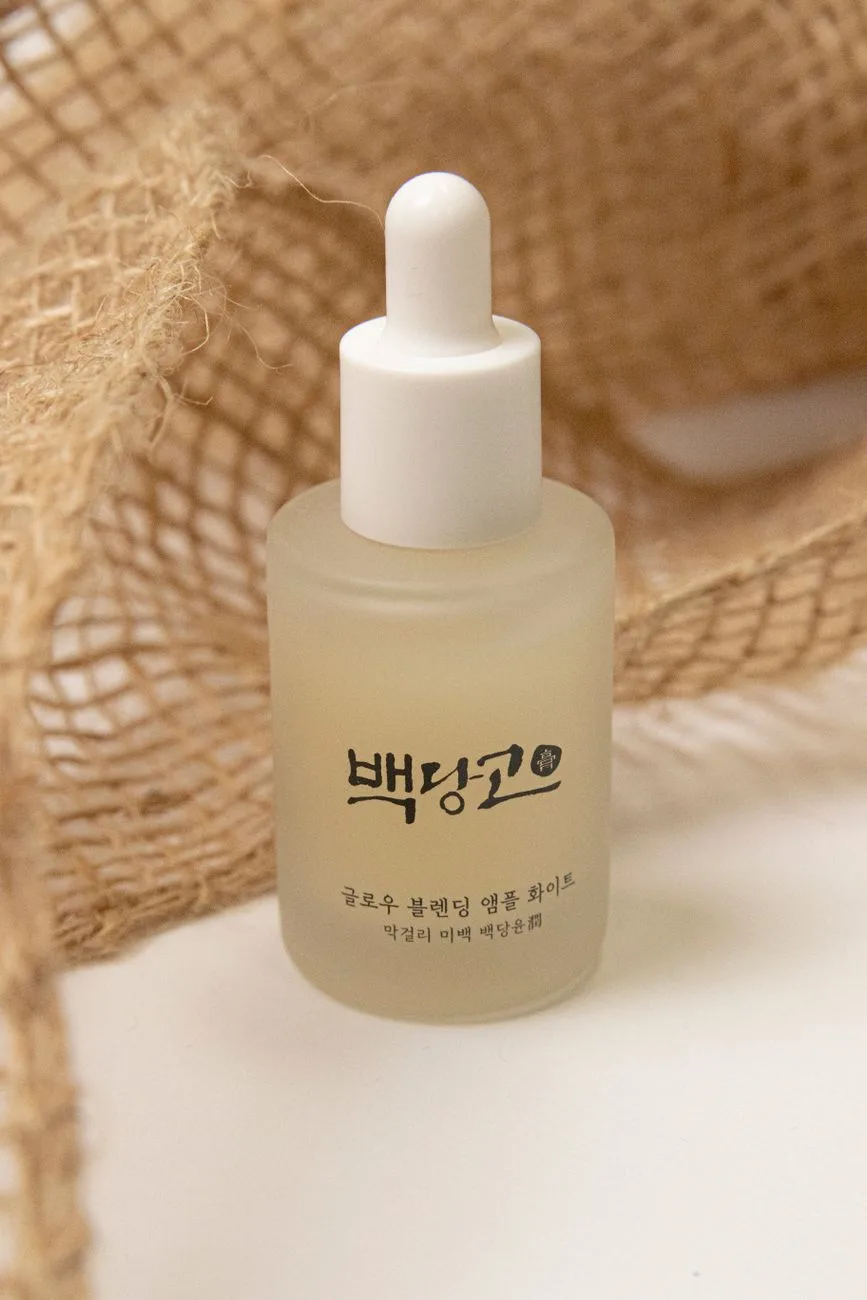
Apply Korean skincare thinnest to thickest: oil cleanser, water cleanser, toner, essence, serum or ampoule, sheet mask, eye cream, moisturiser, then sunscreen as the final morning step. Water-based layers go before oil-based ones because oils, silicones and waxes leave a film that limits how much of the next product reaches skin. At night, a cream or occlusive closes the routine instead of SPF.
The short version
- The rule is about the solvent, not the marketing category: water phase before oil phase. Texture is only a proxy for that.
- Four steps do most of the work. Cleanse, hydrate, moisturise, protect. The other six are optional.
- Sunscreen goes last in the morning, and how much you apply changes the result more than the number on the tube.
- One active per slot: vitamin C in the morning, retinol or acids at night, and not both on the same night while your skin is adjusting.
Why the Korean skincare routine order is a solvent rule, not a texture rule
The common phrasing is "thin to thick," which works most of the time but explains nothing. What actually governs the sequence is what carries the ingredients.
Toners, essences, most ampoules and hydrating serums are water-phase formulas. They spread, absorb or evaporate. Anything with a film-former in it (mineral oil, silicones such as dimethicone, plant butters, petrolatum, most sunscreens) leaves a layer on the surface that a water-based product cannot easily cross. Put the film down first and the essence behind it has nowhere to go.
This is where the shortcut breaks. An oil-soluble vitamin C serum built on ascorbyl tetraisopalmitate can feel lighter than a thick hydrating gel, and a squalane-based facial oil pours like water. Both belong after the water layers regardless of how runny they feel. Judge by the first few ingredients on the label, not by the pour.
One more practical consequence: skin absorbs water-based actives better when it is still slightly damp from the previous layer. That is the real argument for the layered approach, and it is also why the whole sequence collapses if you let each step dry to a crust before the next.
The full morning and night order, layer by layer
Korean product ranges use their own shelf vocabulary, and the same category can be sold under three names. This is the order those categories go in, with the Korean shelf term you will see in Olive Young or a department store counter.
| # | Step | Korean shelf name | Morning | Night | Verdict |
|---|---|---|---|---|---|
| 1 | Oil cleanser or balm | 클렌징 오일 / 밤 | No | Yes | Only needed if you wore sunscreen or makeup |
| 2 | Water cleanser (low-pH gel or foam) | 폼클렌저 | Water rinse or gentle foam | Yes | Core |
| 3 | Chemical exfoliant (AHA / BHA / PHA) | 필링젤 · 토너패드 | No | 1–3 nights a week | Optional |
| 4 | Toner or hydrating toner | 스킨 · 토너 | Yes | Yes | Optional if your cream is good |
| 5 | Essence | 에센스 | Optional | Optional | First thing to cut |
| 6 | Serum or ampoule (the active step) | 세럼 · 앰플 | Yes | Yes | Keep exactly one |
| 7 | Sheet mask | 마스크팩 | No | 2–3 a week | Treat, not routine |
| 8 | Eye cream | 아이크림 | Optional | Optional | Skippable |
| 9 | Emulsion, then cream | 로션 · 에멀전 · 크림 | Yes | Yes | Core |
| 10 | Sunscreen (AM) or sleeping mask (PM) | 선크림 · 수면팩 | Yes, always | Optional | Sunscreen is the non-negotiable one |
A note on step 9: Korean lines often sell an emulsion and a cream from the same range. The emulsion is the lighter of the two and goes first. Using both is a texture preference for dry skin in winter, not a requirement.
The numbered "10-step routine" itself is largely an export-market framing rather than a national daily standard. Korean shelves sell all ten categories, but nobody is checking your compliance with a list.
How long to wait between layers, and when waiting is pointless
The honest answer is short. Wait until the previous layer stops looking wet: roughly 30 seconds for a watery toner, one to two minutes for a cream or sunscreen. That is enough to stop the next product from smearing the last one off.
The widely repeated advice to wait 20 or 30 minutes after an acid before applying anything else is not well supported. Leave-on exfoliants are formulated to work at pH 3 to 4 and their effect on the stratum corneum begins within minutes; there is little published human data establishing a fixed waiting period. Giving a low-pH L-ascorbic acid serum a minute or two before layering is sensible. Standing in a cold bathroom for half an hour is not.
Sunscreen carries the one genuinely time-bound instruction, and it comes from the label rather than from beauty forums. The US Food and Drug Administration's Drug Facts labelling for sunscreens directs users to apply 15 minutes before sun exposure and to reapply at least every two hours, with water-resistance claims limited to 40 or 80 minutes. Korea's Ministry of Food and Drug Safety (식품의약품안전처, MFDS) regulates UV-protection products as functional cosmetics with their own testing standards. Both agencies agree on the part that matters: reapplication, not the initial application, is where most people fail.
The sunscreen arithmetic almost every routine gets wrong
SPF is measured at a fixed application density of 2 mg per square centimetre of skin, the standard used in FDA sunscreen testing and the international ISO methods. That number is the hidden assumption behind every SPF 50+ claim on a Korean tube.
Run it through: an adult face is roughly 400 to 600 cm² depending on size and whether you include ears and hairline. At 2 mg/cm² that is about 0.8 to 1.2 grams, or close to a quarter of a teaspoon (about 1.25 ml) for the face alone. Add the neck and ears and you are near half a teaspoon. The "two finger lengths" heuristic exists because it approximates this dose without a measuring spoon.
Most people apply somewhere between a quarter and a half of the tested dose. Measured protection falls off faster than the dose does; the exact relationship is still debated in the literature, but every study points the same direction, which is that under-application costs far more than the difference between an SPF 30 and an SPF 50 tube. Buying a higher SPF and applying a thin layer is the worst combination of the two.
Korean labels cap the SPF figure at SPF50+ and grade UVA protection on the PA scale, from PA+ to PA++++, derived from the persistent pigment darkening (PPD) method, with PA++++ corresponding to a PPD value of 16 or above under MFDS functional-cosmetics standards. Check the current MFDS notice for the exact bands, since testing standards are periodically revised. Practical takeaway for daily city wear: SPF50+ PA++++ is the standard Korean spec and there is no benefit to hunting for something stronger.
One caveat for readers outside Korea. Several UV filters common in Korean sunscreens have not been approved for use in over-the-counter sunscreens in the United States. Buying them for personal use is normal, but they are not FDA-reviewed products, and that is worth knowing rather than discovering later.
Cutting ten steps to four without losing the result
Here is the framework. Start with the four steps that have real evidence behind them, then add exactly one active chosen by your primary concern.
The core four: water cleanser at night, one hydrating layer (toner or essence, pick one), one moisturiser, sunscreen every morning.
Then add one:
- Dull or uneven tone → vitamin C serum in the morning, before moisturiser and under sunscreen.
- Congestion, blackheads, rough texture → a BHA (salicylic acid) two or three nights a week, after cleansing.
- Fine lines → retinol at night, starting at two nights a week and building up over about four weeks.
- Redness, stinging, a barrier that feels raw → no active at all for four weeks. Centella asiatica, panthenol and ceramide creams are what the Korean market sells for exactly this, and they are the reason the category exists.
The time difference is not trivial. A full ten-step night with a 20-minute sheet mask runs past 25 minutes. The core four takes under five. Cost drops too: the drugstore staples that fill Olive Young shelves cluster in the low tens of thousands of won per item, though promotions move prices constantly, so check the current shelf price rather than an old figure. If you buy K-beauty in bulk abroad, our breakdown of what's worth the multipack in Korean skincare at Costco covers where the per-millilitre maths favours a larger size, and where to buy K-beauty products near you covers the retail side.
This framework fails in one situation worth naming. If a dermatologist has prescribed tretinoin, adapalene or an azelaic acid formula, follow their sequencing instead. Prescribers sometimes deliberately reverse the order and have patients apply moisturiser first to buffer the retinoid, which breaks the thin-to-thick rule on purpose to improve tolerance.
Where actives go, and which "conflicts" are real
Three ordering facts drive almost every active decision:
Pure L-ascorbic acid needs a low pH (roughly below 3.5) to stay stable and penetrate, which is why it goes early, on clean skin, before anything buffering it. Morning is the conventional slot because of its antioxidant role under sunscreen. AHAs and BHAs also work in an acidic range, around pH 3 to 4, which is why they sit immediately after cleansing rather than on top of three hydrating layers. Retinol is a night ingredient because of photodegradation and because irritation is easier to manage when you are not adding UV exposure.
The niacinamide-plus-vitamin-C "conflict" is largely overstated. It traces back to laboratory conditions where niacinamide converts to nicotinic acid, a reaction that requires heat and low pH over time, not the conditions inside a finished cosmetic on your face. Plenty of Korean formulas contain both deliberately.
The conflicts that do matter are irritation-driven: a retinoid and a strong acid on the same night, or several exfoliating steps stacked because each one "isn't that strong."
Korea adds a useful piece of information the Western market does not. Under the Cosmetics Act, MFDS designates specific functional ingredients with fixed concentrations for approved claims. Wrinkle-improvement products commonly use adenosine at 0.04%, and brightening products use niacinamide or arbutin in the 2 to 5% range. Because the concentration is set by the notice rather than by the brand, a ₩12,000 tube carrying the 주름개선 claim contains the same regulated dose of adenosine as a ₩120,000 one. Confirm current values against the MFDS notice, since the list is amended over time.
Five reasons your layers pill, sting, or do nothing
- Pilling from film-formers plus friction. Carbomers, silicones and PEG-based thickeners roll into visible flakes when rubbed against each other. Pat, don't rub, and cut a layer.
- Too much product per step. A pea-sized amount of serum is the intended dose. Three pumps do not absorb three times better.
- Sunscreen applied over a layer that hasn't set. This is the single most common cause of white flaking under makeup. Give the moisturiser 60 seconds.
- Stinging misread as "it's working." Acids and denatured alcohol on a compromised barrier sting because the barrier is compromised. That is a stop signal.
- Sheet masks left on until dry. Most labels specify 15 to 20 minutes. Past that, the drying sheet works against you.
One more, specific to Korea: if you wear a cushion foundation or a water-resistant sunscreen, a water cleanser alone will not fully remove it. That is the actual origin of the double cleanse, and it is also why the oil step is pointless on a day you wore neither.
What the Korean label is telling you
Products sold in Korea carrying a 기능성화장품 (functional cosmetics) mark have been reviewed or reported to MFDS for one of a defined set of claims. The three you will meet in a daily routine are 미백 (brightening), 주름개선 (wrinkle improvement) and 자외선차단 (UV protection). A product without that designation cannot legally make those claims in Korea, which makes the mark a genuine filter when you are standing in front of 40 near-identical tubes.
The full ingredient list (전성분) is printed in descending order of concentration down to 1%, after which order is not meaningful. An active listed after the fragrance and the preservative is present in a token amount.
Sources worth checking directly: the Korean Ministry of Food and Drug Safety for functional cosmetics standards and approved ingredient concentrations, and the US FDA's sunscreen guidance for labelling and application instructions if you are buying in the US market.
Frequently asked questions
Does toner go before or after essence?
Toner first, then essence. Korean toners are hydrating or lightly exfoliating preparation steps applied to just-cleansed skin, and essences are slightly more concentrated water-based treatments. If your toner and essence have similar textures and similar ingredient lists, you are duplicating a step and can drop one.
Should sunscreen go before or after moisturiser?
After. Sunscreen is the final morning step because it needs to form an even, continuous film on the surface, and anything applied over it disturbs that film. Makeup is the exception in the sense that it goes on top by necessity; see our guide to buying Korean makeup in store versus online for the base products designed to sit over SPF.
Where does vitamin C fit in a Korean routine?
After cleansing and toner, before moisturiser, in the morning. Low-pH L-ascorbic acid serums perform best on skin that has not been buffered by heavy layers. Oil-soluble vitamin C derivatives are the exception and go after your water-based steps.
Do I need to double cleanse in the morning?
No. Overnight your skin has accumulated sebum and residue from your night cream, none of which requires an oil cleanser. A water rinse or a gentle low-pH foam is enough. Skin surface pH sits around 4.7 to 5.5, and traditional bar soaps at pH 9 to 10 disrupt it, which is why low-pH cleansers dominate the Korean market.
How long before a new routine shows results?
Hydration changes are visible within days. Anything structural takes far longer: efficacy trials for wrinkle-improvement and brightening functional cosmetics in Korea commonly run 8 to 12 weeks. Judge an active on a 12-week timeline, and change one variable at a time so you know what worked.
The one change worth making tonight
Measure your sunscreen once. Squeeze a quarter-teaspoon onto a spoon, look at it, and use that as your reference every morning. Most people are applying less than half of that, which quietly cancels out everything else in the routine.
This article is general information about cosmetic products and their sequencing, not medical advice. Persistent acne, rosacea, eczema or a reaction to a product warrants a dermatologist, and regulated figures such as MFDS ingredient concentrations and sunscreen labelling standards change, so verify current values with the issuing agency.