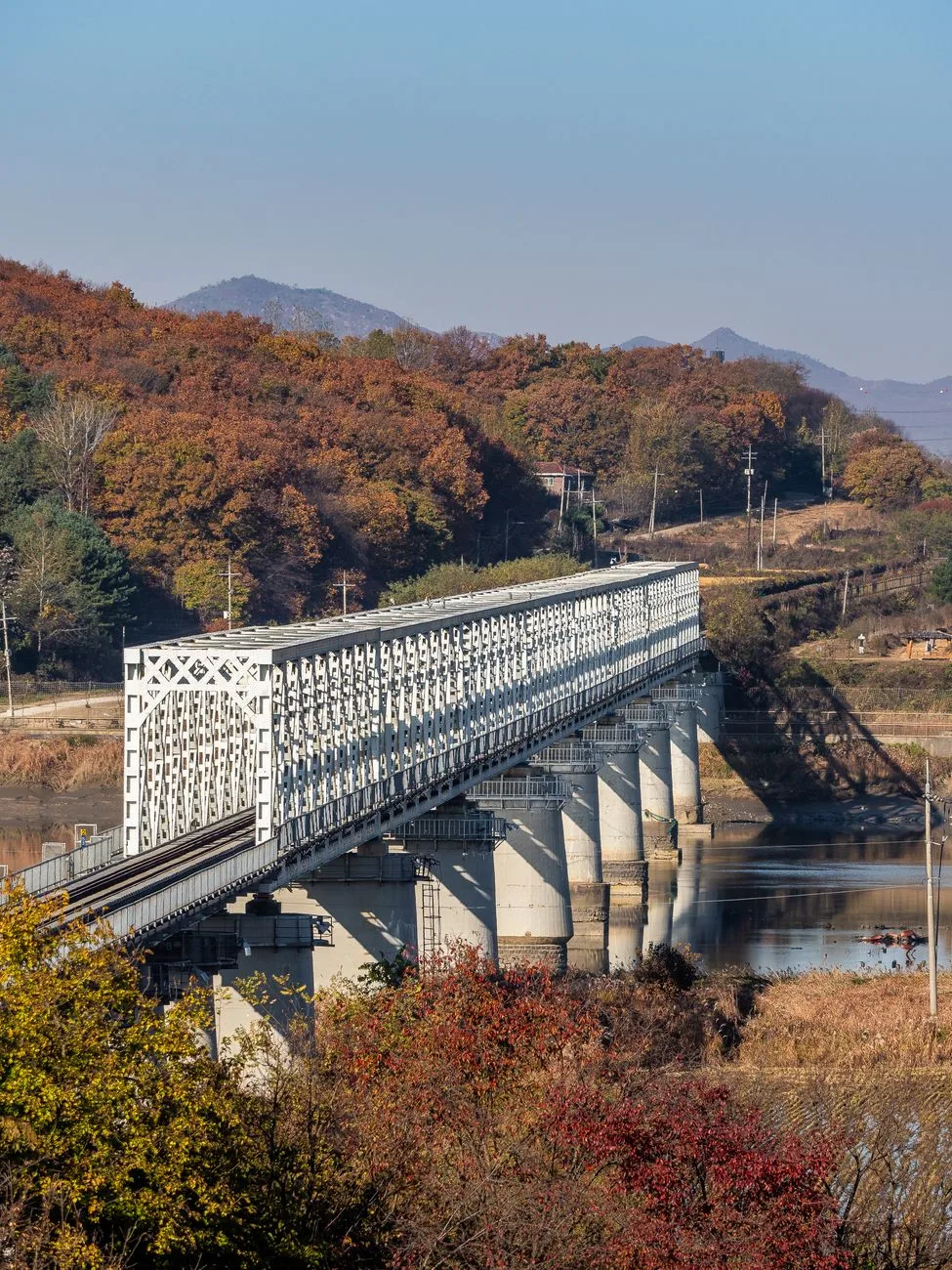
A DMZ tour from Seoul is a guided half- or full-day trip into the Civilian Control Line at Paju, about an hour north of the city. Standard itineraries cover the Third Infiltration Tunnel, Dora Observatory and Dorasan Station. Panmunjom's Joint Security Area is a separate, restricted tour that is frequently suspended. Bring your passport, and skip Mondays.
Before you commit a day to it:
- Almost no commercial tour enters the DMZ itself. They enter the controlled zone south of it.
- The Paju sites close on Mondays and on most national holidays. So do the shuttles.
- Passport originals are checked at the checkpoint. A photo on your phone will not clear you.
- JSA/Panmunjom access has been intermittent since July 2023 and is booked separately, weeks ahead.
What a DMZ tour from Seoul actually gets you
The Demilitarized Zone is a buffer roughly 248 km long and about 4 km wide, running 2 km either side of the Military Demarcation Line fixed by the Armistice Agreement signed on 27 July 1953. That strip is off limits to civilians.
What tour buses cross into is the Civilian Control Line (CCL), a restricted band of farmland, checkpoints and military installations on the South Korean side. Conflating the two is the single most common misunderstanding in DMZ trip planning, and it explains why the day feels less dramatic than the marketing photos: you are looking at the DMZ from a hillside, not standing in it.
The fixed Paju circuit is short and specific:
Imjingak Peace Nuri Park sits outside the CCL, so anyone can walk in without clearance. It holds the Freedom Bridge, the Mangbaedan altar where separated families hold ancestral rites facing north, and a rusted steam locomotive shot up during the war.
The Third Infiltration Tunnel, discovered in 1978, is the centrepiece. Paju City and the Korea Tourism Organization publish its length at about 1,635 m, bored roughly 73 m below ground with a cross-section near 2 m square. Visitors descend an access ramp of around 358 m on a steady incline, or ride a small monorail where it is running. Hard hats are compulsory, the ceiling is genuinely low, and phones and cameras must go in lockers before you enter. The walk back up is the part people underestimate.
Dora Observatory is the viewpoint over Kaesong, the shuttered Kaesong Industrial Complex and the empty settlement of Kijŏng-dong with its enormous flagpole. Visibility is entirely weather-dependent. On a hazy summer afternoon you may see a grey smear and nothing else.
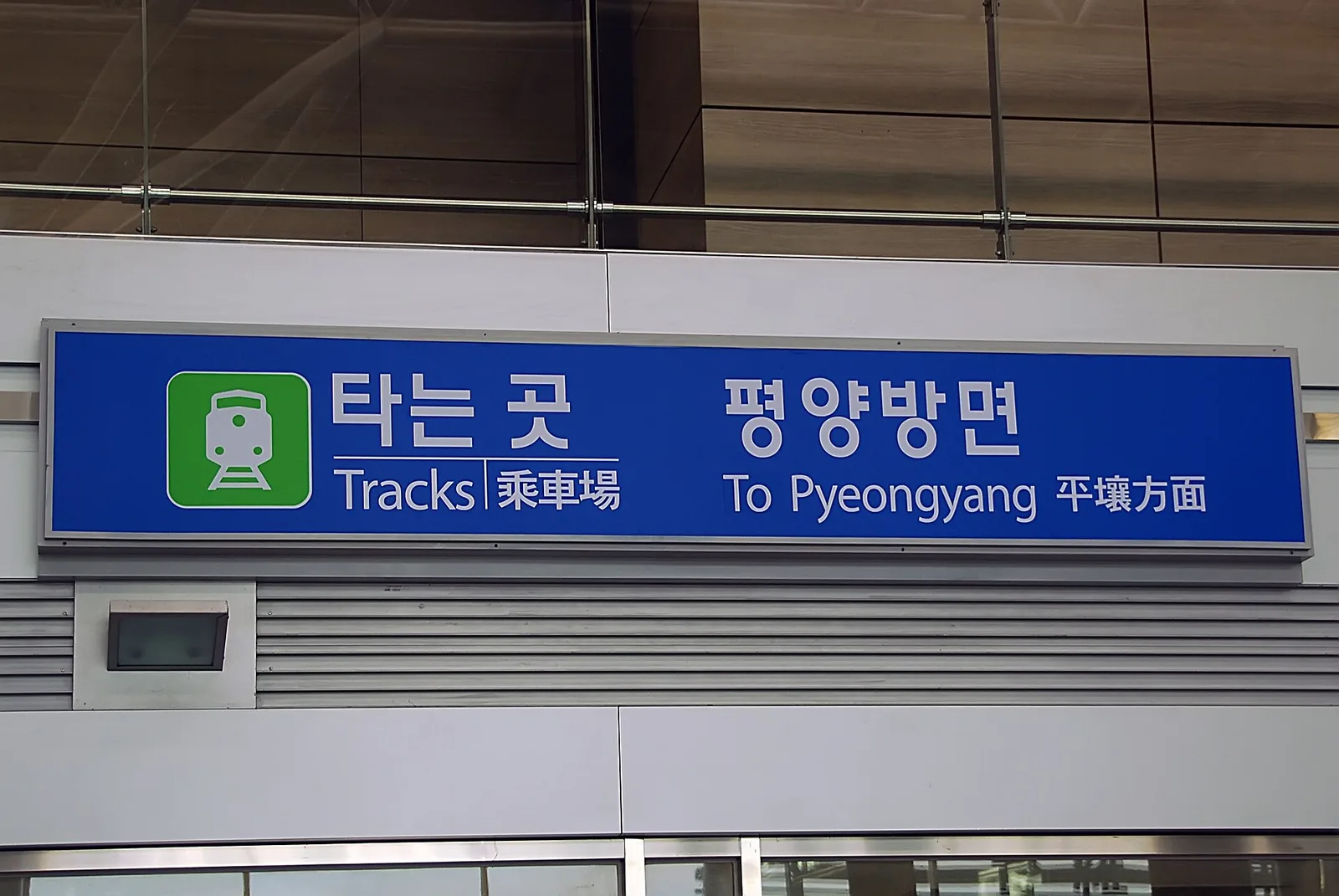
Dorasan Station opened in 2002 on the Gyeongui Line as the northernmost station of the South Korean network, with a platform sign pointing to Pyeongyang. Passenger service beyond it has never run commercially.
The three routes north: Paju, Panmunjom, and the eastern border
Most travellers assume there is one DMZ tour. There are three quite different products, and picking wrong is how people end up disappointed.
| Route | Core stops | Time from Seoul | Booking lead time | Suits |
|---|---|---|---|---|
| Paju standard (half day) | Imjingak, Third Tunnel, Dora Observatory, Dorasan Station | ~1 hr each way | 1–3 days, sometimes same day | First visit, tight itinerary, families |
| JSA / Panmunjom (full day) | Joint Security Area, conference huts, Bridge of No Return, plus Paju stops | ~1.5 hrs each way | Weeks; passport details submitted in advance | Travellers whose main goal is the border line itself |
| Eastern / Cheorwon & Goseong | Second Tunnel, Woljeongni Station, Goseong Unification Observatory | 2–3 hrs each way | Varies by county programme | Repeat visitors, military history focus |
The verdict: for a first trip to Korea with five days or fewer, book the Paju half-day and spend the afternoon back in Seoul. It delivers the tunnel, the observatory and the station by early afternoon, and it survives cancellations better than anything JSA-dependent.
JSA tours are the exception worth chasing only if Panmunjom is the specific reason you came. Access was halted in July 2023 after a US soldier crossed the Military Demarcation Line, and availability since then has moved with the security situation rather than with any published calendar. The United Nations Command administers the area, and the Ministry of National Defense is the authority on current visitor status. Verify with United Nations Command and your operator before paying a deposit, and expect a no-refund window once your details are submitted.
The eastern routes reward people who already know the story. Cheorwon's terrain, the Labour Party headquarters ruin and the abandoned Woljeongni Station read differently from Paju's polished visitor centres, but the driving time makes them a full day with little left over.
Passport, nationality, age and dress: what gets people turned away
Security screening is the part travellers treat as a formality and then fail.
Every participant needs an original passport. A South Korean resident registration card or driver's licence works for nationals; for foreign visitors, no photocopy, no photo, no ARC substitute at some checkpoints. A soldier boards the bus inside the CCL and checks documents against the manifest.
Nationality restrictions apply to the JSA specifically, and they are set by the military rather than by tour companies. Holders of certain passports need extended clearance and longer lead times, and some are refused outright. Ask the operator to confirm your nationality before you pay, not after.
Age limits differ by route. The Paju circuit accepts children, though the tunnel ramp is unpleasant for small kids and anyone claustrophobic. JSA tours have historically excluded younger children, with the threshold set by the operator under UNC rules.
The dress code is real for JSA and loosely enforced elsewhere: no ripped jeans, no sleeveless tops, no sandals or flip-flops, nothing military-patterned. Wear shoes you can climb 358 m of incline in.
One exception worth naming: if you are on a layover rather than a full stay, the Paju circuit rarely fits. Immigration, transfer time and the return check-in eat the margin. A shorter city plan works better, and the options are laid out in our guide to a Korea day tour from the airport.
What it costs, and where the extras hide
Prices move, so treat what follows as a bracket rather than a quotation, and confirm against the operator's own listing.
Seoul operators commonly advertise the Paju half-day in the ₩50,000 to ₩80,000 range per person, with JSA-inclusive full days considerably higher, often above ₩120,000. Private cars with a licensed guide run several times the group rate.
The extras are where budgets slip:
- Lunch is excluded on most half-day itineraries and included on most full-day ones.
- The Imjingak Peace Gondola across the Imjin River is ticketed separately by cabin type and is not part of the standard CCL package. Paju City publishes the current fares.
- Shopping stops. Cheaper tours pad the return leg with a ginseng or amethyst centre. This is the clearest signal of a low-margin operator, and it costs you 40 minutes.
A worked comparison for two adults. A group half-day at ₩70,000 each is ₩140,000 total, hotel pickup included, back in central Seoul around 3 pm. Doing it independently, the rail fare to Munsan is roughly ₩2,000 to ₩2,500 each way with a T-money card, so under ₩10,000 for the pair, plus the local bus or a short taxi to Imjingak, plus separate shuttle tickets into the CCL. The saving is real, perhaps ₩80,000 to ₩100,000. It costs you roughly three extra hours and adds the risk that the shuttle is full.
For a couple on a short trip, the group tour wins on time. For a solo traveller with a spare weekday and a flexible plan, going independently is defensible.
Going independently to Imjingak, and where do-it-yourself breaks down
Imjingak Peace Nuri Park is genuinely open access. Take the Gyeongui-Jungang Line to Munsan Station, then a local Paju bus or a 10 to 15 minute taxi for the last stretch. Service beyond Munsan toward Imjingang Station is limited and has been suspended at times, so check Korail's timetable on the day rather than assuming.
Once there, you are still outside the Civilian Control Line. Crossing it independently is impossible. What bridges the gap is the DMZ security shuttle that Paju City operates from the Imjingak ticket office to the Third Tunnel, Dora Observatory and Dorasan Station. It runs on fixed departures, requires your passport at booking, and sells out on weekends and Korean holidays.
This is where the independent plan fails. If the shuttle is full, suspended for a military exercise, or cancelled for weather, there is no fallback: you have spent two hours travelling to a park with a bridge and a locomotive. A group tour absorbs that risk by holding allocated seats. Check current shuttle operation with Paju City or the Korea Tourism Organization before setting out.
The DMZ Peace Trail, run across the border counties under national and provincial administration, is a separate walking programme with its own application windows and quotas. It is not interchangeable with a bus tour and books out well ahead.
Timing: Mondays, weather, and suspensions
The Paju sites close on Mondays. If Monday is a substitute holiday, the closure shifts. Most national holidays close the circuit as well, which catches travellers during Chuseok and Lunar New Year in particular. Our Korean festivals calendar covers which dates move each year.
Departure is early. Most Seoul pickups run between 7:00 and 8:00 am from Hongdae, Myeongdong or City Hall, which makes accommodation location worth a thought before booking; the districts are compared in our guide on where to stay in Seoul.
Season changes what you see rather than whether you go. Clear, dry air in late autumn and winter gives the best visibility from Dora Observatory. Summer haze and monsoon cloud can reduce the view to nothing while the rest of the itinerary runs normally, and no operator refunds for weather.
Suspensions are the genuine variable. Tours have been halted for African swine fever control, for military exercises, and for periods of heightened tension along the border. Book a DMZ day early in your trip rather than on your last full day, so a cancellation leaves room to rebook. If it slips entirely, the alternatives in things to do in Seoul fill the gap without another early start.
A short honesty note: the sites are administered by military and civil authorities whose rules change without much notice, and figures published on visitor signage occasionally differ from older sources. Confirm anything time-sensitive with the operator and the agencies named above.
Frequently asked questions
Can you visit the DMZ without a tour?
You can reach Imjingak Peace Nuri Park in Paju independently by train and local bus, with no clearance needed. You cannot cross the Civilian Control Line on your own. The Third Tunnel, Dora Observatory and Dorasan Station require either a registered tour vehicle or the Paju City shuttle booked at Imjingak with your passport.
Do DMZ tours from Seoul enter North Korea?
No. Standard Paju tours stay well south of the Military Demarcation Line. Only the Joint Security Area at Panmunjom puts visitors on the line itself, inside conference buildings that straddle it, and that route is restricted and often unavailable.
Are Panmunjom and JSA tours running right now?
Availability has been intermittent since the July 2023 crossing incident and depends on the security situation rather than a published season. The United Nations Command and the Ministry of National Defense are the authoritative sources; operators reselling JSA slots should be able to show current confirmation before taking payment.
Is a DMZ tour safe?
The Paju circuit is a controlled, heavily supervised civilian visit with fixed routes and briefings. The practical constraints are procedural: stay with the group, photograph only where permitted, and expect the day to be cancelled outright if conditions change. Tours have been suspended during periods of tension, which is the mechanism that keeps them safe.
How long does the whole thing take?
A Paju half-day runs roughly 7:30 am to 3:00 pm door to door from central Seoul, including about two hours of driving. Full-day itineraries with JSA or the eastern border sites return closer to 5:00 or 6:00 pm.
What should I bring?
Your original passport, closed shoes for the tunnel ramp, and a jacket in winter because the observatory deck is exposed. Leave the ripped jeans and sandals at the hotel if any part of your booking touches the JSA.
Book the Paju half-day for a weekday that is not a Monday, put it in the first half of your trip, and confirm your passport details match the booking name exactly before you pay.
This article is general travel information. Access rules, fares and operating status at the border are set by Korean military and civil authorities and can change without notice; confirm with the operator and the agencies named above before travelling.