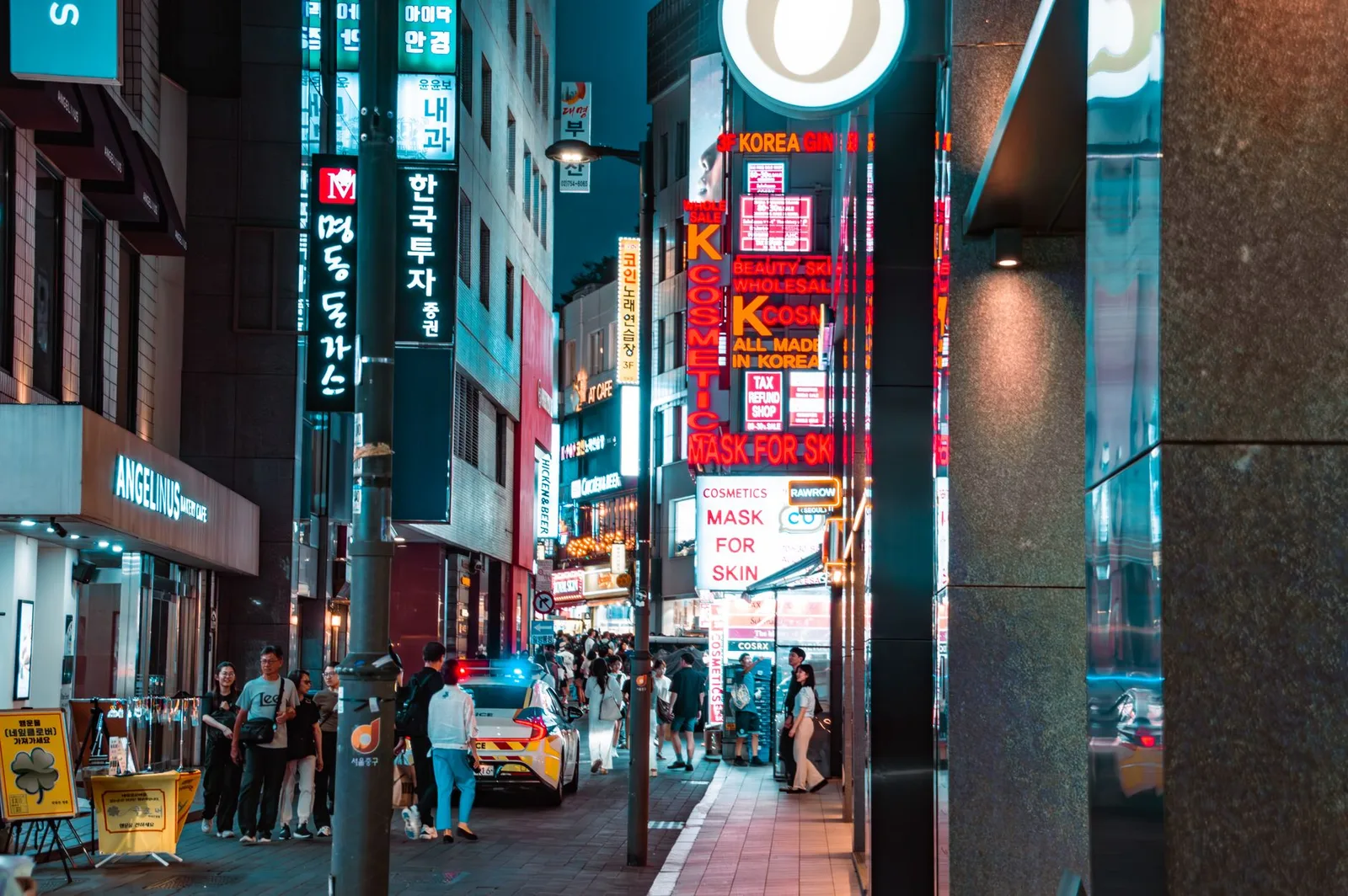
Stay in Myeongdong. For a first trip it wins on the only two things that decide whether a Seoul week works — you can be standing at Gyeongbokgung in 21 minutes with one transfer, and you can get there from Incheon on a single 17,000 KRW bus that stops in the neighbourhood itself, luggage in the hold, no stairs.
Everything below is the arithmetic behind that call, so you can overrule me if your trip is a different shape. Where the numbers are unreliable or simply do not exist, I say so rather than filling the space.
Getting in from Incheon: fares and times
This table answers what each route costs, how long it takes, and where it drops you. Fares are as of August 2026.
| Route | Adult fare | Time from the airport | Where you land |
|---|---|---|---|
| AREX Express (non-stop, reserved seat) | 13,000 KRW; 9,500 KRW child 6–12 | 43 min from T1, 51 min from T2 | Seoul Station |
| AREX All-Stop (transport card) | 4,750 KRW from T1, 5,350 KRW from T2 | 59 min from T1, 66–67 min from T2 | Seoul Station, after 11 stops including Hongik University |
| Bus 6015 | 17,000 KRW; 12,000 KRW child | Not published | Myeongdong, Namdaemun Market, Hoehyeon, Chungjeongno, Gongdeok, Mapo |
| Bus 6002 | 17,000 KRW | Not published | Cheongnyangni, Jongno, Sinchon, Hongdae |
| Bus 6703 | 18,000 KRW | Not published | Gangnam and COEX, over 18 stops |
Three things fall out of that table.
The 8,250 KRW gap between AREX Express and all-stop buys you 16 minutes and a guaranteed seat. If you land with two suitcases at 21:00, take the Express. If you land at 07:00 with a backpack, the all-stop is the better deal — and if you are staying in Hongdae, the all-stop reaches Hongik University before it reaches Seoul Station, so it is both shorter and cheaper than riding to the terminus.
The bus fares are certain; the bus times are not published by anyone. Not by the operators, and not on Incheon Airport's own bus route page, which lists routes without durations or fares. Budget for traffic on the Yeongjong bridge and do not book a same-evening dinner reservation.
Watch the last departures. AREX Express runs from about 05:15 from Terminal 2 to about 22:48 from the airport. Bus 6002 stops at 21:17 and 6703 at 19:35, with a night service N6703 for Gangnam. Late-night services carry a surcharge over the daytime fare, so confirm the price on the operator page if your flight lands after 22:00.
The subway from each candidate base
One warning before the numbers. Every minute figure in the table below comes from the route planner Rome2Rio, checked on 10 August 2026, and I am not linking it because I do not trust it enough to send you there. Rome2Rio quotes subway fares of ₩2,800–5,960 on these routes, which is far above what Seoul Metro actually charges — its cost data is wrong, and that lowers confidence in its timings too. Its totals also appear to include walking at both ends, which is why the Hongdae-to-Gyeongbokgung figure is more than double the two in-train segments it lists. Treat the minutes as planning figures. The line numbers, station names and transfer points are solid — those come from the operators and do not change. If a connection is tight, check it in Naver Map or KakaoMap on the day.
This table answers how long it takes to reach the three places a first-timer actually goes, from each place a first-timer actually considers sleeping.
| Base (lines) | To Gyeongbokgung | To Hongdae | To Gangnam |
|---|---|---|---|
| Myeongdong (Line 4) | 21 min, 1 transfer via Chungmuro onto Line 3 | 11 min, no transfer on Line 2 from Euljiro 1-ga; or 14 min, 1 transfer via Seoul Station and AREX | 28 min, 1 transfer via Line 3 to Sinsa then Sinbundang; or 43 min direct on Line 2 |
| Hongik University (Line 2, AREX, Gyeongui–Jungang) | 35 min, 1 transfer via Euljiro 3-ga — in-train time is only 16 min | — | 39 min, 17 stops per iVisitKorea; 43–46 min per Rome2Rio. No transfer either way |
| Anguk / Insadong (Line 3) | One stop on Line 3, no transfer. Minute figure not published | 21 min, 1 transfer via Euljiro 3-ga | 25 min, 1 transfer via Sinsa; the all-Line-2 route is 59 min |
| Gangnam (Line 2, Sinbundang) | 33 min, 1 transfer via Sinsa; the all-Line-2 route is 1 hr 5 min | 39–46 min, no transfer | — |
| Itaewon (Line 6) | 26 min, 1 transfer via Yaksu | 13 min, 1 transfer via Gongdeok; or 28 min direct on Line 6 to Sangsu | 25 min, 1 transfer via Yaksu and Sinsa |
| Seoul Station (Lines 1, 4, AREX) | 22 min, 1 transfer via Jongno 3-ga | 8 min, no transfer on the AREX all-stop | 29 min, 1 transfer via Sadang; the all-Line-2 route is 1 hr 6 min |
The pattern is blunt: from Myeongdong and Seoul Station, nothing on a first-timer's list is more than half an hour away. From Gangnam, the palaces cost you 33 minutes each way, and the wrong routing costs you 65. Gangnam is where you go for an evening, not where you sleep on trip one.
One caveat on the Myeongdong row. Myeongdong Station is on Line 4; Euljiro 1-ga on Line 2 is the next nearest and is a real walk from the Myeongdong core, so the 11-minute Hongdae figure assumes you cover that first. Book toward the northern edge of Myeongdong if that route matters to you.
What a room costs — and why no one can tell you by district
Be clear-eyed here: per-district nightly rates in KRW are largely not published by anyone credible. The Korea Tourism Organization, the Ministry of Culture, Sports and Tourism and Seoul Metropolitan Government all publish accommodation statistics by district — but they are counts of businesses and rooms, not prices. Everything at neighbourhood level comes from booking platforms, and it is inconsistent.
What is properly sourced is city-wide. Seoul's average daily rate hit about 296,000 KRW in September 2025, up 14.6% year on year, per STR — though that is a single peak month across the Seoul-Incheon market. On an annual basis, Cushman & Wakefield Korea puts Seoul ADR at 207,000 KRW in 2024, up from 145,000 KRW in 2022, a 38.6% rise, with 2025 RevPAR at 207,345 KRW in its report published 8 July 2026. Those two ADR figures measure different things; do not read them as one line going up.
Two districts have KRW figures at all, both from Agoda:
- Hongdae: 3-star average 116,056 KRW, 4-star 185,519 KRW, with weekend 3-star at 91,088 KRW.
- Yongsan Station: 3-star average 85,872 KRW, 4-star 195,275 KRW. Note carefully — this is Yongsan Station, about 2 km from Itaewon and a different place commercially. It is not an Itaewon rate, and no Itaewon rate is published.
Myeongdong appears only in dollars: $183 a night on HotelsCombined, with December cheapest at about $95 and June dearest at about $330, and $163 on KAYAK. Ignore KAYAK's individual district pages — one shows a "3-star average" of 13,255 KRW next to named properties at 199,835 KRW. There is no published 3-star KRW figure for Myeongdong, Gangnam, Insadong or Seoul Station.
Trip.com does publish Seoul-wide star-grade averages — 3-star 226,210 KRW weekday and 294,904 KRW weekend, 5-star 803,349 / 948,913 KRW — but these sit far above the industry ADR for the same city because they are advertised rates, not rates anyone paid.
Book early, and here is the hard number that proves it
Seoul hotel occupancy ran at 80.8% in August 2025 and 81.6% in September 2025, and 79.2% across 2025 as a whole. Meanwhile foreign arrivals to Korea hit 18.93 million in 2025 and passed 10 million by 20 June 2026 — the first time before the end of a first half. New supply is running at about 1,000 rooms a year, a quarter of the pre-pandemic rate.
New beds are landing exactly where I am telling you to sleep. Of Seoul's 152 new lodging facilities opened in the first half of 2026, Jongno-gu took 58 and Jung-gu 46 — 68.4% between them — against 14 in Mapo-gu and 9 in Gangnam-gu. Jung-gu is Myeongdong, Namdaemun and Seoul Station; Jongno-gu is Insadong.
Nights: which areas are loud, and the one that is quiet by law
Hongdae has measured noise on the Walking Street of 102.9 dB, described as construction-site level. Mapo-gu banned street performance after 22:00 in July 2015 and set 60 dB as the illegal threshold, but complaints rose from 12 in 2015 to 53 in 2018, and officials concede enforcement is impractical because a busker's noise cannot be separated from shopfront music. If you want the Hongdae location without the volume, one guide suggests Yeonnam-dong or Hapjeong instead.
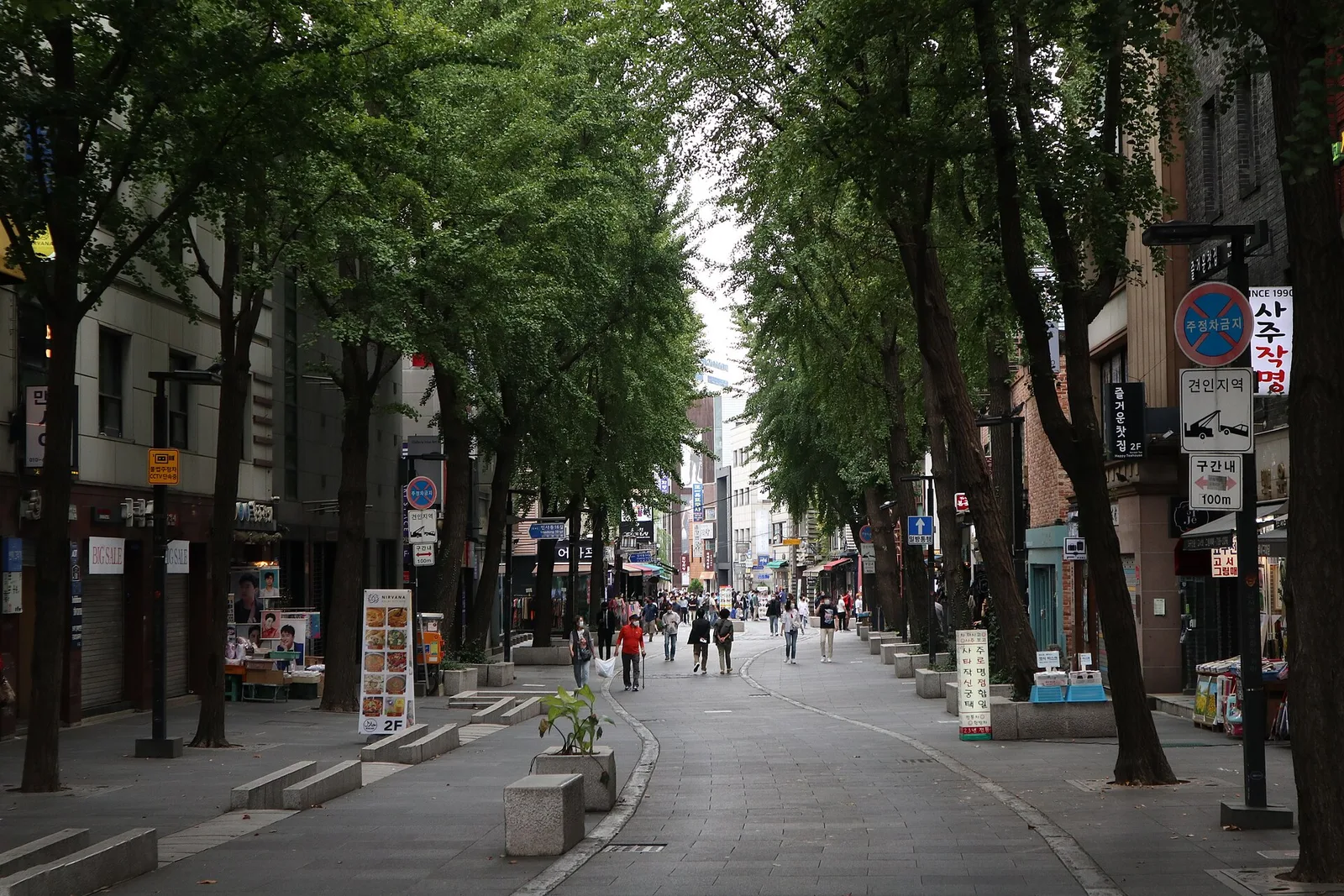
Insadong is the opposite, and by regulation rather than luck. It became Korea's first designated Culture District in 2002, which bars hostess bars, room salons, franchise coffee chains and fast-food outlets from opening there. As of 4 August 2026 those rules are being loosened on the main thoroughfare to allow chicken restaurants, snack shops and convenience stores on second floors and above — but ordinary bars and coffee specialty shops stay restricted, with implementation targeted for January 2027. Stay here if you want to sleep.
So: what to book
Book Myeongdong for a first trip of a week or less. It is on Line 4, it is inside a Special Tourist Zone, it is one stop from Seoul Station's AREX platform, bus 6015 delivers you from Incheon for 17,000 KRW, and it was the area 85.9% of surveyed foreign visitors reached in 2023 — though that measures where people went, not where they slept.
Book Hongdae instead if your nights matter more than your mornings — you get the airport train stop and the published rates, and the last Line 2 train to Gangnam leaves Hongik Univ. at 23:13 on weekdays and 23:16 at weekends. Book Insadong if you are here for palaces and quiet. Do not book Gangnam or Itaewon for a first trip: Gangnam puts 33 minutes between you and Gyeongbokgung, and Itaewon has no airport bus fare published for it at all.