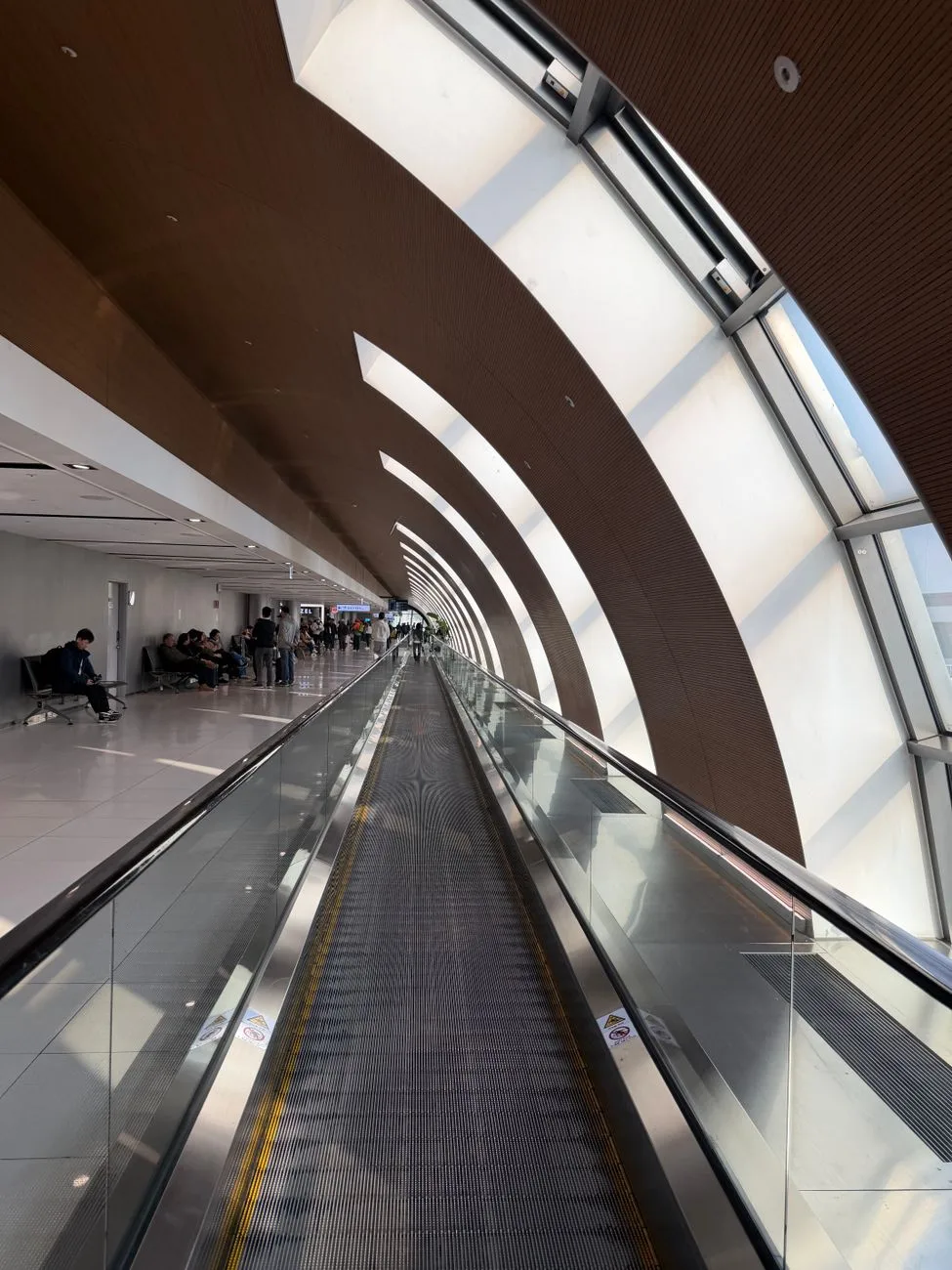
The simplest way to get to Gwangju from Incheon Airport is the direct intercity bus to U-Square Bus Terminal. It takes about 4 hours, costs ₩39,900 for deluxe service as of August 2026, and avoids a Seoul transfer. The train is faster on the rail section but requires airport rail travel and a transfer before the KTX.
Key takeaways for choosing your route
- Choose the direct bus if you have luggage, arrive outside Seoul rail operating hours, or want one vehicle from the airport to Gwangju.
- Choose AREX plus KTX if rail speed matters and the available departure times fit your arrival.
- Use the bus timetable carefully. Terminal 1 and Terminal 2 have different first and last departures.
- Do not confuse Gwangju Metropolitan City with Gyeonggi Gwangju. Incheon Airport’s N8842 night bus serves Gyeonggi Gwangju and Gwacheon, not the southern city of Gwangju.
- The current route-specific KTX fare is not exposed in the official timetable material reviewed for this article, so the direct bus is the only option with a verified end-to-end fare here.
Direct bus from Incheon Airport to Gwangju U-Square
The direct airport bus is the practical default for most arrivals. It runs to Gwangju’s U-Square Bus Terminal, the city’s major intercity bus terminal, and the ride takes approximately 4 hours according to the Korea Tourism Organization’s airport-to-Gwangju transport information.
The 2026 Gwangju Institute of Science and Technology guide lists Kumho Express and Kwangshin Express as the operators. The same guide gives these one-way fares: ₩39,900 for deluxe service, ₩43,900 for night service, and ₩49,900 for premium service. These figures apply to the guide published in January 2026, so the departure date and service class still matter.
This route has one decisive advantage: there is no airport-to-Seoul transfer. A passenger collects luggage, reaches the correct airport bus platform, boards once, and arrives at U-Square. That reduces the number of places where a large suitcase, a delayed flight, or a missed connection can disrupt the trip.
Airport platforms and operating hours
The boarding locations in the January 2026 GIST guide are:
| Airport location | Platform | First listed departure | Last listed departure |
|---|---|---|---|
| Terminal 1 | First floor, platform 12 | 05:35 or 06:00 listing | 23:30 |
| Terminal 2 | Basement transport center, platform 8 | 05:35 | 23:05 |
The source material presents the first-departure information in a way that requires care: the airport-to-Gwangju listing gives 06:00 for Terminal 1 and 05:35 for Terminal 2, while the terminal guide describes the services separately. Treat the terminal-specific listing as the controlling detail for the departure point and date, and allow time to reach the platform after immigration and baggage collection.
The bus is a poor choice when the next departure is full or when the arrival time leaves too little margin before the final listed service. A flight scheduled to land at 22:00 does not mean a 22:00 arrival at the bus platform. Immigration, checked baggage, customs, and walking through the terminal all happen first.
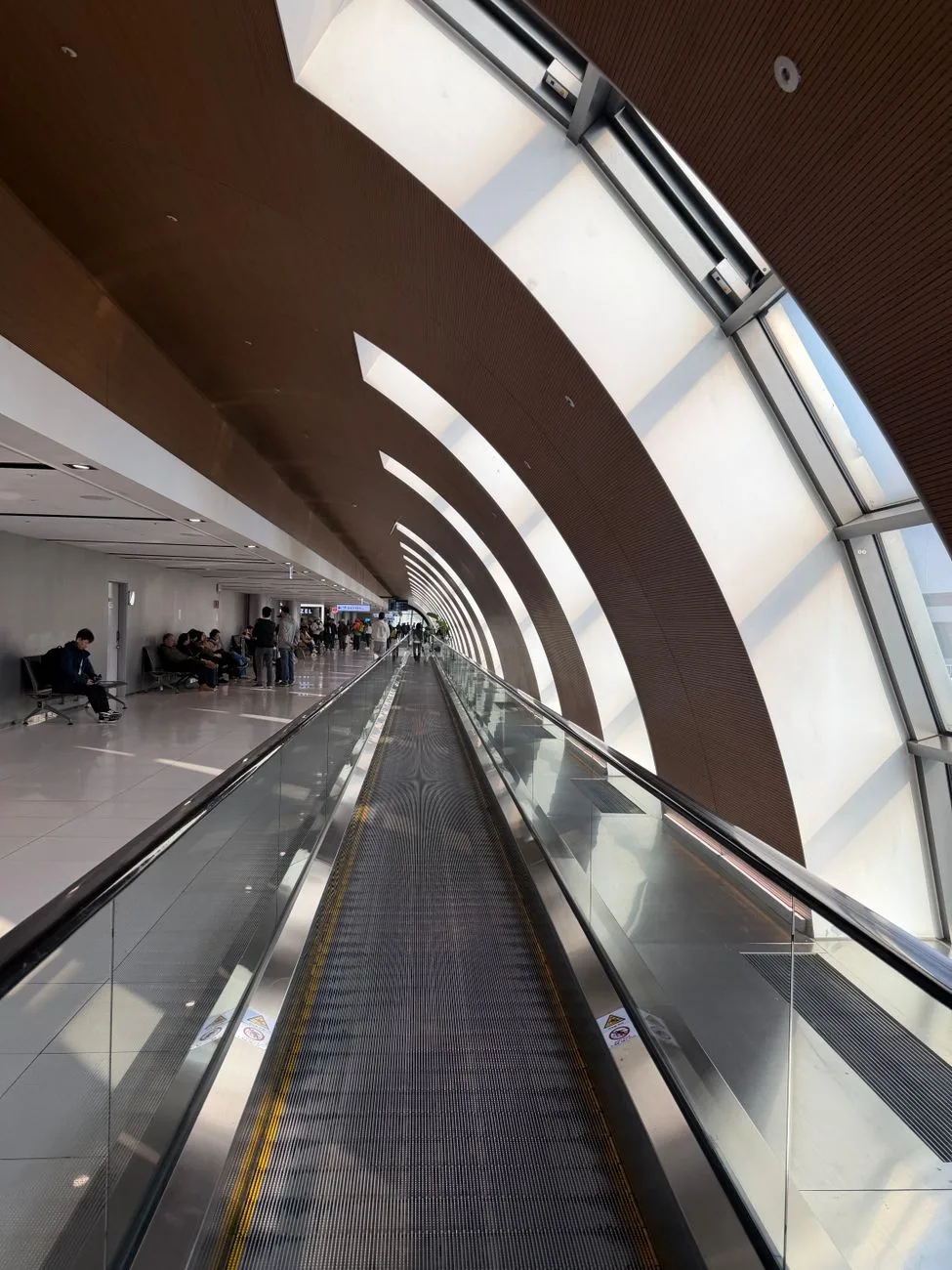
Step-by-step: taking the direct bus
- Confirm whether the flight arrives at Terminal 1 or Terminal 2. The platforms are different.
- Follow airport signs for the intercity bus or transportation center after collecting luggage.
- Find the ticketing point or departure information for Gwangju and U-Square Bus Terminal.
- Match the destination name carefully. The destination is Gwangju in southwestern Korea, not Gyeonggi Gwangju.
- Select the service class. The January 2026 guide lists deluxe at ₩39,900, night at ₩43,900, and premium at ₩49,900.
- Go to Terminal 1 platform 12 or Terminal 2 platform 8 and check the bus display before boarding.
- Keep the ticket and note U-Square as the arrival terminal. Local transport from U-Square to the final accommodation is separate from the airport fare.
A useful preparation is to save the Korean destination name 광주 유스퀘어. It reduces the risk of selecting a similarly named destination at a ticket machine or asking for directions at the airport.
Train route: AREX, a Seoul transfer, and KTX
The train route has two separate rail legs. The Korea Tourism Organization route description describes AREX from Incheon Airport to Seoul Station, followed by KTX to Gwangju Songjeong Station. It gives approximate durations of 1 hour 15 minutes for AREX and 2 hours for KTX.
Korail’s station information identifies Yongsan Station as the Seoul departure point for KTX services to Gwangju Songjeong and states that the shortest Yongsan-to-Gwangju Songjeong journey is 1 hour 33 minutes. The two official sources therefore use different descriptions of the Seoul transfer. The operational lesson is more useful than the wording difference: confirm the KTX departure station shown on the Korail booking before leaving the airport rail system.
The airport rail leg depends on the AREX service selected. The Korea Tourism Organization’s AREX information lists express-train travel at approximately 43 minutes from Terminal 1 and 51 minutes from Terminal 2 to Seoul Station. Its all-stop service takes approximately 59 minutes from Terminal 1 and 66 minutes from Terminal 2.
The Seoul Metropolitan Government lists the AREX express fare at ₩9,500 one way, with trains every 20 to 40 minutes. It lists the all-stop fare from Incheon Airport to Seoul Station as ₩4,150 to ₩4,750. These airport rail figures come from the Seoul Metropolitan Government airport transport page.
The KTX fare is a separate charge. A current route-specific KTX fare for a particular Incheon Airport to Gwangju Songjeong itinerary was not exposed in the official Korail timetable material reviewed on August 17, 2026. The fare depends on the exact train, seat type, and booking conditions, so this article does not invent a total train price.
The train decision in numbers
The known time arithmetic shows why the train can be attractive even though it is less simple:
- AREX express from Terminal 1: about 43 minutes.
- AREX express from Terminal 2: about 51 minutes.
- Shortest Yongsan to Gwangju Songjeong KTX journey: 1 hour 33 minutes.
- Published Korea Tourism Organization approximation for the KTX leg: about 2 hours.
- Transfer, waiting, walking, and ticketing time: extra, not included in those ride durations.
Using the shortest published rail figures for a Terminal 1 arrival gives 43 minutes + 1 hour 33 minutes = 2 hours 16 minutes of train movement. A Terminal 2 arrival gives 51 minutes + 1 hour 33 minutes = 2 hours 24 minutes. That is not a door-to-door promise because the transfer and waiting periods remain outside the arithmetic.
The direct bus calculation is simpler: approximately 4 hours from the airport to U-Square. The bus therefore trades a longer ride for one boarding process and a direct arrival terminal. The train wins on movement time only when the KTX connection is available without a long wait and the passenger can manage the Seoul transfer.
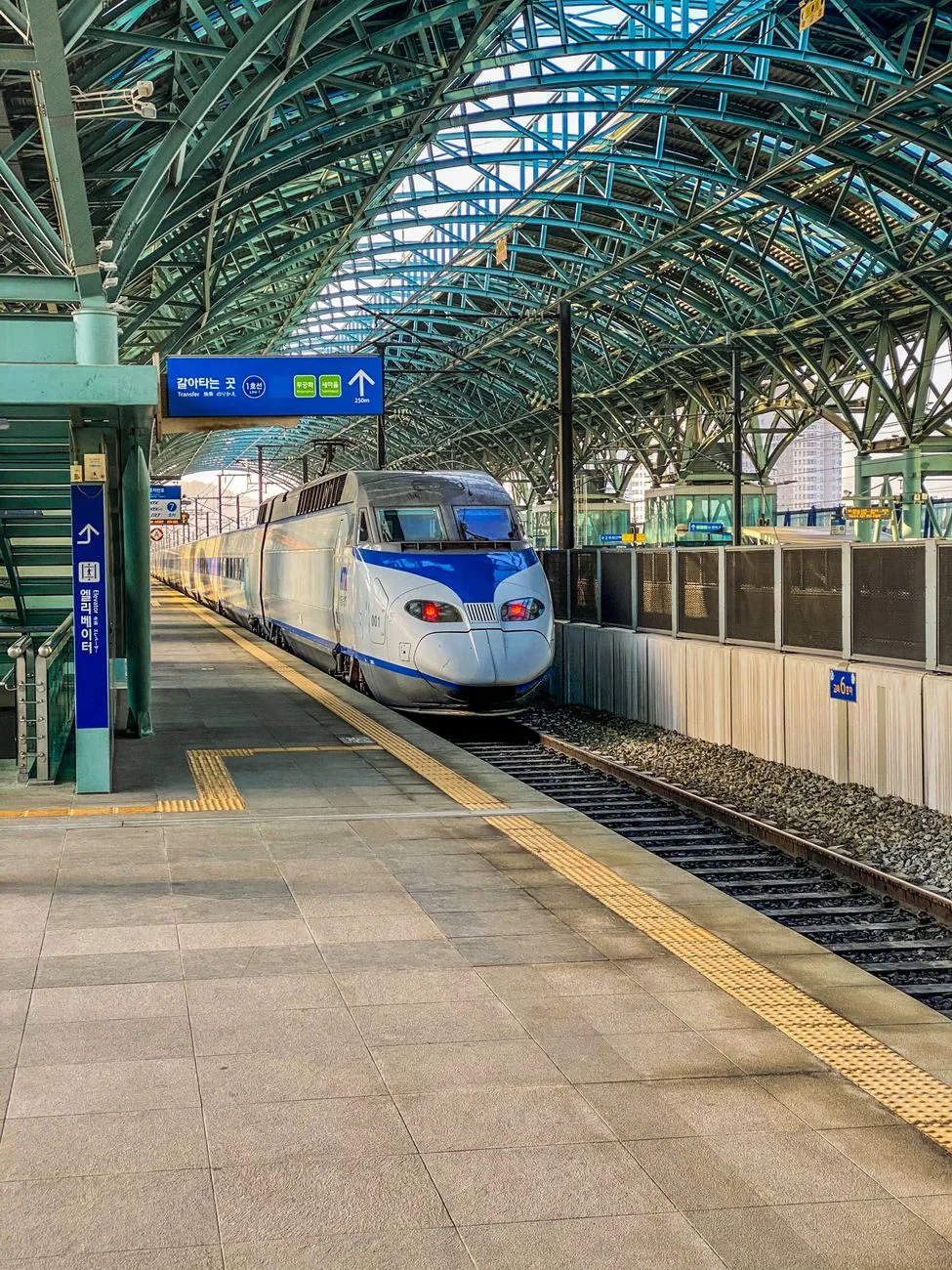
Bus versus train: the practical verdict
This table answers the main choice for a passenger comparing simplicity, time, and verified cost.
| Option | Main arrival point | Published ride time | Verified fare | Transfer |
|---|---|---|---|---|
| Direct deluxe bus | Gwangju U-Square | About 4 hours | ₩39,900 | No |
| Direct night bus | Gwangju U-Square | About 4 hours | ₩43,900 | No |
| AREX express plus KTX | Gwangju Songjeong Station | 43–51 min plus 1 h 33 min to 2 h | KTX total not exposed | Yes |
| AREX all-stop plus KTX | Gwangju Songjeong Station | 59–66 min plus 1 h 33 min to 2 h | KTX total not exposed | Yes |
The table shows a clear recommendation. For a first arrival, heavy luggage, or an itinerary where certainty matters more than the fastest rail segment, take the direct bus. For a light-packing passenger who finds a well-timed KTX and wants to arrive at Gwangju Songjeong, take the train.
The bus and train also finish at different parts of Gwangju. U-Square is the intercity bus terminal. Gwangju Songjeong is the KTX station. The better arrival point depends on the accommodation and the onward local route, not only on the national transport mode.
Worked example: a late-afternoon arrival
Assume a passenger lands at Terminal 1 at 17:00, clears the airport process, and reaches transport services in time for either option.
The direct deluxe bus has a published fare of ₩39,900 and an approximate ride time of 4 hours. The arithmetic is:
₩39,900 + 4 hours = one ticket, one long ride, arrival at U-Square around 21:00 if the bus leaves at 17:00.
The train requires two fares and a transfer:
₩9,500 AREX express + KTX fare + transfer time = airport-to-Gwangju rail cost.
The KTX component is not included as a guessed number because the current official route-specific fare was not exposed in the reviewed Korail material. The train’s movement time is about 43 minutes + 1 hour 33 minutes = 2 hours 16 minutes before waiting and changing stations. If the KTX departure requires a 45-minute wait and the Seoul transfer takes 20 minutes, the rail movement-plus-connection estimate becomes 2 hours 16 minutes + 45 minutes + 20 minutes = 3 hours 21 minutes, before any delay.
The decision is therefore conditional but actionable: take the train when the available KTX connection keeps the complete airport-to-station itinerary comfortably below 4 hours and the extra transfer is acceptable. Take the bus when the connection is uncertain, the luggage is difficult, or the total rail fare is not worth the time saved.
Night arrivals and the Gwangju name trap
Incheon Airport lists the N8842 night bus, but that service is for Gyeonggi Gwangju and Gwacheon. It does not take passengers to Gwangju Metropolitan City. The airport’s official N8842 information lists departures at 00:30 and 04:10 from Terminal 1, and 00:10 and 03:50 from Terminal 2.
This is the most serious naming pitfall on the route. Gwangju Metropolitan City is in southwestern Korea and is served by U-Square and Gwangju Songjeong Station. Gyeonggi Gwangju is southeast of Seoul and is a different destination. Searching only for “Gwangju” at a transport counter can produce the wrong result.
A passenger arriving after the final airport-to-Gwangju intercity bus should not assume that N8842 is a substitute. The direct bus listing gives last departures of 23:30 from Terminal 1 and 23:05 from Terminal 2. A late arrival may require an overnight stop near the airport or a different connection planned around the next available service.
Common mistakes that add time or cost
Choosing Seoul Station without checking the KTX ticket
The Korea Tourism Organization describes the route through Seoul Station, while Korail’s Gwangju Songjeong station information points to Yongsan Station for KTX services. Use the exact departure station printed on the Korail reservation. Seoul Station and Yongsan Station are not interchangeable boarding points.
Treating published ride time as total journey time
The 43-minute AREX express figure excludes immigration, baggage collection, walking, waiting, and the transfer to the KTX. The 4-hour bus figure is also approximate and can be affected by road traffic. Build the trip around the scheduled departure, not the aircraft landing time.
Booking the wrong Gwangju
Check for Gwangju Metropolitan City, U-Square, or Gwangju Songjeong. N8842’s Gyeonggi Gwangju listing is a separate route.
Ignoring the arrival terminal
Terminal 1 uses first-floor platform 12 for the Gwangju-bound bus in the January 2026 GIST guide. Terminal 2 uses basement transport center platform 8. The first and last listed departure times also differ.
Comparing the bus fare with only the AREX fare
The train price is AREX plus KTX. Comparing the ₩39,900 deluxe bus fare with only the ₩9,500 AREX express fare omits the largest rail component. The exact KTX fare was not published in the reviewed route-specific material, so a complete price comparison requires the actual Korail itinerary.
What to book before leaving the airport
A direct bus ticket is the right preparation when the arrival time fits the listed schedule and the final destination is convenient for U-Square. Keep the terminal, platform, destination name, and service class together in a note.
A train itinerary needs more coordination. The airport rail ticket covers only AREX. The KTX reservation covers the Seoul-area departure to Gwangju Songjeong. The station name, departure time, and available seat should be checked as one connection, with enough time to move between services.
The safest route rule is simple: bus for a direct, luggage-friendly journey; train for a confirmed connection and a station arrival that suits the accommodation. That rule fails when the bus is sold out or the train connection leaves an unmanageable gap, so the actual departure times on the travel date remain decisive.
FAQ: getting from Incheon Airport to Gwangju
Is there a direct bus from Incheon Airport to Gwangju?
Yes. Direct intercity buses run from Incheon International Airport to Gwangju’s U-Square Bus Terminal, with an approximate travel time of 4 hours according to the Korea Tourism Organization.
How much is the bus from Incheon Airport to Gwangju?
The January 2026 GIST guide lists ₩39,900 for deluxe service, ₩43,900 for night service, and ₩49,900 for premium service. Those are dated figures and apply to the service classes listed in that guide.
Where does the Gwangju bus leave from Terminal 1?
The January 2026 GIST guide lists first-floor platform 12 at Terminal 1.
Where does the Gwangju bus leave from Terminal 2?
The same guide lists basement-level transport center platform 8 at Terminal 2.
Is the train faster than the direct bus?
The rail legs are faster in movement time. AREX express takes about 43 minutes from Terminal 1 or 51 minutes from Terminal 2 to Seoul Station, and the shortest published Yongsan-to-Gwangju Songjeong KTX journey is 1 hour 33 minutes. Waiting and the Seoul transfer make the total journey longer than the rail arithmetic.
Does N8842 go from Incheon Airport to Gwangju city?
No. N8842 serves Gyeonggi Gwangju and Gwacheon. It is not a route to Gwangju Metropolitan City.
Which route is better with large luggage?
The direct bus is the stronger choice because it removes the airport-to-Seoul rail transfer and delivers passengers to U-Square in one intercity ride. The train can still work when the KTX connection is confirmed and the luggage is manageable.
Should the destination be U-Square or Gwangju Songjeong Station?
Choose U-Square for the direct airport bus. Choose Gwangju Songjeong for the KTX route. The better destination is the one closer to the accommodation or onward transport.