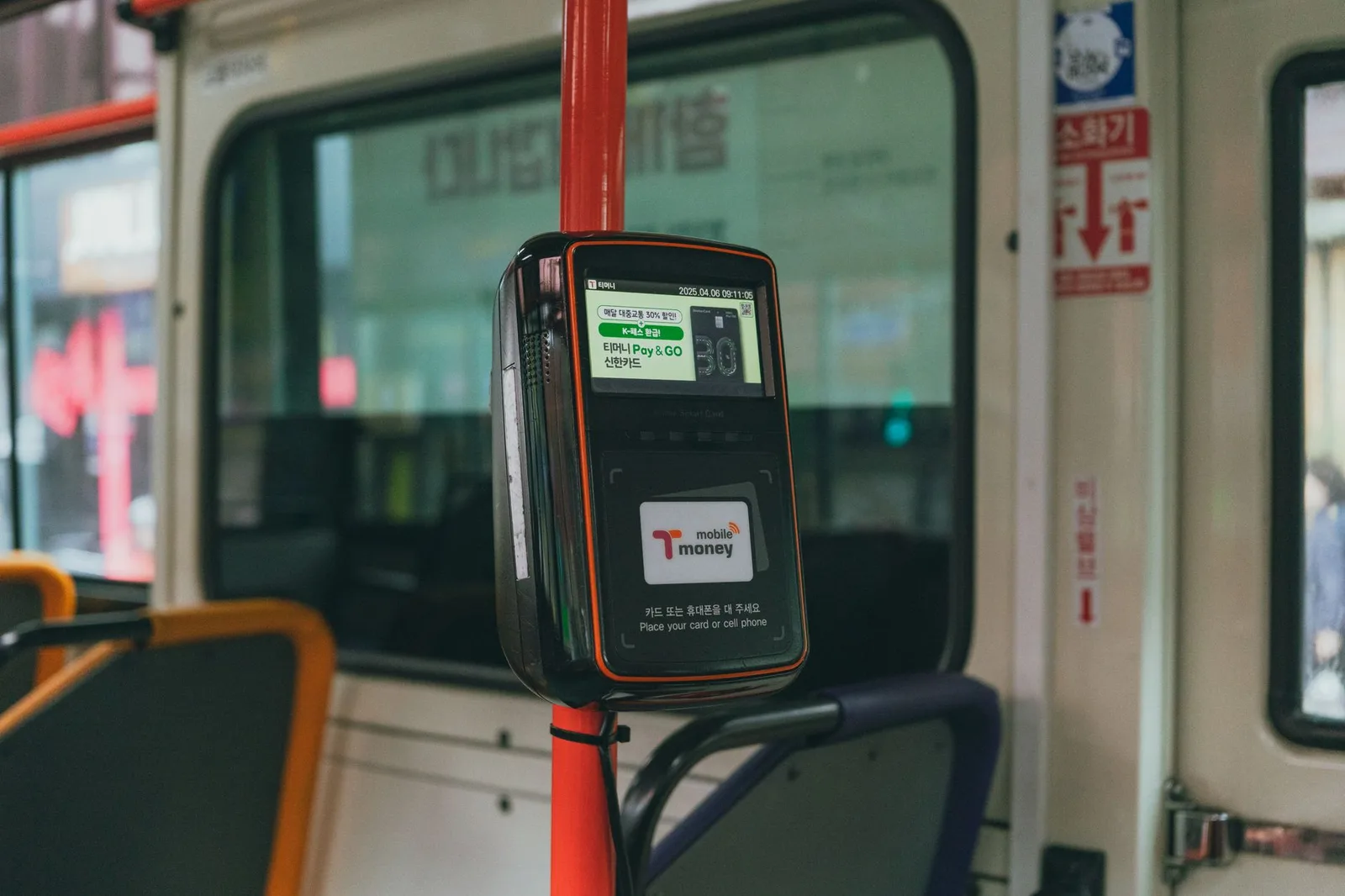
A T-money card is Korea’s rechargeable transit card for buses, subways, taxis, some trains, and participating shops. Buy the card for ₩3,000–₩5,000, add Korean won at a convenience store or subway information center, then tap when entering and exiting. Tapping out preserves Seoul’s transfer discount and calculates the correct fare.
Key takeaways
- Buy a general T-money card at GS25, CU, 7-ELEVEN, or a Seoul subway information center on Lines 1–8.
- Load cash in Korean won. Subway ticket machines accept reloads up to ₩500,000.
- Tap when boarding and leaving. On buses, enter through the front and exit through the rear when possible.
- Seoul transfers must be completed within 30 minutes, or within 60 minutes from 9:00 p.m. to 7:00 a.m.
- T-money is pay-as-you-go. The Seoul Climate Card is a separate product offering unlimited eligible Seoul transit for selected short-term periods.
What a T-money card is and where it works
T-money is a reloadable prepaid card. It does not require a bank account or a personal account, which makes it practical for short visits and for travelers who do not have a Korean payment method.
The Korea Tourism Organization says a general card costs ₩3,000–₩5,000, before adding travel credit. That purchase price is the cost of the plastic card itself, not a refundable balance. The same VisitKorea T-money guidance states that cards can be purchased and reloaded at convenience stores nationwide, including GS25, CU, and 7-ELEVEN, as well as Seoul subway information centers on Lines 1–8.
T-money can be used on city buses, subways, express buses, intercity buses, taxis, and trains. It is also accepted at affiliated shops displaying the T-money logo. Acceptance is not universal, so a T-money balance should be treated as transport money first, with shop payments as an additional convenience.
A T-money card is not the same as a bank card, a credit card, or the Seoul Climate Card. It stores a cash balance and deducts the applicable fare after each ride. The Climate Card follows a different unlimited-use model and covers eligible Seoul bus and subway services for selected periods.
Which card should you choose for a Korea trip?
The right choice depends on where the journeys occur and how many eligible Seoul rides fit into the validity period. A pay-as-you-go card is the safer default for a mixed itinerary that includes Busan, Jeju, intercity travel, or only a few Seoul rides.
This table answers the basic product-choice question for a visitor comparing ordinary payment methods.
| Option | Payment model | Best fit | Main limitation |
|---|---|---|---|
| General T-money | Stored value | Seoul plus nationwide travel | Each ride costs separately |
| Seoul Climate Card | Unlimited eligible transit | Dense Seoul itinerary | Coverage and validity are restricted |
| Cash single-ride ticket | Pay per journey | One occasional subway ride | No stored balance or transfer convenience |
| Bank card or mobile transit payment | Direct electronic payment | Eligible Korean setup | Foreign-card support is not guaranteed |
The table shows why T-money wins as the flexible all-purpose option, while the Climate Card becomes relevant only when a trip consists mainly of frequent eligible Seoul bus and subway journeys. A cash ticket can work for one ride, but it removes much of the convenience that makes a transit card useful.
When T-money is the better choice
Choose T-money when the itinerary includes more than Seoul, when transit use is spread across several days, or when the route involves buses and subways together. It also avoids buying a new single-ride ticket for each subway journey.
Choose the Climate Card only after checking that the planned routes and dates fit its current coverage. A traveler who spends two days in Seoul and then moves to Gyeongju, Busan, or Jeju cannot treat an unlimited Seoul product as a nationwide transit pass.
The advice fails if a traveler assumes that every bus, train, airport service, or regional operator follows Seoul’s integrated fare rules. T-money acceptance is broad, but the fare system and transfer treatment depend on the transport service and area.
How to buy and reload a T-money card
The purchase process is simple, but the first reload is where many visitors need a practical script. Convenience-store staff can help, but the transaction requires cash in Korean won and a clear request to add a specific amount.
- Ask for a T-money card at a participating convenience store or Seoul subway information center.
- Pay the card purchase price, which the Korea Tourism Organization lists as ₩3,000–₩5,000 for a general card.
- Hand over the amount of Korean won to load. Keep the card and the stored balance mentally separate.
- Ask the cashier to confirm the loaded amount and retain the receipt if the balance matters for budgeting.
- Use the card at the transit reader until the balance becomes low.
- Reload before the next trip at a convenience store or an available subway ticket machine.
Subway ticket-vending machines allow reloads up to ₩500,000 according to VisitKorea’s guidance. That is a machine limit, not a recommendation to load the maximum. Loading ₩20,000–₩30,000 first gives a short-trip traveler room to test the card without leaving a large unused balance.
A useful Korean phrase is “T-money 충전해 주세요,” pronounced roughly as “T-money chung-jeon-hae ju-se-yo.” It means “Please recharge my T-money.” The exact spoken phrase is less important than showing the card and the cash amount.
Under-18 travelers need their date of birth registered when the card is purchased to receive discounted public-transport fares, according to VisitKorea. An adult traveler should not assume that a child or youth discount will appear automatically after an ordinary adult card is bought.
How to use T-money on Seoul buses and subways
On a Seoul bus
Enter through the front door and tap the card on the reader. The fare is deducted when boarding. When leaving, tap the card again at the reader near the rear exit.
The second tap is not an optional courtesy. The Seoul Metropolitan Government explains that tapping off is required for the transfer discount. It also helps the integrated fare system identify the journey correctly.
If the bus is crowded, wait for the reader near the exit rather than forcing through passengers. A missed tap can affect transfer treatment and can leave the journey incomplete in the fare system.
In the Seoul subway
Tap at the entrance gate before entering the paid area. Keep the card accessible because another tap is required at the exit gate. The reader confirms the transaction with a sound or screen response.
Do not tap multiple cards together. If several people are traveling, each person needs a separate card for ordinary transit use because the system records each boarding and exit against the card presented.
The Seoul Metropolitan Government lists the adult subway base fare paid by transit card as ₩1,550 as of June 28, 2025. The adult cash single-ride fare is ₩1,650. The ₩100 difference does not represent the full value of T-money, because transfer treatment and the time saved at ticket machines also matter.
Transfer timing and the exit tap
Seoul’s integrated fare system can cover subway-to-bus, bus-to-subway, and bus-to-bus transfers when the conditions are met. The transfer window is 30 minutes after tapping off. Between 9:00 p.m. and 7:00 a.m., Seoul provides a 60-minute window, according to its public-transportation guidance.
The system permits up to four transfers, or five total boardings, when the transfer conditions are satisfied. A transfer is not a blanket promise that every second vehicle is free. Distance and service rules can affect the amount deducted.
The practical sequence is: tap off, walk to the next service, and tap on again inside the allowed interval. Staying inside a subway station does not create a new bus transfer. The important events are the recorded entry and exit taps.
Seoul transit fares and a worked T-money example
The Seoul Metropolitan Government’s fare table, dated August 12, 2023 and still published by the city as of August 17, 2026, lists these adult card fares: ₩1,500 for trunk or branch buses, ₩3,000 for rapid buses, and ₩1,200 for local buses. The subway base fare is ₩1,550 as of June 28, 2025.
This table answers what a short Seoul itinerary costs before distance-based additions or special services are considered.
| Adult service | Card fare (KRW, published Aug 2026) | Payment point |
|---|---|---|
| Seoul subway base fare | ₩1,550 | Entry and exit gates |
| Trunk or branch bus | ₩1,500 | Boarding tap |
| Rapid bus | ₩3,000 | Boarding tap |
| Local bus | ₩1,200 | Boarding tap |
| Cash subway single ride | ₩1,650 | Ticket purchase |
These are base or listed fares, not a promise that every long-distance journey ends at that amount. The city fare system can calculate additional distance or service charges, and the applicable fare depends on the route.
Example: three Seoul sightseeing days
Suppose one adult makes this representative set of journeys in Seoul:
- Day 1: subway from Seoul Station to Gyeongbokgung, then subway back: 2 × ₩1,550 = ₩3,100.
- Day 2: one trunk bus and one subway ride: ₩1,500 + ₩1,550 = ₩3,050.
- Day 3: two trunk-bus rides with no qualifying transfer: 2 × ₩1,500 = ₩3,000.
The listed transport total is:
₩3,100 + ₩3,050 + ₩3,000 = ₩9,150.
Adding the lowest general-card purchase price gives:
₩9,150 + ₩3,000 = ₩12,150.
The traveler therefore needs ₩12,150 for the card and these listed fares, before any additional reload, airport travel, distance-based adjustment, or unused balance. The card purchase price is not part of the ride-fare total, so a budget that says “transport costs ₩9,150” should still account for the initial plastic card separately.
The same itinerary paid as three Seoul subway cash tickets and three bus fares would not be calculated from one universal cash price, because the bus fare and ticket rules differ by service. This is one reason a stored-value card is easier to budget: the reader applies the relevant fare at the gate or vehicle.
Seoul also lists a 20% early-morning discount on the first card-paid ride before 6:30 a.m. The discount does not apply to the owl bus. A traveler planning an early airport or sunrise trip should not assume that every night or early-morning service receives the reduction.
How to check the balance and get a refund
The card reader or reload transaction should be used as the immediate confirmation point. If the displayed balance seems wrong, keep the receipt and ask the store or station information center to inspect the transaction before discarding the card.
Refund rules are the part of T-money use that requires the most care because the available location depends on the remaining balance. VisitKorea’s August 2026 guidance says smaller balances can be refunded at convenience stores, while refunds above ₩50,000 must be handled at Tmoney Town near Seoul Station Exit 10.
The Seoul Metropolitan Government’s 2026 foreign-tourist guide gives more specific store limits: ₩30,000 or less at CU, MINISTOP, and emart24; ₩20,000 or less at 7-ELEVEN and some street kiosks; less than ₩20,000 at GS25; and ₩50,000 or less at subway-station information centers. Because the two official guides describe limits at different levels of detail, the safest practical rule is to keep the final balance modest and use a station information center or Tmoney Town for a larger refund.
A refund does not make the initial plastic-card purchase free. The stored balance is the money left on the card; the card price is a separate purchase cost. Ask about the refund amount and any applicable service charge at the location before handing over the card.
Common T-money mistakes and how to avoid them
Tapping only when boarding a bus
The exit tap is needed for Seoul’s transfer discount and for correct journey processing. Make it part of the normal routine: front reader when boarding, rear reader when leaving.
Loading a large balance on the first day
A large reload is unnecessary for a short visit and creates a refund problem at the end. Start with an amount that covers the first day or two, then add more after the actual route pattern is clear.
Confusing the card price with usable credit
A ₩3,000–₩5,000 purchase gives the physical card. It does not mean the card already contains that amount as travel credit. The first reload is a separate cash transaction.
Expecting one card to cover every traveler
The ordinary tap records one passenger’s journey. A group should plan on one card per traveler for normal bus and subway use, especially when members split up or use transfers.
Expecting the Seoul transfer rule outside Seoul
The 30-minute or 60-minute Seoul transfer windows belong to the city’s integrated fare system. Regional transport operators can use different rules, and a T-money card’s acceptance does not convert every journey into a Seoul transfer.
Using the wrong product for a dense Seoul itinerary
T-money is flexible but charges each journey. If the itinerary contains repeated eligible Seoul bus and subway rides during a short continuous period, compare the actual ride count and coverage against the current Climate Card terms before buying stored value.
FAQ: using T-money in Korea
Can tourists buy a T-money card in Korea?
Yes. Tourists can buy a general T-money card at participating convenience stores and Seoul subway information centers on Lines 1–8. VisitKorea lists the general card price as ₩3,000–₩5,000, before adding stored value.
Can I use T-money from Seoul in Busan?
T-money is accepted on many Korean public-transport services, including city buses, subways, express buses, intercity buses, taxis, and trains. Acceptance and transfer rules depend on the local operator, so Seoul’s transfer timings should not be applied automatically in Busan or another city.
How much money should I put on a T-money card?
For a short trip, load enough for the first day or two and add more after the route becomes clear. The worked Seoul example totals ₩9,150 in listed adult fares for six rides across three days, plus the ₩3,000 card purchase at the low end of VisitKorea’s stated range.
Do I tap T-money when leaving a bus?
Yes. Tap when boarding and again when exiting. Seoul requires the exit tap for its transfer discount and integrated fare calculation.
Can I get unused T-money money back?
Yes, but the refund location depends on the remaining balance. VisitKorea says refunds above ₩50,000 must be processed at Tmoney Town near Seoul Station Exit 10. Store and station limits differ, so keeping the final balance low is the simplest approach.
Is T-money better than the Seoul Climate Card?
T-money is better for flexible travel across Korea or a light Seoul schedule. The Climate Card deserves comparison for a concentrated Seoul itinerary with frequent eligible bus and subway use during its available validity period. They are separate products with different coverage and payment models.
This is general travel information, not personalized financial or transportation advice. Fares and product conditions can change; the figures above are dated to the official guidance identified in the text.