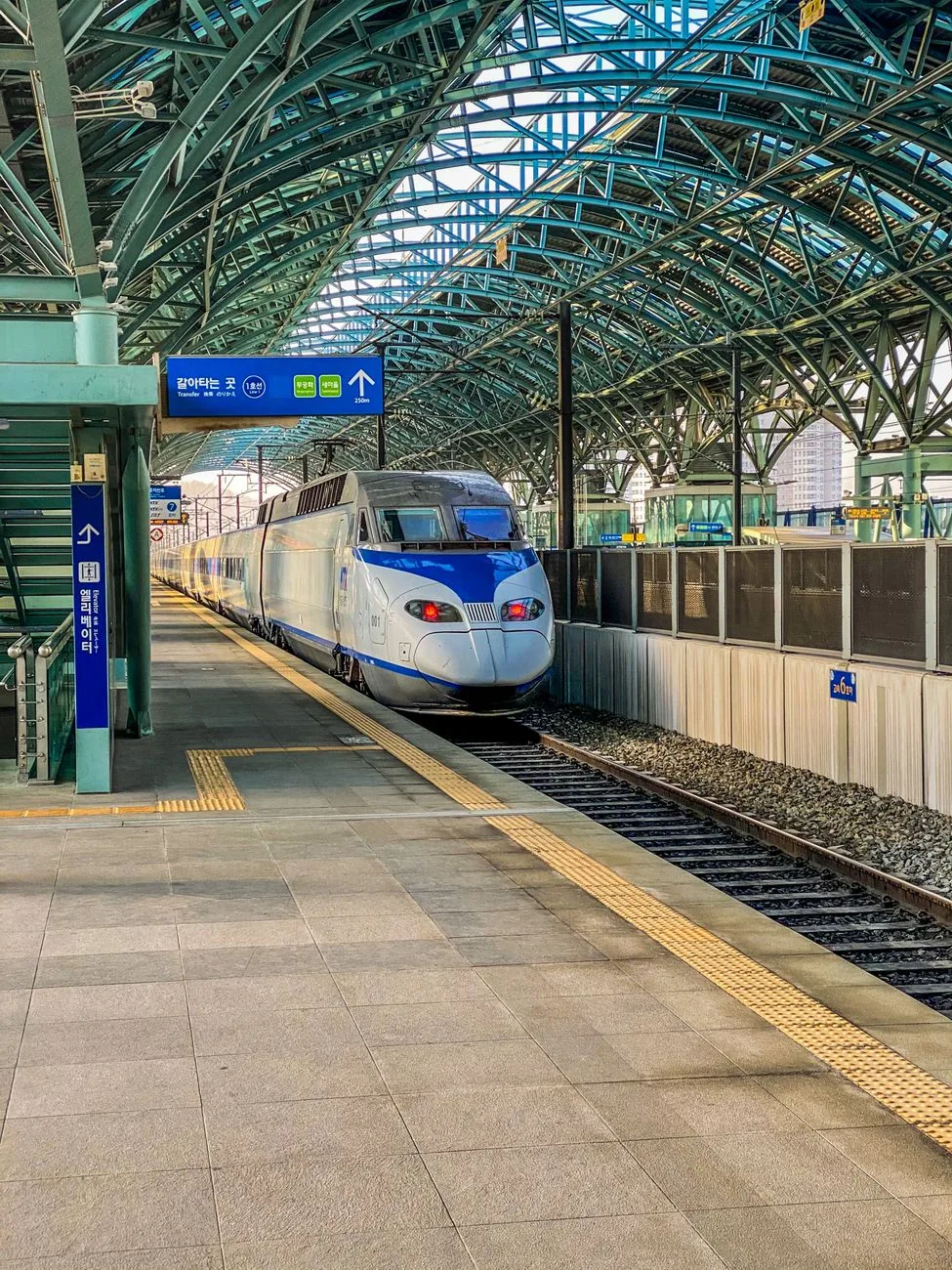
The simplest route is ITX-Cheongchun from Yongsan or Cheongnyangni Station to Gapyeong Station, followed by a taxi of about 10 minutes to Gapyeong Rail Bike. The Gyeongchun Line local train also reaches Gapyeong Station. From Gapyeong Intercity Bus Terminal, the rail park is about a 10-minute walk.
Key takeaways for getting to Gapyeong Rail Bike from Seoul
- Best for most visitors: ITX-Cheongchun to Gapyeong Station, then taxi.
- Lower-cost rail alternative: Gyeongchun Line from Sangbong Station, then taxi.
- Best without a station transfer: Intercity bus to Gapyeong Intercity Bus Terminal, then walk.
- Best for several people or bulky luggage: Drive via the Seoul–Yangyang Expressway and exit at Hwado Interchange.
- Rail-bike fare as of August 18, 2026: ₩36,000 for a two-seater and ₩48,000 for a four-seater.
- Important booking issue: The operator lists departures at 10:00, 11:30, 13:30, 15:00, 16:30, and 18:00. A Korea Tourism Organization page lists a different first session, so use the operator's current booking schedule for the attraction.
Where Gapyeong Rail Bike is and which arrival point matters
Gapyeong Rail Bike is located at 14 Jangteo-gil, Gapyeong-eup, Gapyeong-gun, Gyeonggi-do. The attraction is close to Gapyeong Intercity Bus Terminal, but Gapyeong Station is not close enough to treat as a walk by default.
The operator's official map says the journey from Gapyeong Station to the rail park takes approximately 10 minutes by taxi. The same map places the attraction about a 10-minute walk from Gapyeong Intercity Bus Terminal. That difference determines the practical choice: rail passengers need a short last-mile ride, while bus passengers can walk from the terminal. Gapyeong Rail Park's official map provides the operator's access directions and address.
The destination is a rail-bike attraction rather than a station-side activity. Leave enough time for the final transfer, ticket collection, and boarding. A train arrival that looks close to the departure time on paper can become risky if the taxi queue is long or the train is delayed.
The best route: ITX-Cheongchun to Gapyeong Station, then taxi
For visitors starting in central Seoul, ITX-Cheongchun is the clearest rail option. Board at Yongsan Station or Cheongnyangni Station, travel to Gapyeong Station, and take a taxi for approximately 10 minutes to the rail park, according to the operator's access map.
This route is the strongest choice when the group wants a reserved intercity train and a simple connection. It also keeps the final transfer short. The weakness is that the train timetable and seats depend on the selected date, and the current Seoul-to-Gapyeong fare was not published in the supplied official timetable information.
KORAIL's timetable page lists ITX-Cheongchun and Gyeongchun Line schedules effective from February 28, 2026. Exact departures and journey times are date-sensitive, so select the travel date in KORAIL before building the rest of the itinerary. KORAIL's official train timetable page is the primary source for the rail schedule.
Step-by-step ITX route
- Choose either Yongsan Station or Cheongnyangni Station as the Seoul departure point.
- Search KORAIL for an ITX-Cheongchun service to Gapyeong Station on the planned date.
- Select a train that reaches Gapyeong with a buffer before the reserved rail-bike session.
- At Gapyeong Station, take a taxi to 14 Jangteo-gil. The operator estimates the taxi ride at about 10 minutes.
- Keep the booking confirmation available and arrive early enough for on-site boarding procedures.
The key timing rule is simple: schedule the rail-bike session after the transfer, not immediately after the planned train arrival. The taxi fare from Gapyeong Station is not published on the operator's access page, so the transport budget must leave that amount open rather than rely on an invented estimate.
The cheaper rail alternative: Gyeongchun Line from Sangbong
The Gyeongchun Line local train runs from Sangbong Station to Gapyeong Station. From Gapyeong Station, the operator gives the same approximate 10-minute taxi connection to the rail park. This is useful when the local train departure fits the day better than ITX-Cheongchun or when the group prefers a local rail service.
The trade-off is less about the destination and more about the travel experience. The local train has more intermediate stops than an express-style ITX service, so the journey can take longer. The exact duration and departure pattern depend on the date and train selected. Use KORAIL's current timetable for the chosen day rather than assuming an old schedule.
The Gyeongchun Line route fails as a practical plan if the only available train reaches Gapyeong too close to the rail-bike departure. A lower rail fare does not compensate for missing a reserved session.
Bus route: Gapyeong Intercity Bus Terminal to the rail park
An intercity bus can be the most straightforward route if its Seoul departure point and arrival time match the itinerary. The important detail is the arrival location: Gapyeong Intercity Bus Terminal is approximately a 10-minute walk from Gapyeong Rail Bike, according to the operator's official map.
That short walk removes the station-to-attraction taxi connection. It may be preferable for travelers who want to avoid a second vehicle transfer or who are comfortable walking with light luggage. The limitation is that the supplied official information does not establish a current Seoul departure timetable, fare, or terminal-specific route for every origin in Seoul. Those figures should not be guessed.
Once at Gapyeong Intercity Bus Terminal, follow the operator's map and allow more than the bare 10-minute walking estimate if carrying luggage, traveling with children, or arriving during busy periods.
Driving from Seoul: when a car makes sense
The official driving route from Seoul uses the Seoul–Yangyang Expressway and exits at Hwado Interchange. The operator warns that congestion can occur on weekends and during peak season, so driving does not automatically produce the shortest arrival time.
A car makes sense when several people are sharing the vehicle, the itinerary includes nearby destinations, or the group carries equipment and luggage that would make a station transfer awkward. Public parking for rail-bike guests includes two free hours, according to the operator's official introduction page. Gapyeong Rail Park's course information states the parking benefit and describes the attraction.
The decision changes on a busy weekend. A road journey with no fixed arrival time can absorb the buffer that a reserved rail-bike departure requires. Leave earlier than the theoretical driving time and treat the two free parking hours as a parking allowance, not as a promise that the whole outing will fit inside two hours.
This table answers which Seoul-to-Gapyeong option best matches each type of day.
| Route | Last-mile connection | Best fit | Main risk |
|---|---|---|---|
| ITX-Cheongchun | Taxi, about 10 minutes | Reserved rail journey | Date-specific seats and schedule |
| Gyeongchun Line | Taxi, about 10 minutes | Local-train alternative | Longer journey and missed session |
| Intercity bus | Walk, about 10 minutes | No station taxi | Seoul bus details depend on origin |
| Car | Drive from Hwado Interchange | Groups and luggage | Weekend congestion |
The table shows why ITX-Cheongchun is the default recommendation, while the bus can be more convenient after arrival. The right choice depends on whether a fixed rail departure, a short walk, or shared driving matters most.
Rail-bike departures, course length, and what the ticket covers
The operator lists six regular departures: 10:00, 11:30, 13:30, 15:00, 16:30, and 18:00. A Korea Tourism Organization listing says the first session is at 09:00 and that sessions are offered at 90-minute intervals, which conflicts with the operator's current schedule. For a booking made on August 18, 2026, the operator's schedule is the more direct source for the attraction's current departure times. The operator's official Gapyeong schedule lists the current departures and prices.
The course is an 8-kilometre round trip between Gapyeong Station and Gyeonggang Station. It includes the Bukhangang Railway Bridge, Zelkova Tree Tunnel, Cherry Blossom Tunnel, and Gyeonggang Station. The bikes are electric-assisted, meaning the motor engages as passengers pedal. The operator's official course introduction describes the route and electric-assist system.
The attraction is listed as open year-round, but the Korea Tourism Organization notes that schedules can change because of on-site conditions. Weather, operations, and the selected date can affect the final timetable.
Gapyeong Rail Bike prices and the group-size calculation
As of August 18, 2026, the operator lists ₩36,000 for a two-seater bike and ₩48,000 for a four-seater bike. These are bike prices, not per-person fares.
The booking rule creates an easy-to-miss cost difference. A group of three must book one four-seater. A group of five must book one four-seater and one two-seater. The calculation is:
- Two people: ₩36,000 ÷ 2 = ₩18,000 per person.
- Three people: ₩48,000 ÷ 3 = ₩16,000 per person.
- Four people: ₩48,000 ÷ 4 = ₩12,000 per person.
- Five people: (₩48,000 + ₩36,000) ÷ 5 = ₩16,800 per person.
The lowest rail-bike-only cost per person in this group-size example is four people sharing a four-seater. A three-person group does not pay for three individual places; it pays for the four-seater capacity. The rail fare, taxi, bus fare, food, and any other attraction tickets are separate.
A practical day plan from Seoul
For a four-person group, the most efficient structure is an ITX-Cheongchun departure from Yongsan or Cheongnyangni, arrival at Gapyeong Station, a taxi to the rail park, and the 13:30 or 15:00 session if the selected train arrives with a comfortable buffer.
The arithmetic for the attraction is ₩48,000 total, or ₩12,000 per person. Add the date-specific train fare, the unpublished taxi fare from Gapyeong Station, and meals. The transportation total cannot be stated honestly without the selected train and taxi details, but the fixed attraction component is clear.
For a five-person group, reserve one four-seater and one two-seater. The rail-bike total is ₩84,000, calculated as ₩48,000 + ₩36,000, which equals ₩16,800 per person. A car may become more attractive for this group if the total shared driving cost is lower than five separate rail fares plus the station taxi, but the comparison requires the actual vehicle and travel-date costs.
A useful preparation checklist is:
- Reserve the rail-bike session before committing to a tight train connection.
- Match the bike capacity to the group size, including the three-person and five-person rules.
- Save the exact Gapyeong Station or bus-terminal arrival point in the navigation app. The site's Best Transit App for Seoul guide covers the main mapping options.
- Keep a buffer between train arrival and rail-bike boarding.
- Carry a payment method for the taxi because the operator does not publish a fixed station-to-park taxi fare.
- Recheck the operator's session time if the trip is close to the travel date, especially in peak season.
Common mistakes that cause a bad route
Treating Gapyeong Station as the destination
Gapyeong Station is the rail arrival point, not the rail park entrance. The official map calls for a taxi of approximately 10 minutes. Walking from the station may take far longer than the itinerary allows.
Using the Korea Tourism Organization session time without comparing it
The Korea Tourism Organization page lists a 09:00 first session, while the operator's current schedule lists 10:00 as the first regular departure. The conflict is material. Use the time shown by the operator when selecting the attraction booking.
Booking the train around the session with no buffer
A 10-minute taxi estimate describes the ride, not the entire transfer. Station exit time, taxi availability, traffic, and boarding procedures still consume time.
Assuming three people can buy three seats
The operator's pricing is by bike. Three people need one four-seater, and five people need one four-seater plus one two-seater. The group-size arithmetic should be done before comparing the day with a car trip.
Treating the schedule as permanent
The operator lists the regular departures and the Korea Tourism Organization notes that on-site conditions can change schedules. A published departure is useful for planning, but the selected date remains the controlling detail.
FAQ
What is the easiest way to get to Gapyeong Rail Bike from Seoul?
Take ITX-Cheongchun from Yongsan or Cheongnyangni Station to Gapyeong Station, then take a taxi for approximately 10 minutes.
Can I walk from Gapyeong Station to Gapyeong Rail Bike?
The operator directs visitors from Gapyeong Station by taxi, with an estimated ride of about 10 minutes. The official map does not present the station as the attraction's short walking route.
Is Gapyeong Rail Bike closer to the bus terminal or train station?
It is closer on foot to Gapyeong Intercity Bus Terminal, which the operator places about a 10-minute walk away. Gapyeong Station requires an approximately 10-minute taxi ride.
How much does Gapyeong Rail Bike cost in 2026?
As of August 18, 2026, a two-seater costs ₩36,000 and a four-seater costs ₩48,000. The price is per bike, not per person.
How long is the Gapyeong Rail Bike course?
The course is an 8-kilometre round trip between Gapyeong Station and Gyeonggang Station.
What time does Gapyeong Rail Bike depart?
The operator lists regular departures at 10:00, 11:30, 13:30, 15:00, 16:30, and 18:00. The Korea Tourism Organization lists different information, so the operator's current schedule should control the booking.
Is parking available at Gapyeong Rail Bike?
The operator lists two hours of free parking for rail-bike guests at the public parking lot.
Is Gapyeong Rail Bike open all year?
It is listed as open year-round, but schedules can change because of on-site conditions.