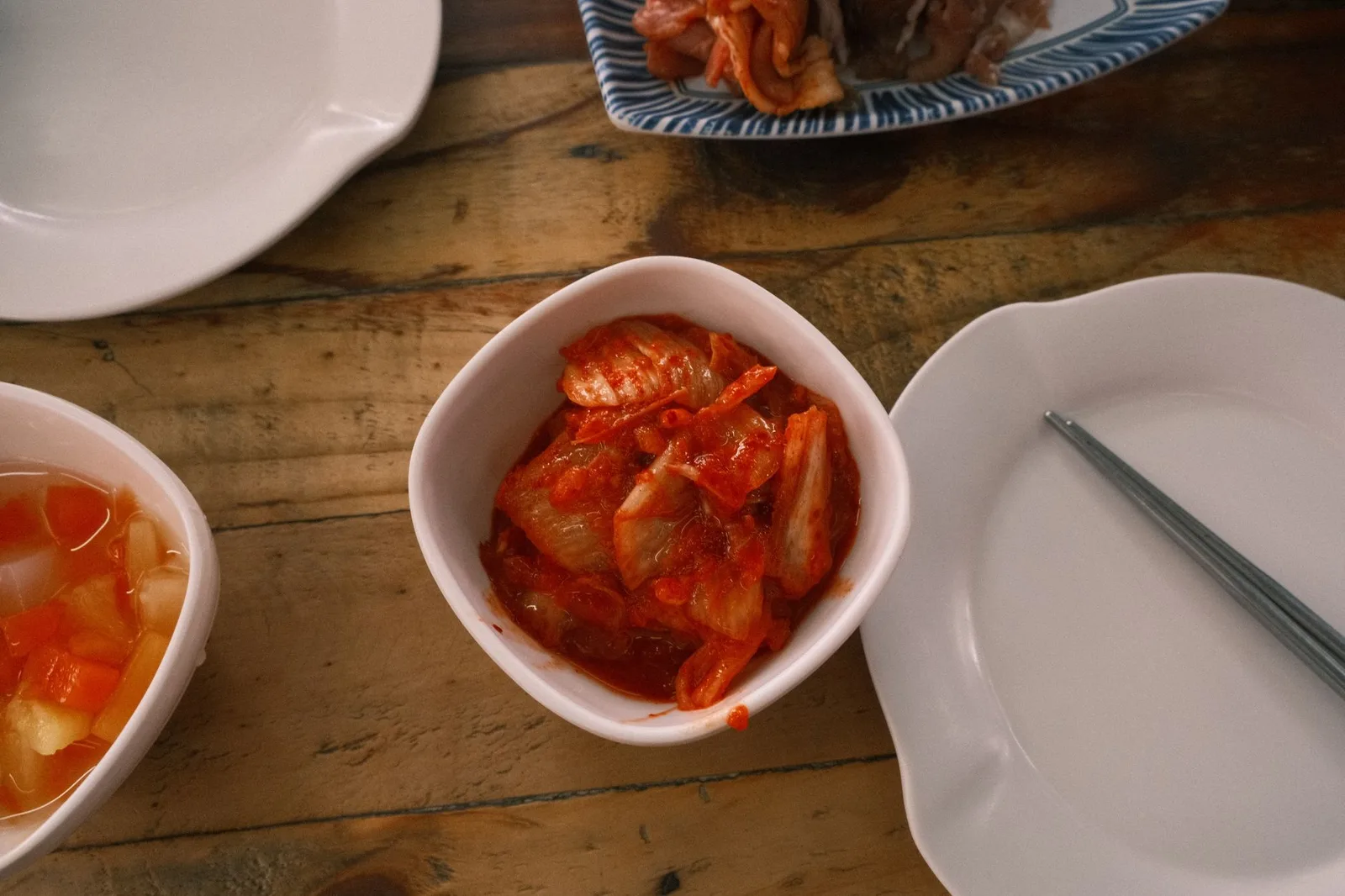
Short answer: The best kimchi for beginners is baekkimchi if spicy food is a concern, or mild baechu kimchi if you want the classic Korean flavor. Choose baekkimchi for a cool, lightly fermented introduction; choose baechu kimchi for garlic, salt, chili, and deeper fermentation. Kkakdugi is the best next step for crunch.
Which kimchi is best for beginners?
“Kimchi” describes a broad family of fermented vegetables rather than one fixed recipe. The Korea Tourism Organization identifies more than 100 varieties in one English-language guide and over 200 in another, so there is no official 2026 ranking called the “best kimchi for beginners.” The practical answer depends on three traits: tolerance for chili, preferred texture, and interest in traditional fermented flavor.
For a first tasting, use this order:
- Baekkimchi for the mildest entry point and a fresh, lightly sour taste.
- Mild baechu kimchi for the familiar cabbage style without an aggressive chili burn.
- Kkakdugi for a crisp, slightly sweet radish texture.
- Nabak kimchi for a chilled, watery and refreshing style.
- Oi sobagi if cucumber is more appealing than cabbage.
This sequence gives a beginner a way to separate heat from fermentation. A kimchi can be non-spicy but strongly sour, or mild in flavor but crunchy and salty. Starting with one variable at a time makes the first tasting more informative.
The decision rule
Choose baekkimchi when chili is the main concern. Choose baechu kimchi when the goal is to understand the flavor most people associate with Korean kimchi. Choose kkakdugi when texture matters more than cabbage. Choose nabak kimchi when a cool, brothy side dish sounds more appealing than a dry vegetable pickle.
The exception is a beginner who dislikes sour foods. Freshly made baekkimchi may be a better first choice than aged baechu kimchi, but even mild kimchi develops acidity as fermentation continues. A product with a recent production date and refrigeration is a safer starting point than one selected only by appearance.
How the main beginner-friendly kimchi styles differ
The table answers the first shopping question: which variety matches a beginner’s taste and texture preferences?
| Variety | Main ingredient | Spice level | Texture | Best first use |
|---|---|---|---|---|
| Baekkimchi | Napa cabbage | Low | Crisp, juicy | Eat chilled with rice |
| Baechu kimchi | Napa cabbage | Medium to high | Tender, layered | Try with grilled meat or rice |
| Kkakdugi | Radish cubes | Low to medium | Very crunchy | Pair with soup |
| Nabak kimchi | Cabbage and radish | Low | Watery, crisp | Drink the chilled brine |
| Oi sobagi | Cucumber | Low to medium | Fresh, crunchy | Eat soon after opening |
The comparison shows why baekkimchi is the safest single recommendation for someone uncertain about chili. Kkakdugi is the strongest alternative when a crunchy bite is more important than a classic cabbage profile.
Baekkimchi: the mildest first taste
Baekkimchi, often translated as white kimchi, is made without red chili-pepper sauce. The Korea Tourism Organization specifically describes it as suitable for people who dislike spicy food. Its flavor can still include salt, garlic, aromatics, and fermentation, but it does not rely on the red pepper mixture found in many baechu recipes.
Baekkimchi works well as a first sample because its liquid makes acidity easy to notice. Serve a small portion cold beside plain rice. If the flavor tastes too sharp, combine one bite with rice rather than judging it alone.
Do not assume “white” means sweet or completely plain. Recipes differ, and fermentation time changes the balance between fresh vegetable flavor and sourness. The useful question at the store is whether the product is refrigerated and how long it has been fermented, not whether the package looks mild.
Baechu kimchi: the classic reference point
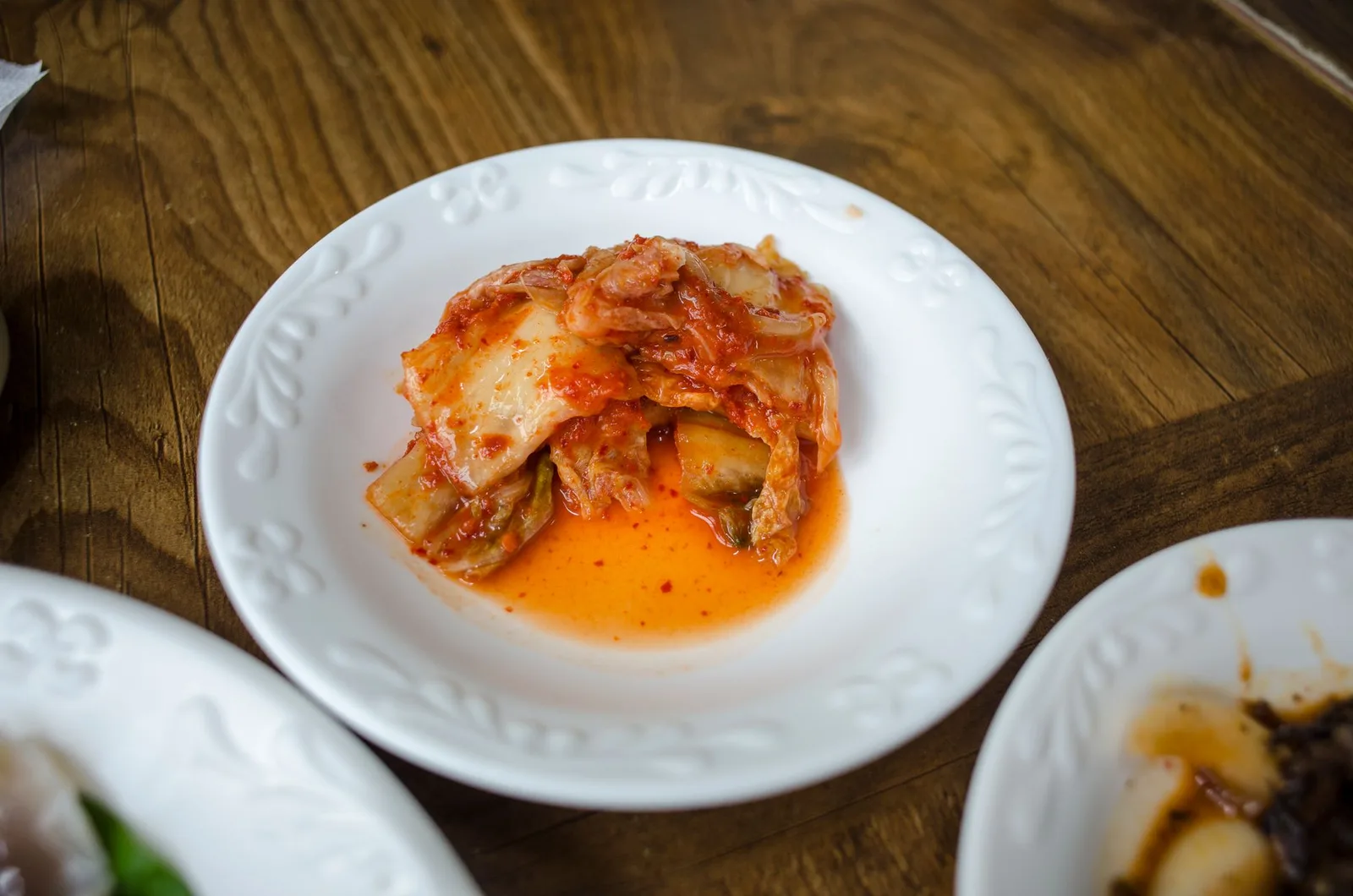
Baechu kimchi uses salted napa cabbage with ingredients such as red-pepper powder, garlic, fish sauce, and fermentation, according to the Korea Tourism Organization. It is the reference style for many people who are learning what Korean kimchi tastes like, but it is not automatically the easiest first bite.
Baechu kimchi can taste salty, garlicky, sour, spicy, or deeply savory depending on its recipe and age. A beginner should avoid taking a large forkful straight from the container. A smaller serving with rice gives the palate time to identify the seasoning without letting chili dominate the experience.
Fish sauce is another point to consider. People who avoid seafood should read the ingredient label because a red cabbage kimchi can contain fish sauce, salted shrimp, or other seafood ingredients. Vegetarian and vegan products exist, but the label needs to make that clear.
Kkakdugi: the texture-led choice
Kkakdugi is diced-radish kimchi. The Korea Tourism Organization describes it as crunchy and slightly sweet, and notes that it is commonly served with soups and stews. That pairing makes it an accessible choice for someone who finds fermented cabbage unfamiliar.
Kkakdugi is a good second purchase after baekkimchi because it changes the texture while keeping the basic idea of seasoned, fermented vegetables. The radish pieces are easier to pick up with chopsticks and retain a clear bite even when the seasoning is strong.
The main failure mode is choosing it for crunch and then storing it too long at room temperature. Keep it refrigerated after purchase and use clean utensils. The texture softens as fermentation progresses, so a person seeking maximum crunch should eat it earlier.
Nabak kimchi and oi sobagi: fresh alternatives
Nabak kimchi is a water kimchi made with thinly sliced cabbage and radish. The Korea Tourism Organization describes it as non-spicy, cool-tasting, and refreshing. It can suit a beginner who likes chilled vegetable soups or finds dense seasoning tiring.
Oi sobagi is cucumber kimchi. The Korea Tourism Organization describes its texture as crunchy and its brine as refreshing, with a traditional association with spring and summer. Cucumber kimchi is often better for someone who already enjoys pickled cucumbers and wants a familiar vegetable in a Korean preparation.
These styles have a shorter texture window than dense cabbage kimchi. Cucumber loses firmness, while water kimchi becomes more acidic. Buy a small container until the preferred fermentation stage is clear.
A beginner tasting framework that produces a real answer
The quickest way to choose a favorite is to score four samples against the traits that matter. This is more reliable than choosing the brightest package or the product with the strongest “traditional” wording.
Use a five-point scale for each category:
- Heat comfort: 1 means too hot, 5 means comfortable.
- Sourness comfort: 1 means too sour, 5 means pleasantly mild.
- Texture fit: 1 means unpleasant, 5 means ideal.
- Meal compatibility: 1 means difficult to pair, 5 means easy to eat with ordinary meals.
Here is a worked example for a beginner who dislikes spicy food, likes crunch, and wants a side dish for rice. The scores are a tasting method, not an official product ranking.
| Variety | Heat | Sourness | Texture | Meal fit | Total |
|---|---|---|---|---|---|
| Baekkimchi | 5 | 4 | 4 | 5 | 18/20 |
| Mild baechu | 3 | 3 | 4 | 5 | 15/20 |
| Kkakdugi | 4 | 3 | 5 | 4 | 16/20 |
| Nabak kimchi | 5 | 4 | 3 | 3 | 15/20 |
The table answers the decision problem for this specific eater. Baekkimchi wins because its 5-point heat score and 5-point meal score outweigh kkakdugi’s stronger crunch. Kkakdugi becomes the better choice if texture receives twice the weight.
The weighted calculation is: baekkimchi, heat 5 × 2 + sourness 4 + texture 4 + meal fit 5 = 23 points. Kkakdugi, heat 4 × 2 + sourness 3 + texture 5 + meal fit 4 = 20 points. The recommendation changes when the eater’s priorities change, which is why “best” cannot be separated from the tasting criteria.
For a second example, a person who enjoys pickles but dislikes cabbage could score oi sobagi heat 4, sourness 4, texture 5, and meal fit 4. The total is 17/20, making cucumber kimchi a more useful first purchase than a technically more famous cabbage variety.
How to buy kimchi in Korea without choosing blindly
The Korea Tourism Organization says kimchi is sold in convenience stores, supermarkets, department stores, and duty-free shops. It also notes that vacuum-packed products are available for travelers. The buying channel matters because container size, refrigeration, packaging, and transport time affect the experience.
For eating during a short stay
A small refrigerated container is easier to finish before the flavor becomes much more sour. Baekkimchi or mild baechu kimchi is practical for a first meal because both can be eaten with rice, noodles, eggs, or soup. Kkakdugi fits a meal built around gukbap or another soup-based dish.
Check the package for storage instructions and allergen information. A sealed vacuum pack can be convenient for transport, but a sealed package still needs to follow the seller’s temperature guidance. Kimchi fermentation can produce gas, so opening a swollen package over a sink is sensible.
For bringing kimchi home
Vacuum-packed kimchi is the most travel-oriented format mentioned by the Korea Tourism Organization. The source does not establish one universal airline or customs rule for every destination, so food import restrictions remain destination-specific. The package’s convenience does not remove the need to follow the carrier and border authority’s current rules.
Avoid buying a large quantity before identifying a preferred style. One 2024 award is not a beginner verdict: the Ministry of Agriculture, Food and Rural Affairs awarded its 2024 kimchi contest grand prize to Mi-geum-chi Yulmu Chonggak Kimchi and its highest excellence prize to Daebok Pogi Kimchi. Those awards describe that competition in 2024, not a current ranking for first-time eaters.
What beginners commonly get wrong
Mistaking red color for fermentation strength
Red pepper makes a kimchi look hot, but color alone does not reveal the exact heat level. Pepper quantity, variety, salt, garlic, seafood seasoning, sugar, and fermentation all affect the final taste. A pale baekkimchi can be strongly sour, while a red product can taste relatively mild.
Eating it without a neutral food
A forkful of kimchi by itself exaggerates salt, acidity, and chili. Plain rice is the simplest control food. Take one bite of kimchi alone, then one bite with rice, and compare the aftertaste.
Buying aged kimchi for a first trial
Older kimchi can be excellent for stews and fried rice, but its sourness may obscure the vegetable flavor. A beginner trying to understand the basic style should start with a fresher refrigerated product. This advice fails if the eater specifically likes sour pickles or plans to cook the kimchi, because deeper acidity can be useful in a stew.
Ignoring seafood ingredients
Baechu kimchi frequently uses fish sauce or salted seafood, but recipes differ. Read the ingredients when following a vegetarian, vegan, halal, kosher, or seafood-free diet. “Traditional” does not identify every ingredient in a particular container.
Assuming every kimchi is served the same way
Kkakdugi belongs naturally beside soup, nabak kimchi is suited to a chilled broth-like presentation, and baekkimchi can work as a clean side dish with rice. Matching the variety to the meal reduces the chance that an unfamiliar flavor feels overwhelming.
The simplest first-purchase plan
For one person, buy two small varieties rather than one large container. Pick baekkimchi plus either mild baechu kimchi or kkakdugi. Eat both with the same plain meal, record heat, sourness, crunch, and aftertaste, then buy a larger container only after one style clearly fits.
If chili is unacceptable, start with baekkimchi and nabak kimchi. If crunch is the priority, start with kkakdugi and oi sobagi. If the goal is the classic Korean side dish, start with mild baechu kimchi and compare it with baekkimchi to isolate the effect of red pepper seasoning.
The Korea Tourism Organization’s descriptions support these distinctions, but they do not certify a universal “best” product. Brand recipes and fermentation stages remain decisive. The useful beginner purchase is the one whose heat, acidity, texture, and ingredients match the meal already being eaten.
FAQ
Is baekkimchi completely non-spicy?
Baekkimchi is made without red chili-pepper sauce and is identified by the Korea Tourism Organization as suitable for people who dislike spicy food. Other seasonings can still create a strong savory or acidic taste.
Is baechu kimchi too spicy for beginners?
Baechu kimchi can be suitable when a mild version is chosen and eaten with rice, but its chili and garlic profile is less predictable than baekkimchi. Start with a small serving.
Which kimchi is the crunchiest?
Kkakdugi is the strongest first choice for crunch because it uses diced radish. Oi sobagi is another crunchy option, especially for someone who prefers cucumber.
What kimchi is served with soup?
Kkakdugi is commonly served with soups and stews, according to the Korea Tourism Organization. Its crisp radish texture contrasts with a hot, soft soup-based meal.
Can vegetarians eat kimchi?
Some kimchi contains fish sauce, salted shrimp, or other seafood ingredients, while other products are made without them. The ingredient label is the deciding evidence for a specific package.
Which kimchi should a traveler buy in Korea?
A small refrigerated container is the most practical first purchase. For taking kimchi home, the Korea Tourism Organization identifies vacuum-packed products as a travel option, while destination customs and carrier rules still determine whether import is allowed.
How many kinds of kimchi are there?
Official Korean tourism pages give different figures, including more than 100 and over 200 varieties. The difference reflects how varieties are counted, so neither number should be treated as a complete universal catalog.
What is the final beginner recommendation?
Choose baekkimchi for low heat, mild baechu kimchi for the classic flavor, and kkakdugi for crunch. If the first sample tastes too sour, try a fresher refrigerated product or eat it with plain rice.