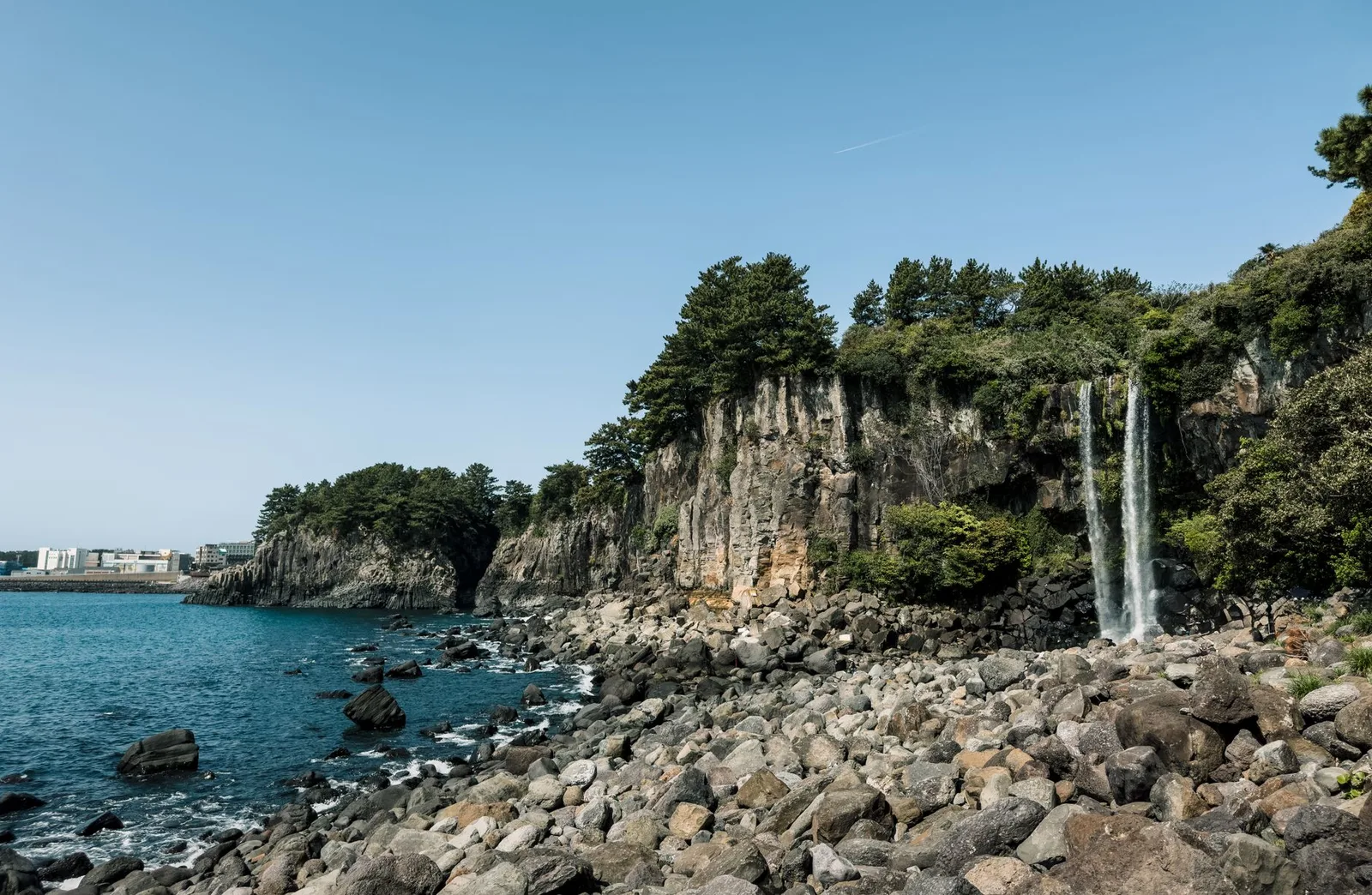
A Jeju Island trip costs at least ₩196,400 per person for a Monday–Thursday round-trip flight from Seoul, before accommodation, meals, local transport, and activities. A practical budget starts with fixed transport, then adds lodging and food. As of August 17, 2026, the biggest unknowns are hotel prices and rental-car rates, which are not published as island-wide official averages.
Key takeaways for planning Jeju Island trip cost
- A Seoul–Jeju round trip on Jeju Air costs ₩196,400 Monday–Thursday, ₩226,400 Friday–Sunday, or ₩269,400 at the listed peak or flexible fare level, as of August 17, 2026.
- Public buses are the lowest-cost option: city and regional trunk buses cost ₩1,150 by transport card for adults, while express buses cost ₩2,000 for up to 20 km.
- A rental car can simplify an east-west itinerary, but there is no official island-wide daily rental rate. The total depends on vehicle, dates, insurance, and supplier.
- Attraction admission can remain modest. Seongsan Ilchulbong and Cheonjiyeon Falls each cost ₩2,000 for adults, while Sangumburi Crater costs ₩7,000.
- The most useful budget figure is a formula, not a single island average: transport + accommodation + food + admissions + activities + contingency.
What makes up Jeju Island trip cost
Jeju expenses fall into five separate decisions: getting to the island, sleeping there, moving between sights, eating, and paying for attractions or tours. Treating them separately prevents a cheap flight from hiding expensive ground transport or a low room rate from being offset by long taxi rides.
The flight is often the first fixed number. Jeju Air’s domestic fare table, checked August 17, 2026, lists Seoul to Jeju one-way totals of ₩98,200 Monday–Thursday, ₩113,200 Friday–Sunday, and ₩134,700 for the listed peak-season or flexible fare. Each total includes the airfare, ₩4,000 airport tax, and a ₩24,200 fuel surcharge. The surcharge applies to tickets issued from July 1, 2026, and Jeju Air states that fares can change by purchase time.
Accommodation is the largest missing number in an official island-wide budget. The Jeju Tourism Organization does not publish one average hotel price for August 2026. A room in Jeju City, Seogwipo, a resort area, or a rural pension also serves a different itinerary, so one island-wide figure would be misleading.
The same limitation applies to rental cars. Jeju International Airport provides car-rental information, but no single official 2026 daily rate covers every vehicle, date, insurance package, and supplier. Rental quotes should therefore be entered as a real reservation amount in the calculation rather than replaced with a generic estimate.
Transport costs: flight, ferry, bus, taxi, or rental car
The right transport choice depends on the route. Public buses suit a city-based or slow itinerary. A car becomes more valuable when the plan links several distant coastal areas in one day. A taxi solves a transfer problem but can become the dominant cost if used between regions.
Flying from Seoul
For two adults travelling Monday–Thursday, the listed round-trip airfare is:
₩98,200 × 2 directions × 2 travellers = ₩392,800 total
For the same two adults travelling Friday–Sunday:
₩113,200 × 2 × 2 = ₩452,800 total
The weekend schedule therefore adds ₩60,000 to the pair’s airfare before any baggage or optional service charges not included in the cited fare. The listed peak or flexible fare produces:
₩134,700 × 2 × 2 = ₩538,800 total
The weekday option saves ₩146,000 compared with that peak or flexible calculation. This is why changing travel days can matter more than trimming a few attraction admissions.
Taking the ferry from Mokpo
A ferry is relevant when the itinerary includes a vehicle, substantial luggage, or a preference for overnight travel. The Ministry of Oceans and Fisheries states that a four-person family’s regular weekday round-trip fare from Mokpo to Jeju is approximately ₩560,000. Its example uses two adults at ₩147,000 each and two teenagers at ₩133,800 each for the round trip calculation.
The 2026 Badaro ferry discount pass costs ₩7,900 and offers up to 50% weekday discounts or up to 20% weekend discounts on participating ferries, for up to 12 trips through May 31, 2027. The pass only helps when the selected sailing participates and the discounted fare exceeds the pass price.
Using Jeju buses
The Jeju Bus Information System fare table dated January 1, 2026 lists adult city and regional trunk-bus fares at ₩1,150 by transport card or ₩1,200 in cash. Teenagers pay ₩850 by card or ₩900 cash, and children pay ₩350 or ₩400.
Adult express buses start at ₩2,000 by card for journeys up to 20 km, with a listed maximum of ₩3,000. Airport limousine fares are listed at ₩1,300–₩5,500 for route 600 and ₩1,300–₩5,000 for routes 800 and 800-1.
There is a source conflict worth knowing. An older Visit Jeju bus PDF lists an adult express-bus maximum of ₩4,000, while the current Jeju Bus Information System lists ₩3,000. Use the current bus system table for budgeting and treat the older PDF as historical information.
Taking taxis from Jeju Airport
The Jeju International Airport official taxi estimates show how quickly distance changes the first-day budget:
| Destination | Standard taxi | Deluxe taxi | Time estimate |
|---|---|---|---|
| Jeju City Hall | ₩9,000 | ₩16,200 | 30 minutes |
| Aewol-eup | ₩25,000 | ₩45,000 | 55 minutes |
| Jungmun Tourism Complex | ₩35,000 | ₩63,000 | 80 minutes |
| Seongsan-eup | ₩45,000 | ₩81,000 | 100 minutes |
This table answers the first-transfer question: whether arriving at a distant resort saves enough on accommodation to offset the taxi or car cost. The airport-to-Seongsan standard estimate alone is five times the Jeju City Hall estimate.
Food and attraction costs you can price precisely
Food has no single official Jeju average, but several Visit Jeju listings provide useful anchors. A government-designated budget-friendly restaurant lists an 800-gram assorted black-pork platter at ₩76,000 and 200-gram portions at ₩20,000. Halla Chuksan Jeongyuk Sikdang lists Jeju black pork at ₩6,800 per 100 grams, with a 300-gram minimum order, plus table-setting fees of ₩4,000 for adults and ₩3,000 for children. These are menu examples, not a claim about every restaurant.
A low-cost meal reference also appears in the Visit Jeju listing for Sangmyeong Sikdang, which gives an all-you-can-eat lunch buffet price of ₩9,000 and an evening cup-ramyeon surcharge of ₩2,000.
Attractions are easier to model because admission is published. Visit Jeju lists Seongsan Ilchulbong at ₩2,000 for adults and ₩1,000 for youth and children aged 7–24. The same listing gives Cheonjiyeon Falls at ₩2,000 for adults and ₩1,000 for children, with free admission for children under six and people aged 65 or older.
Visit Jeju lists Yongmeori Coast at ₩2,000 for adults and ₩1,000 for teenagers aged 13–24 and children aged 7–12. Access can be restricted by tides, waves, or weather, so its admission price does not guarantee entry on a chosen day.
Sangumburi Crater costs ₩7,000 for adults, ₩6,000 for teenagers and children, and ₩5,000 for seniors, Jeju residents, national merit recipients, and people with disabilities. Its official listing gives July–August and November–February hours of 09:00–17:40, with last admission at 17:00.
For a current cultural-event example, the Jeju Museum of Contemporary Art exhibition “Colorful Hearts” runs from July 10 through October 25, 2026. Visit Jeju lists admission at ₩2,000 for adults, ₩1,000 for youth and military personnel, and ₩500 for children.
A worked Jeju budget for two adults
The following calculation prices the parts that have official figures. It deliberately leaves accommodation and rental-car hire as inputs because no official island-wide 2026 averages were found for either category.
Assume two adults take a four-night weekday trip from Seoul, use public transport, eat one ₩9,000 buffet lunch each day, share one ₩76,000 black-pork platter, and visit Seongsan Ilchulbong, Cheonjiyeon Falls, Yongmeori Coast, and Sangumburi Crater. Use 10 adult city or regional bus rides per person and the Jeju City Hall airport taxi estimate on arrival and departure.
Flight: ₩98,200 × 2 directions × 2 adults = ₩392,800
Airport taxis: ₩9,000 × 2 rides = ₩18,000
Bus rides: ₩1,150 × 10 rides × 2 adults = ₩23,000
Buffet lunches: ₩9,000 × 4 days × 2 adults = ₩72,000
Black-pork platter: ₩76,000 × 1 = ₩76,000
Admissions: (₩2,000 + ₩2,000 + ₩2,000 + ₩7,000) × 2 adults = ₩26,000
Priced subtotal before accommodation and rental car: ₩607,800 for two adults, or ₩303,900 per person.
The complete trip formula is therefore:
₩607,800 + accommodation total + rental-car total + unpriced meals and activities
If the same pair chooses the listed Friday–Sunday airfare instead, add ₩60,000 to the subtotal, producing ₩667,800 before accommodation and rental-car costs. That difference is known. A hotel or vehicle number should be inserted from the actual dates and quote, not guessed from an island-wide average that does not exist.
This example is intentionally conservative in one way and incomplete in another. It includes four priced admissions and a substantial pork meal, but it does not pretend that four buffet lunches cover every meal. It also assumes Jeju City Hall taxi distances, so a Jungmun or Seongsan base changes the transfer cost immediately.
Choose buses, a rental car, or taxis by itinerary
Choose buses when the itinerary concentrates on Jeju City, Seogwipo, or a small number of connected sights. The fare ceiling is easy to control, but travel time and service frequency can limit how many remote locations fit into one day.
Choose a rental car when the plan includes several distant areas such as Aewol, Jungmun, and Seongsan, especially with luggage or children. The decision fails if parking, insurance, fuel, and long driving days erase the time saved. Since no official island-wide 2026 rental rate is available, compare the complete quote rather than the headline daily price.
Choose taxis for airport transfers, late arrivals, or one difficult connection. The official airport estimates show a standard taxi at ₩25,000 to Aewol-eup, ₩35,000 to Jungmun, and ₩45,000 to Seongsan-eup. Repeating those distances for sightseeing can exceed the cost logic of a car or a slower bus itinerary.
The practical decision rule is simple: use buses for a compact base, a car for a geographically ambitious route, and taxis for isolated transfers. A cheap room in the wrong part of the island can be a false saving.
Common budgeting mistakes on Jeju
Counting only the airfare
The flight is visible at booking, while airport transfers, meals, and admissions accumulate later. The two-person weekday example reaches ₩607,800 before lodging and car hire even though each individual attraction costs only ₩2,000–₩7,000.
Treating every black-pork price as a per-person meal
The ₩76,000 listing is for an 800-gram assorted platter. The ₩20,000 figure is for a 200-gram portion, and Halla Chuksan Jeongyuk Sikdang adds table-setting fees. Portion size and service charges must stay attached to the price.
Using the wrong bus-fare document
The older Visit Jeju PDF and the current Jeju Bus Information System disagree on the express-bus maximum. A budget built from the older ₩4,000 adult maximum overstates the current listed maximum of ₩3,000, while assuming every bus costs ₩1,150 understates express and airport-limousine journeys.
Planning tide-dependent attractions as fixed activities
Yongmeori Coast can restrict access because of tides, waves, or weather. Keep a flexible substitute nearby rather than treating the ₩2,000 admission as a guaranteed part of the day.
Ignoring the return transfer
Airport-to-hotel cost is often calculated only once. The worked example uses two Jeju City Hall taxi rides. A Seongsan base would use the official ₩45,000 standard estimate each way, adding ₩90,000 before any local movement.
FAQ about Jeju Island trip cost
How much does a Jeju trip cost for two people?
A two-person weekday example costs ₩607,800 before accommodation, rental-car hire, unpriced meals, and extra activities. That total includes round-trip Seoul flights, two Jeju City Hall taxi transfers, 20 adult bus rides, four buffet lunches, one ₩76,000 black-pork platter, and four paid attractions.
Is Jeju expensive compared with Seoul?
There is no single official comparison because lodging, transport distance, and itinerary style differ. Jeju can keep attraction and bus costs low, but remote accommodation can raise taxi or rental-car costs. The route, rather than the island name alone, determines the final budget.
Is a rental car necessary in Jeju?
No. Buses work for compact itineraries, while a rental car is useful for several distant areas in one day. The car decision depends on the full quote, including insurance and fuel, and no official island-wide 2026 daily rental average is published.
What is the cheapest way to get to Jeju?
The lowest listed Seoul–Jeju example in the supplied 2026 fare table is Jeju Air’s ₩98,200 Monday–Thursday one-way total. A weekday ferry can make sense for a family or vehicle-based trip, but the Ministry of Oceans and Fisheries gives a four-person weekday round-trip example of approximately ₩560,000 from Mokpo.
How much should be reserved for Jeju attractions?
The four-attraction example costs ₩26,000 for two adults: ₩4,000 each for Seongsan Ilchulbong, Cheonjiyeon Falls, and Yongmeori Coast, plus ₩14,000 for Sangumburi Crater. Add event or tour prices separately because they are not covered by those admission fees.
What is missing from an official Jeju trip-cost estimate?
An island-wide 2026 average hotel price and a single official rental-car daily rate are not available. Those figures depend on dates, location, vehicle, insurance, and supplier, so the final budget must use the actual accommodation and rental quote.
For a usable budget, calculate the dated flight and route first, then add the real room and vehicle quotes. If the itinerary stays compact, buses and low admission fees can keep the known portion near the worked example. If it crosses the island repeatedly, distance becomes the expense that decides the trip.