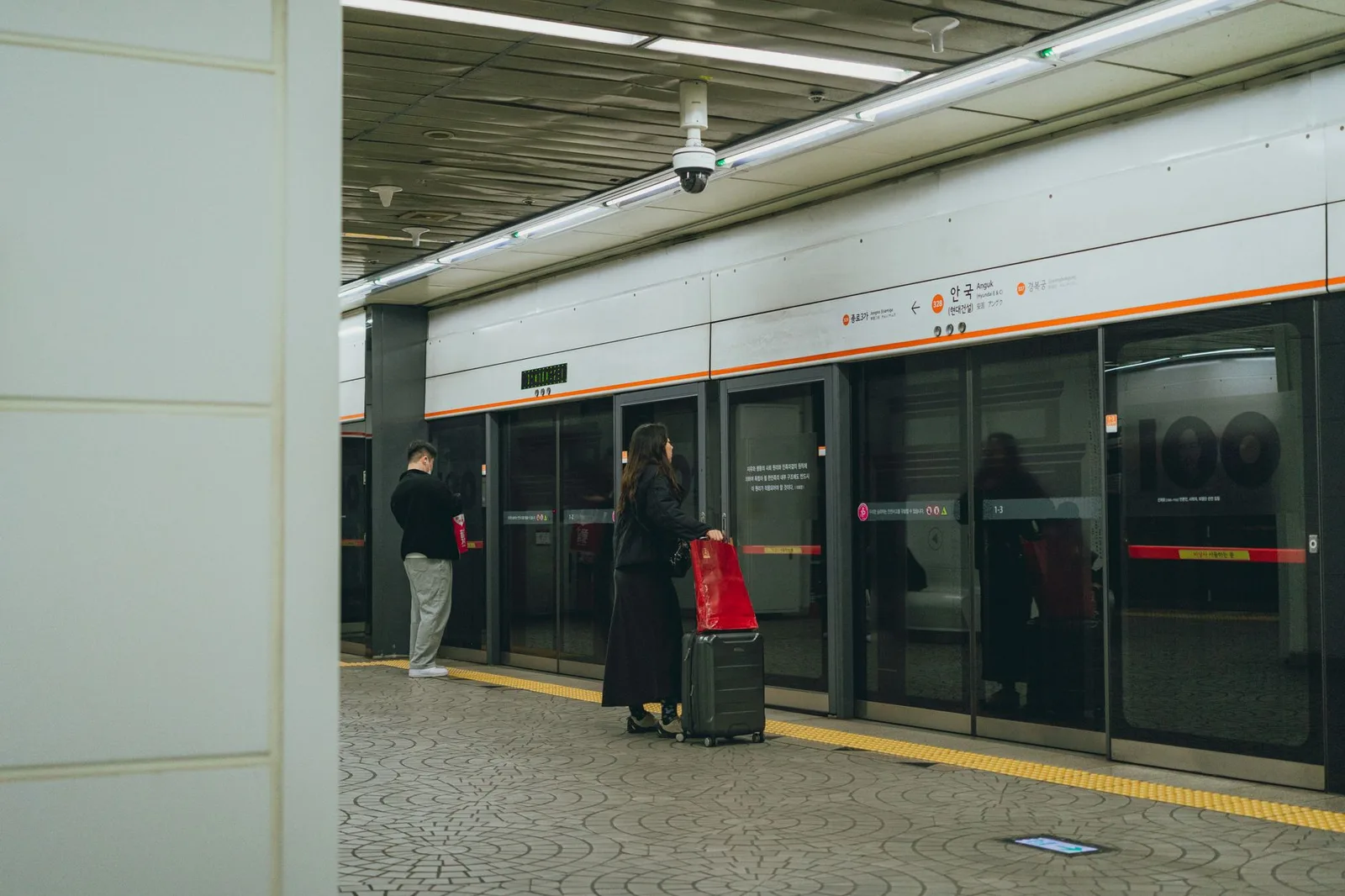
A solo Korea trip costs about ₩1.18 million for seven days before international airfare, using the existing site budget as a baseline. The amount rises when a private room replaces a shared room, but solo travelers save on food and local transport. The decisive question is whether privacy, flexibility, or intercity travel matters most.
Key takeaways
- Use ₩1.18 million as a seven-day planning baseline before flights, shopping, travel insurance, and visa-related charges.
- A private room is the largest solo premium. Shared accommodation can reduce the daily total more than cutting restaurant meals.
- Seoul transport is comparatively predictable: a transit-card subway ride costs ₩1,550 as of June 28, 2025.
- The Seoul Climate Card pays off when the itinerary contains frequent subway and bus journeys inside its coverage area.
- Solo travel becomes poor value when the itinerary includes several private taxis, expensive tours, or a hotel room priced for two people.
What the Korea solo trip cost estimate includes
The published baseline for a one-week South Korea trip is ₩1,180,300. That figure is useful as a reference point, but it is not an official national price. The total depends on the departure city, booking date, accommodation standard, exchange rate, season, and whether the route stays in Seoul or adds Busan, Gyeongju, Jeju, or other regions.
The existing seven-day South Korea budget guide is the canonical page for that line-by-line baseline. This article focuses on the solo adjustment: which costs increase when one person pays, which remain almost unchanged, and where a different travel style reaches its break-even point.
A practical budget should separate expenses into three groups:
- Fixed trip costs, such as international airfare, travel insurance, and entry paperwork.
- Per-person costs, such as meals, admission fees, and transit fares.
- Shared costs, such as a hotel room, taxi, rental car, or private guide.
Solo travel mainly changes the third group. A museum ticket does not become more expensive because one person enters. A hotel room still charges for the room, whether it contains one guest or two.
Korea solo trip cost by travel style
The most useful comparison is not “cheap versus expensive.” It is whether the itinerary prioritizes a private room, long-distance movement, food experiences, or spontaneous local transport. Seoul-focused trips give the clearest control over the budget because the subway network can replace many taxi journeys.
This table shows the main cost behavior for a seven-day visit. It does not invent a hotel or airfare price, because those figures change by city, dates, and booking conditions.
| Expense | Solo traveler | Two travelers sharing | What changes |
|---|---|---|---|
| International airfare | 1 ticket | 2 tickets | No solo discount |
| Hotel room | 1 room | 1 room split in two | Biggest solo premium |
| Restaurant meals | 1 portion | 2 portions | Usually proportional |
| Subway and bus fares | 1 fare | 2 fares | No sharing benefit |
| Taxi or rental car | Full ride | Split ride | Solo premium on each use |
The table shows why reducing restaurant spending does not always solve the main problem. If a private room costs ₩100,000 per night, seven nights create ₩700,000 of accommodation cost before any meal or attraction is purchased. A shared room at ₩40,000 per night would total ₩280,000 over the same period, leaving a ₩420,000 difference.
That is a worked scenario, not a market-wide hotel quote. The actual price depends on the property and dates. The arithmetic is still useful because it identifies the expense with the largest leverage.
A worked seven-day budget with the arithmetic shown
Start with the published baseline of ₩1,180,300 for one week. Add only the expenses that clearly represent the solo decision. The calculation below assumes a Seoul-centered trip, one private room, subway-heavy transport, casual meals, and no major shopping purchase.
The solo adjustment can be written as:
Solo total = baseline budget + private-room premium + solo taxi or room supplements − transport savings
Use the following illustrative room comparison:
- Shared-room reference: ₩40,000 × 7 nights = ₩280,000
- Private-room reference: ₩100,000 × 7 nights = ₩700,000
- Private-room premium: ₩700,000 − ₩280,000 = ₩420,000
Now apply that premium to the published baseline:
₩1,180,300 + ₩420,000 = ₩1,600,300
The resulting planning figure is ₩1,600,300 before international airfare, shopping, insurance, and entry charges. It is not a promised price for every solo itinerary. It answers a narrower and more useful question: what happens when a seven-day baseline built around shared accommodation becomes a private-room trip?
Food can move the total in either direction. Numbeo’s Seoul page, updated in June 2026, reports ₩13,000 for an inexpensive restaurant meal, ₩10,000 for a McDonald’s-style combo meal, and ₩90,000 for a mid-range meal for two. These are crowd-sourced reference figures, not government-set prices, so use them as planning inputs rather than guarantees. Numbeo’s June 2026 Seoul data supports the following seven-day food scenarios:
- Three inexpensive restaurant meals per day: ₩13,000 × 3 × 7 = ₩273,000
- Two inexpensive meals plus one ₩10,000 combo per day: (₩13,000 × 2 + ₩10,000) × 7 = ₩252,000
- One mid-range meal for two is ₩90,000, so one solo diner should not automatically divide that figure by two. The restaurant may price a set menu, require a minimum order, or serve portions designed for sharing.
The failure mode is assuming that “solo” always means half of a couple’s bill. Shared dishes, room rates, taxis, and private tours do not divide evenly. A solo traveler who chooses a private room and taxis can spend more than two people who share accommodation and use public transport.
Seoul transport: when the Climate Card pays off
Seoul’s adult subway base fare is ₩1,550 with a transit card or ₩1,650 for a cash single-ride ticket, according to the Seoul Metropolitan Government’s transportation information, with the fare applying as of June 28, 2025. The cash option therefore costs ₩100 more per base ride.
The short-term Seoul Climate Card costs ₩5,000 for one day, ₩8,000 for two days, ₩10,000 for three days, ₩15,000 for five days, or ₩20,000 for seven days. The physical card adds ₩3,000. These prices are listed by VisitKorea’s Climate Card guidance.
The simple seven-day break-even calculation is:
₩20,000 ÷ ₩1,550 = 12.9 rides
That means the seven-day pass begins to beat the base subway fare at 13 rides, before considering the ₩3,000 physical card. Including the card purchase:
(₩20,000 + ₩3,000) ÷ ₩1,550 = 14.8 rides
So the practical threshold is 15 base-fare rides across seven days. A traveler taking two subway rides on five days would make 10 rides and pay ₩15,500 by transit card. That is below the ₩23,000 pass-and-card cost. A traveler taking three rides on five days would make 15 rides and reach ₩23,250, making the pass slightly cheaper before any coverage limitations.
The calculation fails if the itinerary includes destinations outside the card’s coverage or journeys requiring separate payment. It also fails if many days are spent walking within one neighborhood. A Climate Card is a transport decision, not an automatic part of every solo budget.
A regular taxi starts at ₩4,800 for up to 1.6 kilometers, according to the Seoul Metropolitan Government. The late-night surcharge is 20% from 10 p.m. to 4 a.m. A ₩4,800 starting fare therefore becomes ₩5,760 before distance, traffic, tolls, or other charges during the surcharge period. Seoul’s official taxi information provides the applicable conditions.
The solo cost advantage is strongest when the route uses trains, buses, and walking. A taxi that would cost ₩20,000 for two travelers costs the full ₩20,000 for one traveler. Five such rides add ₩100,000 to the solo budget, before late-night surcharges.
Food, attractions, and the solo dining constraint
Food is easier to control than accommodation, but solo dining changes what is practical. A single diner can order one bowl of noodles, kimbap, soup, or a set meal without waste. Restaurants built around shared barbecue, hot pot, or large seafood platters can create a higher minimum spend or make it difficult to sample several dishes.
The best budget structure is to mix individual portions with two or three planned splurge meals. For example, using the June 2026 Seoul reference of ₩13,000 for an inexpensive restaurant meal, a seven-day schedule with two such meals and one ₩10,000 combo each day produces ₩252,000. Add one ₩30,000 special meal and the food total becomes ₩282,000.
That arithmetic gives a target without pretending every restaurant follows the same price. It also prevents a common mistake: setting a daily food allowance that only works if every meal is convenience-store food, then treating the first restaurant visit as an unexpected overrun.
Attractions can be modest in a Seoul itinerary. Gyeongbokgung Palace admission is ₩3,000 for Koreans aged 25–64. The Seoul Metropolitan Government’s 2026 guide lists June through August hours as 09:00–18:30, with last admission one hour before closing. The 2026 Seoul guidebook is the source for those published details. International visitors should confirm the applicable ticket category at the palace because admission rules can differ by visitor status and special conditions.
The cost advantage of a solo traveler appears when the itinerary favors free neighborhoods, parks, markets, viewpoints, and walking routes. The disadvantage appears when a private tour, rental car, or paid performance is the central purpose of the trip. The activity budget should follow the itinerary rather than a generic daily number.
Timing: the season changes the total before arrival
Travel dates affect the largest pre-trip costs, especially accommodation and airfare. VisitKorea identifies March through May and September through November as mild periods suited to walking. It describes summer as hot and humid and winter as cold and dry. The same guidance identifies July–August and December–January as peak travel seasons.
For 2026, the published festival calendar includes the Yeon Deung Hoe from May 8–25, Boryeong Mud Festival from July 24–August 9, Incheon Pentaport Rock Festival from July 31–August 2, Andong Maskdance Festival from September 24–October 4, and Jinju Namgang Yudeung Festival from October 3–18. VisitKorea’s 2026 festival listings provide those dates.
A festival can justify a higher room rate if it is the reason for the trip. It can also make a budget fail if the dates were chosen without checking demand. The same principle applies to cherry blossoms. VisitKorea’s 2026 spring guidance places Jinhae blossoms in mid-to-late March and Yeouido Cherry Blossom Road in early-to-mid April.
The decision rule is direct: choose spring or autumn for walking-heavy itineraries, choose a peak-season event only when the event is worth the accommodation premium, and avoid treating a low-season room price as proof that every other cost will be lower.
Entry costs and charges that sit outside the daily budget
The daily figure does not answer every pre-arrival question. K-ETA costs ₩10,000 plus a separate online-payment fee, and the official K-ETA site states that assessment takes 72 hours or less under its published guidance. The K-ETA official application guidance is the source for the current charge and processing statement as of the research date, August 17, 2026. Eligibility and temporary exemptions can change, so the fee should be added only when the traveler’s nationality and travel purpose require it.
International airfare is deliberately excluded from the worked total because no departure airport was supplied. A flight from Tokyo, Taipei, Singapore, London, or New York creates a different budget before the first Korean won is spent. The same limitation applies to travel insurance and baggage fees.
VisitKorea also lists a 2026 promotion offering international visitors 50% off selected tourist taxis and city-tour buses from July 13 through November 30, subject to early termination and maximum discount limits. The VisitKorea promotion notice gives the conditions. Treat the discount as an optional reduction, not as a guaranteed part of the base budget.
Common budgeting mistakes for solo visitors
Pricing a room like a bed
A room charge is usually attached to the room, not the number of occupants. A solo traveler who chooses a private ensuite room absorbs the full nightly price. Compare the seven-night room total before comparing meal budgets.
Dividing every couple’s expense by two
This works for per-person admission and subway fares. It does not work for a taxi, private guide, rental car, or room. Shared Korean meals can also have minimum orders that make a solo portion more expensive than half of a group bill.
Counting only subway fares
The Seoul subway fare is clear, but airport transfers, late-night taxis, intercity trains, and luggage-heavy journeys can dominate the transport total. A route from Seoul to another region deserves its own line in the spreadsheet.
Ignoring the physical Climate Card fee
The seven-day pass is ₩20,000, but VisitKorea lists the physical card at ₩3,000. The break-even point must use ₩23,000 when a new physical card is required.
Building the budget around an unverified promotion
A discount with a stated end date, usage cap, or early-termination condition should sit in a separate “possible saving” line. The trip must remain affordable without it.
Which solo budget should be used?
Use the ₩1,180,300 baseline when the trip follows the existing one-week plan and the accommodation assumptions remain comparable. Use ₩1,600,300 as a worked private-room planning figure when the seven-night room premium is ₩420,000. Add airfare, insurance, shopping, K-ETA where applicable, intercity transport, and paid tours separately.
Choose a private room if sleep, luggage security, or late arrivals matter more than the accommodation premium. Choose a hostel or shared room if the trip is Seoul-centered and the priority is keeping the total below the private-room scenario. Choose regular transit fares if the itinerary is compact. Choose the seven-day Climate Card once the arithmetic reaches 15 base-fare rides and the journeys fall within its coverage.
The most reliable solo budget is therefore a small decision sheet, not one universal number:
Total trip budget = arrival costs + accommodation + food + local transport + intercity transport + attractions + insurance and entry charges + contingency.
Fill in the room total first. Then test the transport threshold. Those two lines reveal whether the itinerary is genuinely low-cost or only appears cheap because major solo expenses were omitted.
FAQ
Is ₩1 million enough for a solo trip to Korea?
It can cover a seven-day trip before international airfare if the itinerary follows the ₩1,180,300 baseline closely, but a private room, shopping, intercity travel, insurance, or entry charges can push the total above ₩1 million.
What is the biggest extra cost of traveling alone in Korea?
Accommodation is usually the biggest extra cost because one traveler pays the full room rate instead of splitting it with a companion. Taxis, rental cars, private tours, and shared-dish restaurants can also create a solo premium.
Is the Seoul Climate Card worth buying for seven days?
It is worth considering at 15 base-fare rides when a new physical card is included in the calculation: (₩20,000 + ₩3,000) ÷ ₩1,550 rounds up to 15 rides. Coverage and travel pattern still matter.
How much should one person budget for food in Seoul?
A seven-day food plan using two ₩13,000 inexpensive meals and one ₩10,000 combo meal per day totals ₩252,000, based on Numbeo’s June 2026 Seoul reference figures. Restaurant choice and shared-dish minimums can raise the total.
Does Korea have an official fixed solo-trip price?
No. VisitKorea provides accommodation and travel guidance, but there is no official fixed 2026 total for a solo trip because the amount depends on origin, dates, lodging, transport, and itinerary.
Should a solo traveler visit during a Korean festival?
Visit for the festival when the event is central to the trip and the higher room or transport cost fits the budget. A festival date is poor value when it adds demand without adding an experience the traveler actually wants.