The Ministry of Culture, Sports and Tourism put average spending per foreign visitor at about ₩934,000 for the first half of 2026. That average is built mostly from three-night trips out of Shanghai, Tokyo and Taipei, and it does not survive contact with a seven-day itinerary flown from North America or Europe.
A one-week trip to South Korea runs ₩470,000 to ₩2,210,000 per person on the ground, about $330 to $1,560 at the 1,416 won-per-dollar rate quoted on 14 August 2026, before international airfare. A mid-range Seoul-and-Busan week comes to ₩1,180,300 solo, or ₩820,300 per person when two share a room. Round-trip US flights add around $1,058.
The five numbers that decide your total
- Accommodation is 40–60% of ground costs, and a shared double room halves the largest line on the page.
- Seoul city transit is almost a rounding error: a 7-day Climate Card is ₩20,000, less than one airport taxi.
- KTX fares dropped by an average of 10% on 1 September 2026, when KORAIL and SR merged. Seoul–Busan standard fell from ₩59,800 to ₩54,400.
- Food runs ₩20,000 per day if you eat where office workers eat, ₩70,000 if you sit down in restaurants three times daily.
- Airfare is the biggest and most seasonal line, swinging roughly $900 between the February trough and the December peak.
What a week in South Korea costs, by budget tier
This table answers the question most people are actually asking: what does the ground portion of seven days cost at three realistic spending levels? Each row is a full week (six nights) for one person, international airfare excluded, priced in August 2026 won.
| Tier | Stay per night (KRW) | Food per day (KRW) | 7-day ground total (KRW) | Approx. USD |
|---|---|---|---|---|
| Thrifty, hostel dorm, buses | 34,000 | 20,000 | 472,500 | $334 |
| Mid-range, business hotel, solo | 120,000 | 34,000 | 1,180,300 | $833 |
| Mid-range, two sharing (per person) | 60,000 | 34,000 | 820,300 | $579 |
| Comfortable, 4-star, some taxis | 230,000 | 70,000 | 2,211,800 | $1,562 |
The gap between the first and last row is 4.7x, and almost all of it is the bed. Food between the thrifty and comfortable rows differs by ₩350,000 across the week; accommodation differs by ₩1,176,000. Anyone trying to compress a Korea budget should attack the room rate first and the restaurant bill second.
The two mid-range rows are the same trip. Only the room is split. That single decision is worth ₩360,000, which is why what solo travel adds to a seven-day budget is worth reading before you book a private room out of habit.
The line-by-line week: Seoul, Busan, six nights
Here is the mid-range column with the arithmetic exposed. The itinerary is four nights in Seoul, two in Busan, arriving and departing through Incheon.
| Line item | Detail | Cost (KRW, Aug 2026) |
|---|---|---|
| Accommodation | 6 nights, business hotel at 120,000 | 720,000 |
| Airport transfer | AREX All-Stop both directions at 4,750 | 9,500 |
| T-money card | Card price, never refunded | 4,000 |
| Seoul transit | 5-day Climate Card plus physical card | 18,000 |
| Seoul–Busan KTX | Return at 54,400 post-merger | 108,800 |
| Busan local transport | Two days of subway and bus | 12,000 |
| Food | 7 days at 34,000 | 238,000 |
| Sights and entry | Palace integrated ticket plus paid attractions | 70,000 |
| Total | Excludes international airfare | 1,180,300 |
That is $833 at 1,416 won to the dollar. Add the $1,058 Kayak quotes as the average round trip from the United States to Incheon and the whole week reaches about $1,891 solo, or $1,637 per head when two people share the room.
The ₩34,000 daily food figure is not a guess. It is a gimbap-and-coffee breakfast at ₩5,000, a ₩9,000 lunch, a ₩14,000 dinner and ₩6,000 of snacks and cafés, built from the price levels in the food section below.
The rail fare change that saves you ₩10,800
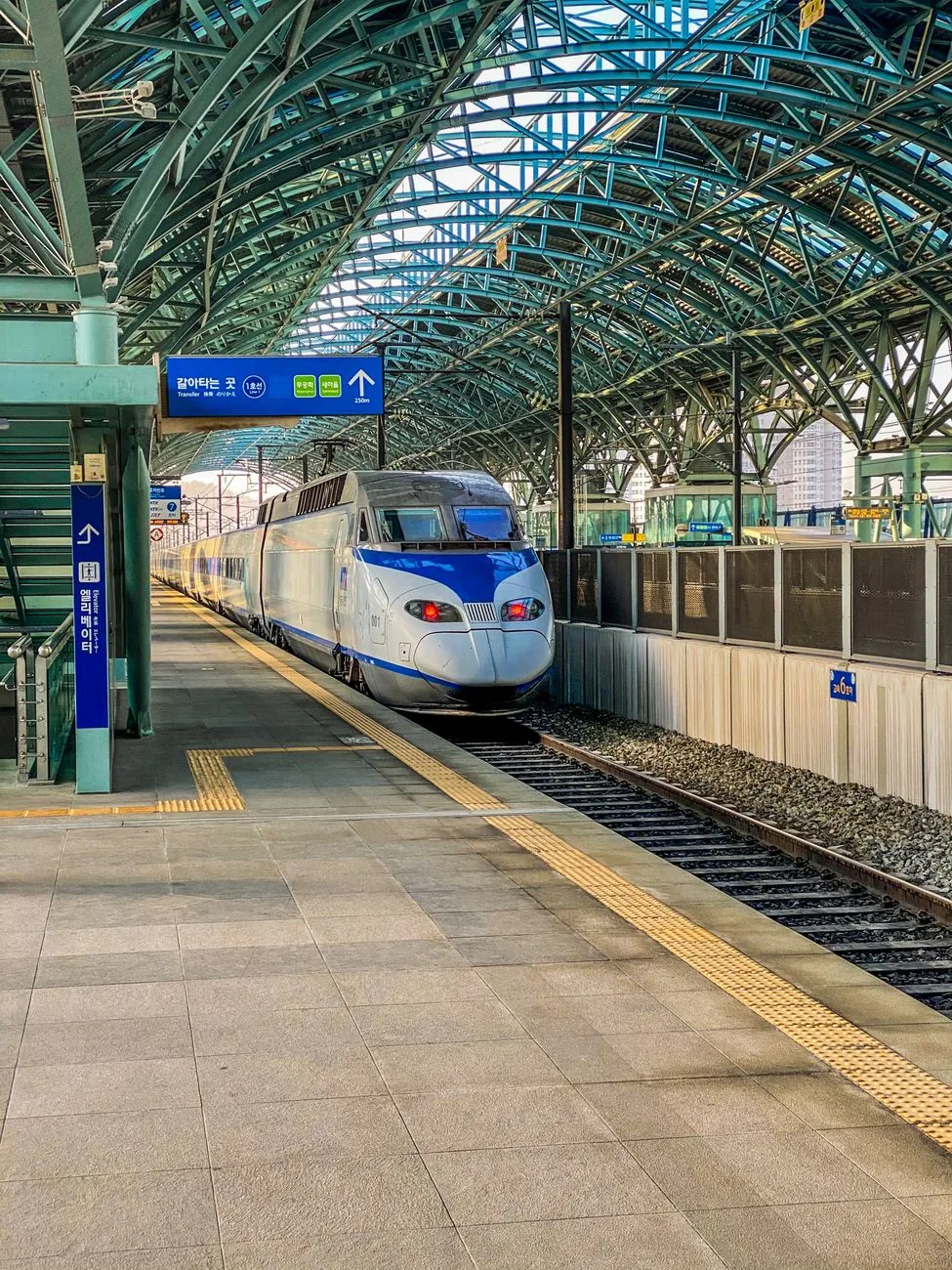
KORAIL and SR merged on 1 September 2026, and KTX fares were cut by an average of 10% to align with the old SRT price level. Seoul–Busan standard class went from ₩59,800 to ₩54,400, and Yongsan–Gwangju Songjeong from ₩46,800 to ₩42,000, per the fare schedule published with the merger announcement and reported in Seoul Economic Daily on 5 August 2026. The reduction is set to hold for three years. A Seoul–Busan return therefore costs ₩108,800 instead of ₩119,600.
That also settles the KORAIL Pass question for a one-week trip. Third-party sellers list the 2026 flexible pass at about ₩131,000 for two travel days and ₩186,000 for three, though KORAIL does not publish an English fare table I can point you to. Against a ₩108,800 Busan return, the two-day pass loses by ₩22,200. The pass only wins above roughly ₩131,000 of separate high-speed fares, which in practice means three or more intercity legs. A Seoul-plus-one-city week never gets there; a Seoul–Busan–Jeonju–Seoul week does. If your second city is closer in, compare against the cheaper routings in our guide to getting to Jeonju from Seoul before you buy anything.
The express bus is the thrifty alternative at about ₩25,000 each way to Busan, roughly ₩58,800 cheaper than KTX for the return, in exchange for four and a half hours instead of two and a quarter.
Transit passes: where the Climate Card pays off, and where it fails
Seoul's subway base fare has been ₩1,550 by card since 28 June 2025, with ₩100 added per 5 km beyond the first 10 km, per the Seoul Metropolitan Government. Blue and green city buses are ₩1,500, red express buses ₩3,000, according to the Seoul Tourism Organization. A medium-sized taxi starts at ₩4,800, rising to ₩6,700 between 23:00 and 02:00.
The short-term Climate Card is ₩5,000 for one day, ₩10,000 for three, ₩15,000 for five and ₩20,000 for seven, with ₩3,000 extra for the physical card if you cannot load the mobile version.
Do the break-even. A five-day card with the plastic costs ₩18,000, which is 11.6 base subway fares. The pass pays for itself on ride twelve, a little over two subway trips a day. On the mobile version with no card fee, it breaks even on ride ten. Any normal sightseeing day clears that by lunchtime.
Where it fails: the Climate Card covers Seoul subway sections and Seoul-licensed city buses only. Airport buses, intercity buses and the Sinbundang Line are excluded, and so is anything past the city boundary. If your hotel sits in Incheon or you are commuting in from a Gyeonggi suburb, a plain T-money card charging distance fares is cheaper and simpler.
One timing note that has confused travellers all year: Seoul is retiring the 30-day Climate Card, with last use on 29 September 2026 for the prepaid version and full termination on 1 October 2026. The 1-to-7-day tourist passes continue. A week-long visitor is unaffected.
From Incheon, the AREX All-Stop train to Seoul Station is ₩4,150 to ₩4,750 and takes just under an hour, per the Seoul Tourism Organization's transfer page, which lists the non-stop Express at ₩9,500. Resellers quote the Express anywhere from ₩11,000 to ₩13,000 and the operator publishes no fare table I could confirm, so budget the All-Stop figure, which every source agrees on. A taxi is ₩31,000 to ₩58,500 plus a ₩7,900 expressway toll, which is between six and twelve times the train.
Food: what Seoul restaurants actually charge
Korea has an unusually good public data set here. The Korea Consumer Agency surveys eight dine-out staples monthly through its Chamgagyeok price portal. Seoul averages for April 2026: samgyetang ₩18,154, naengmyeon ₩12,615, bibimbap ₩11,692, kalguksu ₩10,038, a kimchi jjigae set meal ₩8,654, jajangmyeon ₩7,731, gimbap ₩3,800. The May 2026 survey put 200 g of samgyeopsal at ₩21,321.
Those numbers have been climbing faster than general inflation. Gimbap is up 77% in Seoul since 2017, and samgyetang rose from ₩14,077 in 2021 to ₩18,154 in 2026, a 29% increase in five years. Dining-out prices in the year to August 2026 rose 4.4% for kalguksu and 4.3% for pork belly, against overall CPI growth of 2.6%.
The practical reading: a ₩20,000 food day means gimbap, jajangmyeon and a jjigae set. A ₩34,000 day means one of those replaced by a proper sit-down dinner. Grilled pork for one, at ₩21,321 for 200 g before sides and soju, is a ₩30,000 dinner on its own and cannot be a nightly habit on a mid-range budget.
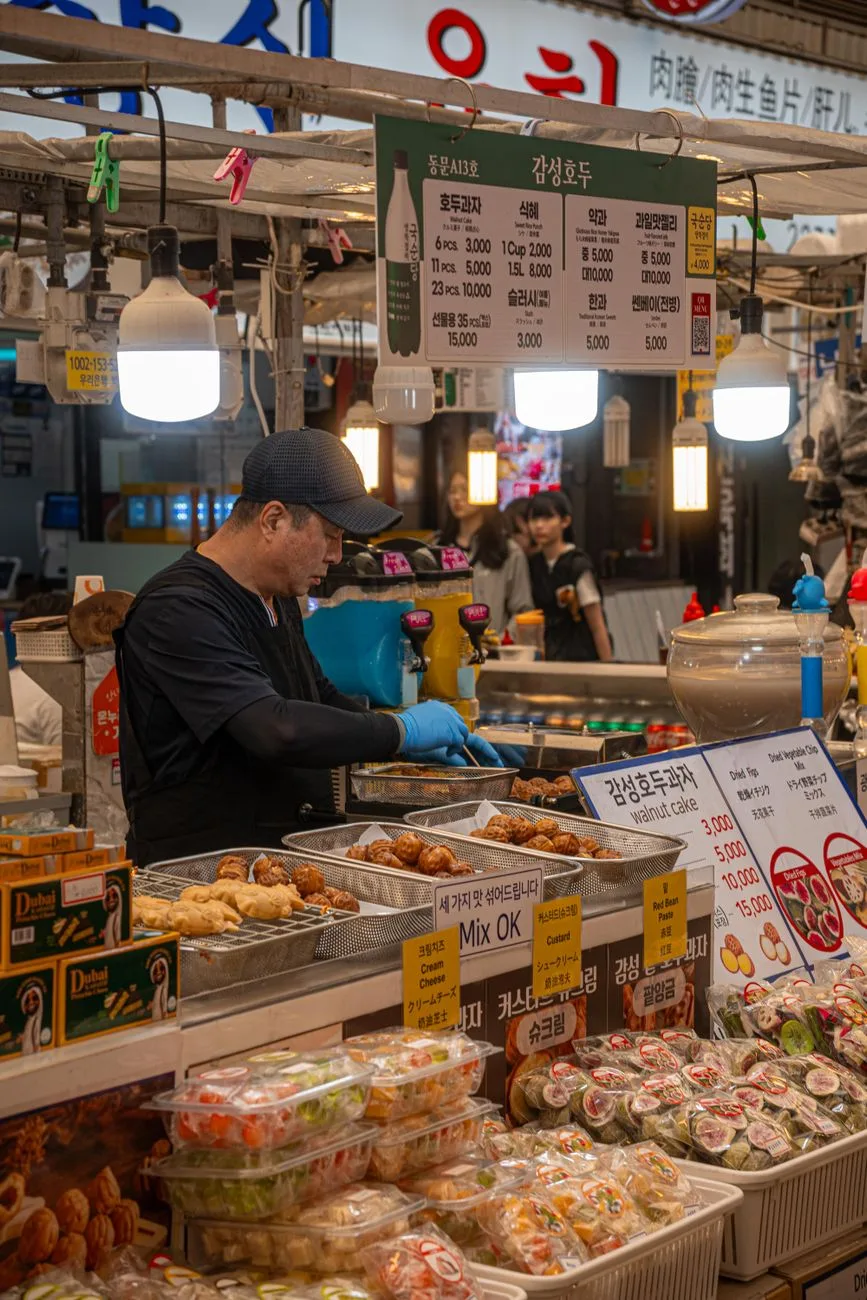
Market eating sits below all of it. An evening of stall food at Gwangjang Market, which has operated since 1905, runs ₩15,000 to ₩25,000 per person with drinks according to market guides. No government body surveys street food prices, so treat that as an approximation rather than a published figure.
Accommodation: why the "average Seoul hotel rate" misleads
STR data reported in October 2025 put the average daily rate across the Seoul–Incheon market at about ₩296,000 for September 2025, up 14.6% year on year, with occupancy above 80%. That number gets quoted constantly and it is close to useless for planning, because it averages the whole inventory including Four Seasons Seoul above ₩900,000 and Signiel Seoul from ₩1,000,000 on weekends.
What a traveller actually books, using 2026 guide-level figures rather than official statistics: hostel dorms near ₩34,000, three-star rooms near ₩70,000, business and budget hotels between ₩80,000 and ₩150,000, upper-tier properties around ₩230,000. The ₩120,000 used in the worked example is a mid-band business hotel in a central district.
Neighbourhood moves this more than star rating does, and the choice interacts with your transit budget. Our guide to where to stay in Seoul the first time compares Myeongdong, Jongno and Hongdae on exactly that trade-off.
Entry paperwork, and the fees that aren't fees
Two administrative items apply to every one-week visitor, and only one of them ever costs money.
The K-ETA is currently waived. The Ministry of Justice extended the temporary exemption for 22 countries and regions, including the United States, Canada, Australia, Germany and Japan, through 31 December 2026. If you hold one of those passports and travel this year, you pay nothing and apply for nothing. That waiver lapses on 31 December 2026. Anyone planning a 2027 trip should assume the ₩10,000 non-refundable fee listed on the K-ETA portal applies again unless a further extension is announced.
The e-Arrival Card became mandatory for all foreign nationals on 1 January 2026, replacing the paper card. It is free, submitted online at e-arrivalcard.go.kr within the 72 hours before you land. Budget zero won and ten minutes.
On the way out, the tax refund is worth real money if you shop. The threshold is ₩15,000 per receipt, with immediate in-store refunds available on single payments between ₩15,000 and ₩1,000,000 provided total trip spending stays under ₩5,000,000. Goods must be unused and you must depart within three months. Cosmetic and aesthetic procedures lost their refund eligibility on 1 January 2026.
Entry fees to the big sights are low enough to barely register. Gyeongbokgung is ₩3,000, Changdeokgung ₩3,000 with a separate ₩5,000 for the Secret Garden, and the integrated ticket covering four palaces and Jongmyo is ₩6,000, valid six months, per the Korea Heritage Service. Anyone in hanbok enters free, which is why the rental shops cluster outside the gates. Note that these fees have been frozen at ₩3,000 since 2005, and the National Heritage Service said on 5 August 2026 it will announce new admission standards in November 2026 to apply from 1 January 2027. The ₩6,000 combined ticket is in its final months.
When you go moves the price more than how you travel
Season swings airfare by roughly $900 and hotel rates by a similar proportion, which dwarfs every optimisation in the sections above.
| Window | Seoul temps (°C) | Rain | Flights (US round trip) | Go |
|---|---|---|---|---|
| Mid-Sep to mid-Oct | 10–26 | 140mm Sep | Cheaper months | Yes |
| Early May to early Jun | 13–27 | 105mm May | Mid | Yes |
| Jul to Aug | 22–30 | 415mm Jul | Mid | No |
| December | −4 to 4 | 25mm | $1,490 avg, peak | No |
| Jan to Feb | −6 to 5 | Driest | Cheapest | Optional |
The table reads as one recommendation: mid-September to mid-October is the window where good weather and cheap flights overlap, using Seoul's 1991–2020 climate normals and Kayak's month-by-month averages. July is the monsoon, with 415 mm of rain and 16 wet days. December is both the coldest month and the most expensive to fly into, at a $1,490 average from the US.
One date to route around this autumn: Chuseok falls on 24–26 September 2026. Palaces and department stores stay open, but the entire country moves at once, and intercity trains and highways clog for the better part of a week. If your dates are fixed and they collide, keep the trip inside Seoul and use short day trips from Seoul instead of a long-haul rail leg.
Five ways a one-week budget goes wrong
- Pricing the trip at the government's ₩934,000 average. That figure is a short-haul average and excludes airfare entirely.
- Buying a rail pass for a single intercity return. It loses by ₩22,200 on the standard Seoul–Busan week.
- Taking a taxi from Incheon. ₩31,000 to ₩58,500 plus a ₩7,900 toll, against ₩4,750 on the AREX All-Stop.
- Booking the private room by reflex. Sharing takes ₩360,000 out of a six-night mid-range week.
- Using an old exchange rate. The won moved about 5% in the month to 14 August 2026 alone. On a ₩1,180,300 budget, 5% is $42.
The exception to all of this: if your week is built around one high-cost activity, a multi-day festival, a Jeju flight, a hanbok-and-studio photo day, the arithmetic above stops describing your trip. It is a sightseeing-and-eating baseline, not a ceiling.
Prices in this article carry the date they were checked because most of them change monthly. This is general planning information rather than personalised financial advice, and the figures should be treated as a starting estimate for your own booking.
Questions people ask before booking
Is $2,000 enough for a week in South Korea?
Yes, if you share a room and avoid December. The mid-range shared-room week comes to $579 on the ground plus $1,058 in average round-trip US airfare, leaving roughly $363 for shopping and upgrades. Travelling solo in a private room, the same week reaches $1,891 and $2,000 becomes tight.
How much does food cost per day in Seoul?
Budget ₩20,000 to ₩34,000 per person per day for normal eating. The Korea Consumer Agency's April 2026 Seoul averages put gimbap at ₩3,800, jajangmyeon at ₩7,731, a kimchi jjigae set at ₩8,654 and bibimbap at ₩11,692. Barbecue pushes a single dinner past ₩30,000.
Do I need a K-ETA for a one-week trip?
Not in 2026 if you hold one of the 22 exempted passports, which include the US, Canada, Australia, Germany and Japan. The Ministry of Justice waiver runs to 31 December 2026. You do need the free e-Arrival Card, submitted within 72 hours before you land, regardless of nationality.
Is the KORAIL Pass worth it for one week?
Only above three intercity high-speed legs. A two-day pass listed near ₩131,000 loses to a ₩108,800 Seoul–Busan return bought as ordinary tickets. Since the 1 September 2026 fare cut, individual KTX tickets have gotten cheaper while the pass has not, which widens the gap.
Is Korea cheaper than Japan right now?
The cost-of-living indices disagree and you should not trust a single one. Expatistan's July 2026 comparison puts Seoul 36% below Tokyo; Numbeo and other 2026 comparisons put Seoul slightly above Tokyo. The methodologies weight housing very differently. For a one-week visitor, the meaningful comparison is the two lines that dominate this budget, your specific hotel rate and your specific airfare, both of which you can price directly before you commit.