A seven-day solo trip to South Korea costs about ₩388,000 (US$274) staying in hostel dorms, ₩1,440,000 (US$1,016) at business-hotel level, and ₩2,670,000 (US$1,885) in comfort, flights excluded, converted at ₩1,417 to the dollar on 13 August 2026. Travelling alone adds around ₩450,000 to the hotel-level week, almost all of it the unshared room.
The four numbers that set a solo budget
- ₩55,500 a day is the realistic hostel-level floor in Seoul once transport and admissions are counted, not the ₩30,000 a dorm bed suggests.
- ₩450,000 is the single-room premium over six nights, about 31% of a mid-range week.
- ₩119,600 buys a Seoul–Busan KTX return, against ₩186,000 for a 3-day KORAIL Select Pass. One person doing one intercity round trip should not buy the pass.
- ₩15,000 is the per-receipt minimum for a VAT refund, which is claimed per passport and so costs a solo traveller nothing extra.
What a South Korea solo trip cost looks like, line by line
The table prices one itinerary at three levels: six nights based in Seoul, seven days on the ground, with a Busan return by KTX at the two higher levels. Flights are excluded because airfare aggregator quotes for the same US–Incheon route ranged from a $313 deal floor to a $711 season low in August 2026, which makes any single number misleading.
| Line item (7 days / 6 nights) | Budget (KRW) | Mid-range (KRW) | Comfort (KRW) |
|---|---|---|---|
| K-ETA fee + T-money card | 12,500 | 12,500 | 12,500 |
| Airport transfer, return | 9,500 | 26,000 | 26,000 |
| Accommodation, 6 nights | 180,000 | 900,000 | 1,776,000 |
| Food, 7 days | 133,000 | 308,000 | 532,000 |
| Local transport, 7 days | 43,400 | 43,400 | 105,000 |
| Seoul–Busan KTX return | 0 | 119,600 | 119,600 |
| Attractions | 10,000 | 30,000 | 100,000 |
| Total | 388,400 | 1,439,500 | 2,671,100 |
| Per day | 55,486 | 205,643 | 381,586 |
The budget column stays in Seoul: adding the Busan return would push it to ₩508,000 ($358), because a single KTX round trip costs more than three nights in a dorm. The mid-range daily figure of ₩205,643 looks high against the ₩80,000–100,000 "solo sweet spot" quoted across travel blogs, and the difference is entirely the hotel room. Strip lodging out and the mid-range day drops to ₩77,000, which lands inside that range.
Here is how the mid-range column is built, so the assumptions are visible. Accommodation assumes ₩150,000 a night for a standard Seoul business hotel, about half the ₩296,000 average daily rate STR recorded for the Seoul–Incheon market in September 2025. That ADR is a 2025 figure covering all hotel classes, so it works as a ceiling reference rather than a 2026 rate.
Food assumes a ₩5,000 convenience-store breakfast, a ₩13,000 lunch (Numbeo's Seoul inexpensive-restaurant figure, dataset refreshed 13 August 2026), a ₩20,000 dinner, and one ₩5,759 cappuccino: ₩43,759, rounded to ₩44,000 a day, times seven equals ₩308,000. Local transport assumes four subway taps a day at the ₩1,550 T-money adult base fare: ₩6,200 daily, ₩43,400 for the week. Note that Seoul's ₩62,000 monthly transport pass loses to pay-as-you-go over seven days by ₩18,600.
For a broader three-tier breakdown that is not solo-specific, our line-by-line Korea 7-day trip cost piece covers the same ground for couples and pairs.
The solo premium: what one person pays that two people split
The room is the whole gap
A double room in Seoul costs the same whether one or two people sleep in it. At the ₩150,000 assumption above, six nights cost ₩900,000 solo and ₩450,000 each when shared. That single line is 31% of the mid-range total, and it is the only large cost in a Korea trip that does not scale per person.
The answer is the dorm bed, priced at ₩20,000–40,000 a night across Hongdae, Myeongdong and Jongno, with a competing published range of ₩25,000–45,000 and a reported Seoul average of about $21. Advertised floors as low as $4 exist and are not representative of a bookable bed in a central district. This is where the advice fails: a solo traveller who will not share a room loses the budget tier entirely, and their floor becomes the mid-range number, not a discounted version of it. Choice of district changes the rate more than choice of week, which our guide to picking a Seoul district by cost and transfers works through.
Taxis, and what 23:00 does to them
Seoul sedan taxis start at ₩4,800 for the first 1.6 km, then ₩100 per 131 m or ₩100 per 30 seconds, as listed by the Seoul Metropolitan Government. A 6 km ride works out at ₩4,800 plus 34 distance increments of ₩100, so ₩8,200 before any time-based charge in traffic.
Between 23:00 and 02:00 the base rises to ₩6,700 and the increment to ₩140, making the same 6 km ₩11,460. Two people split that. One person does not. Against a ₩1,550 subway fare, a nightly late taxi home from Hongdae adds close to ₩70,000 across a week for a solo traveller. Base fares are lower outside the capital: ₩4,600 in Gangwon State, ₩4,500 in Daegu and Ulsan, ₩4,300 in Daejeon and Jeju.
One caution on the official figures: the Seoul city page quotes ₩7,000 as the deluxe-taxi base for the first 3.0 km, while the Korea Tourism Organization's own fare page quotes ₩6,500 for the same 3 km. Two government bodies disagree, so budget the higher of the two.
The rail pass math turns against one traveller
KORAIL's Saver Pass discount of up to 10% requires a group of two to five people, so it is closed to solo travellers by design. That leaves the Select Pass, listed by resellers for 2026 at ₩131,000 for two days, ₩186,000 for three, ₩234,000 for four and ₩275,000 for five. KORAIL's own pass pages return HTTP 404 as of August 2026, so those prices are reseller-listed rather than operator-published.
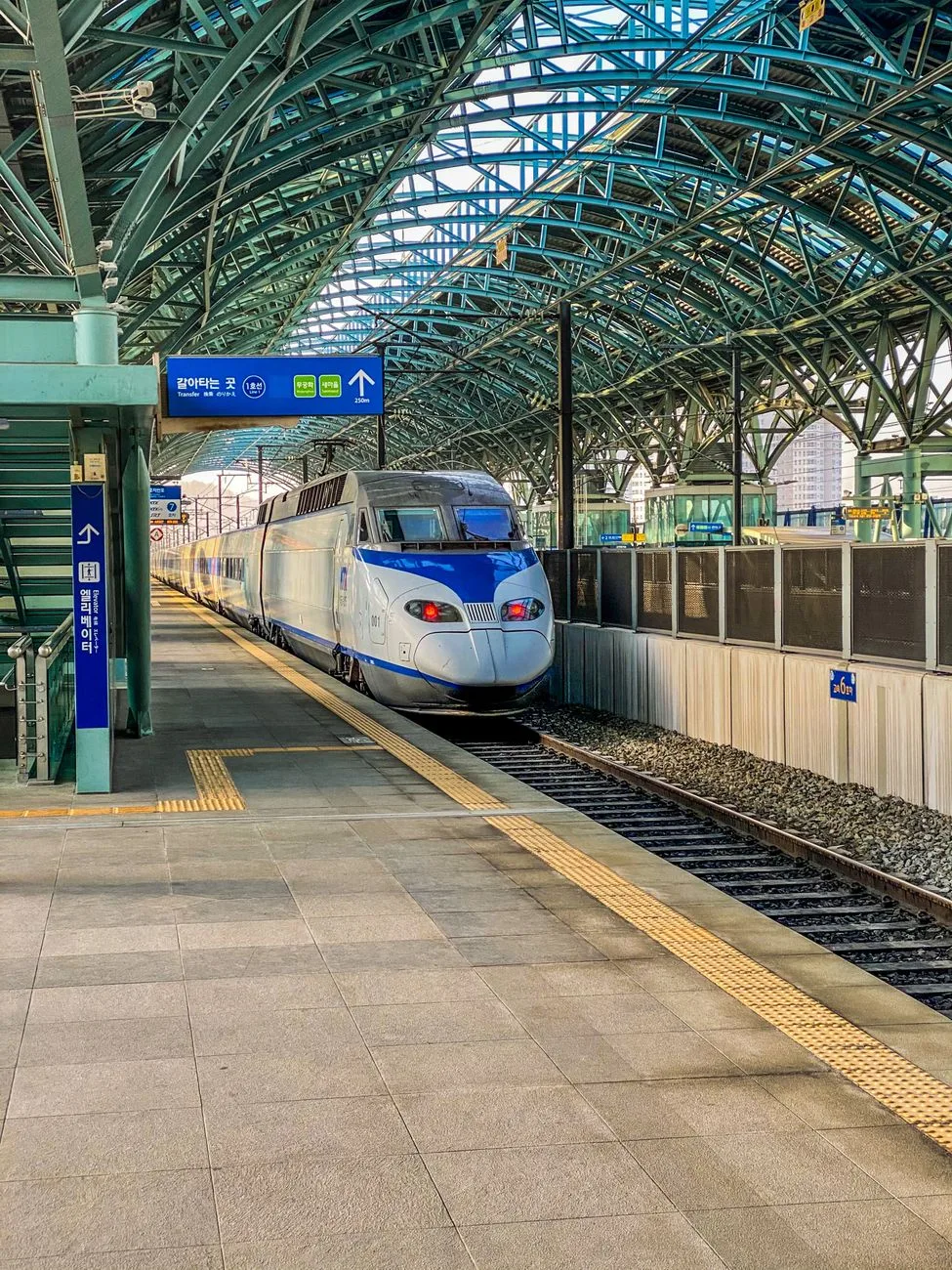
Run the break-even against a Seoul–Busan KTX seat at ₩59,800 each way, 2 h 15 min. Two legs cost ₩119,600, which beats the 2-day pass by ₩11,400. Three legs cost ₩179,400, still under the 3-day pass. Four legs cost ₩239,200, and only there does the 3-day pass at ₩186,000 win, by ₩53,200. The verdict: buy point-to-point tickets unless your solo itinerary contains four or more intercity legs of Busan length. Shorter corridors change the arithmetic, and our Seoul to Gwangju fare comparison shows one worked case. For same-day returns, the three-hour rule for day trips from Seoul is the cheaper structure.
Eating alone without paying the two-portion tax
Korean restaurant menus commonly price shared dishes for two servings minimum, which quietly excludes solo diners from samgyeopsal, jjimdak and budae jjigae unless the restaurant explicitly serves 1인분. Ordering two portions to eat alone doubles a ₩20,000 dinner.
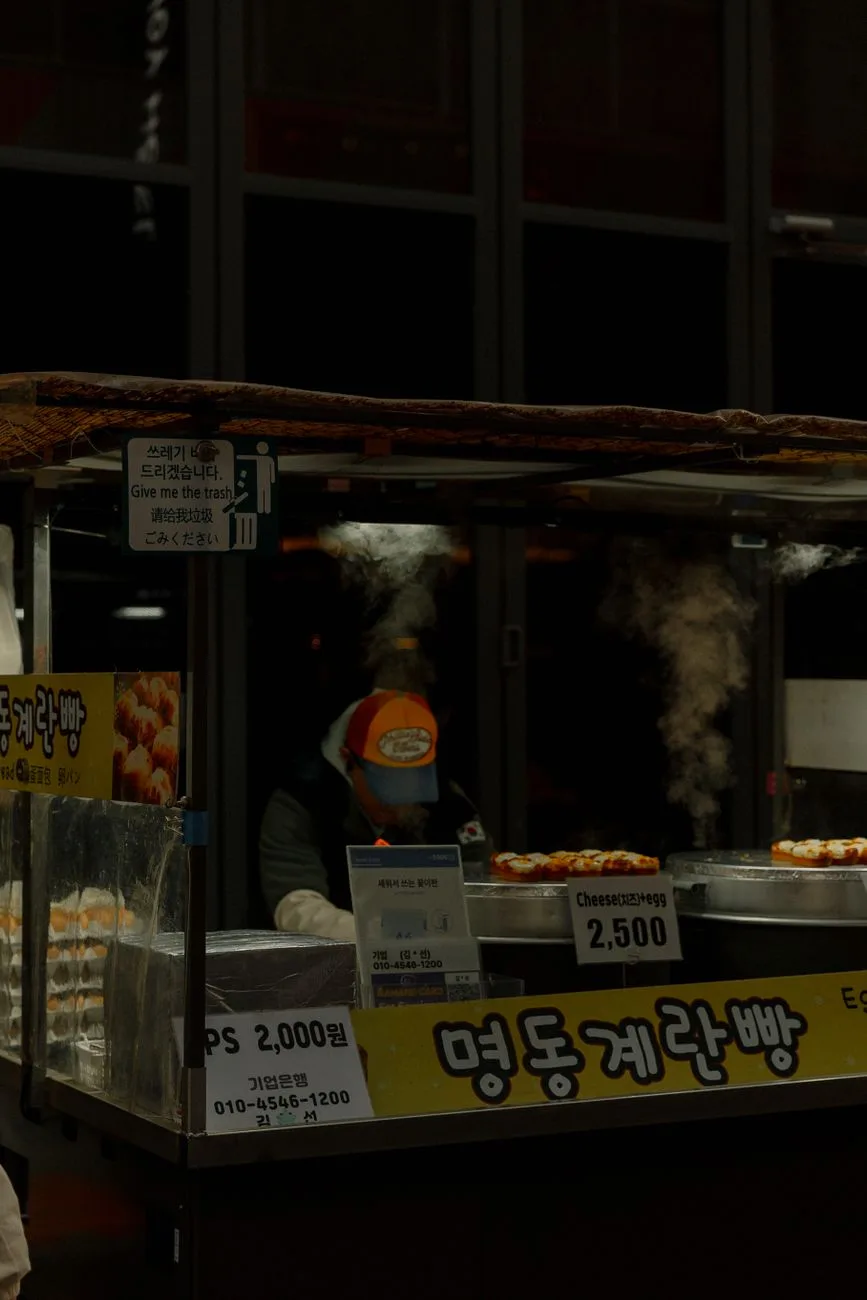
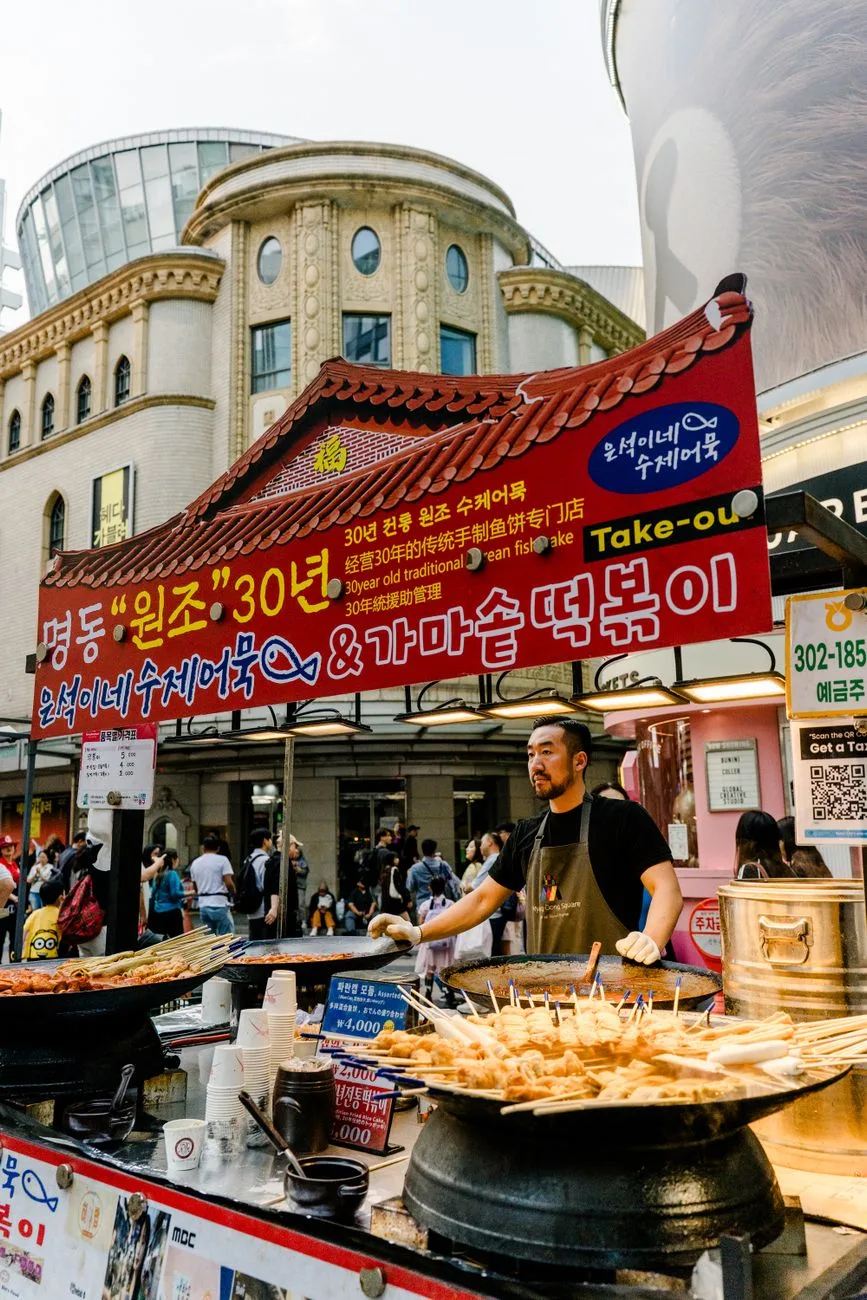
The categories built for one person are bunsik, gimbap, noodle shops and street food. A full gimbap roll runs under ₩5,000 at small restaurants. In Myeongdong, tteokbokki is around ₩5,000, japchae ₩6,000, fried dumplings ₩5,000–7,000, egg bread ₩2,000, and a whole evening of grazing lands at ₩15,000–20,000. Hotteok is quoted at ₩1,500–2,000 per piece in Myeongdong against ₩3,000–5,000 in some non-tourist listings, which runs against the usual tourist-premium logic and is worth knowing before assuming central Seoul is always dearer.
For scale, South Korea's 2026 minimum wage is ₩10,320 an hour, set by the Minimum Wage Council, so a ₩13,000 restaurant lunch is about 1.3 hours of minimum-wage work. That is the local yardstick for whether a price is high. Where to spend the dinner budget is covered in our look at which Seoul restaurant recommendations hold up.
Fixed costs that ignore how many of you there are
Three costs land on every arriving traveller regardless of group size. The K-ETA application fee is ₩10,000, non-refundable, described on the official portal as roughly US$7–8. Korea's Ministry of Justice extended a temporary K-ETA exemption through 31 December 2026 for eligible nationals, but published counts of who is covered disagree sharply: one immigration advisory describes 22 countries under the Visit Korea Year programme, while a travel-policy tracker reports 67 countries and territories. The official portal does not publish the list, so run your passport through the exemption checker on k-eta.go.kr rather than trusting either count.
The AREX express from Incheon to Seoul Station is a flat ₩13,000 for a 43-minute non-stop run, with discounted online tickets around ₩11,500. The all-stop train is priced like the subway and reaches Seoul Station for about ₩4,750, taking longer for a ₩8,250 saving each way. A T-money card costs ₩2,500–4,000 at convenience stores and station machines, and since March 2026 it can be loaded into Apple Wallet and tapped through gates with an iPhone. Broader arrival admin is covered in what to know before visiting Seoul.
Getting money back: the ₩15,000 VAT refund floor
The refund is claimed per passport, so a solo traveller recovers exactly what a couple would recover each. According to VisitSeoul, the official Seoul travel guide, the minimum qualifying purchase is over ₩15,000, immediate in-store refunds are capped at under ₩1,000,000 per single purchase and under ₩5,000,000 across the trip, and eligibility covers foreign visitors in Korea less than six months. Purchases must be made within three months of departure, and goods shown to customs before you fly.
Two practical catches. Individual shops can set their own floor higher than the statutory one, and ₩30,000 is a common shop-level minimum, so consolidate small cosmetics buys onto one receipt instead of paying separately. Second, cosmetic surgery and aesthetic laser procedures lost refund eligibility on 1 January 2026, which removes a line item some medical-tourism budgets still assume.
Timing: what the 2026 calendar does to a solo budget
Single rooms are the first inventory to disappear and the last to be discounted, which makes date choice a cost decision for one person. The Ministry of Culture, Sports and Tourism reported 10.71 million foreign visitors in the first half of 2026, up 21% year on year, with foreign card spending passing 10 trillion won three months earlier than in 2025. Demand is not softening.
Avoid Chuseok, which falls on Friday 25 September 2026 with the holiday running 24–26 September; no bridge day was added and Monday 28 September is a normal working day, per the Korea Tourism Organization's 2026 holiday list. Busan is the wrong bet for cheap rooms during the 31st Busan International Film Festival, 6–15 October 2026.
Two free festivals sit in that window and cost a solo traveller nothing but the fare: the Andong International Maskdance Festival, 24 September to 4 October 2026, and the Jinju Namgang Yudeung Festival, 3–18 October 2026, both listed as free admission by the Korea Tourism Organization. On foliage, the Korea Meteorological Administration had not published its 2026 forecast as of mid-August; it normally appears in early September. Third-party projections put peak colour in the northern mountains around 12–15 October and Seoul's own peak in the 5–15 November window, with ginkgo turning slightly before red maple.
Seoul's climate normals explain the pricing pattern: July alone brings 414.4 mm of rain against 16.8 mm in January, and June to August carries about 63% of the annual 1,417.9 mm. August averages 26.1 °C, January −1.9 °C. Cheap rooms in midsummer are cheap for a reason. If you are pairing countries, our note on when Korea and Japan's seasons line up covers the overlap.
One currency caveat: the won traded at 1,417.43 to the dollar on 13 August 2026, but the 2026 year-to-date average was 1,485.30 and the year's high reached 1,559.36. Budgeting at the annual average rather than the spot rate builds in a margin. The Federal Reserve publishes the official daily won series in its weekly H.10 release. This article is general information about costs, not personalised financial advice, and every figure carries the date it applies to for that reason.
Three purchases that rarely pay off for one person
Hanbok rental for free palace entry. Full hanbok gets free admission to all paying palace sites year-round, and rental near the palaces runs ₩15,000–25,000 for four hours, often with hairstyling. The tickets it replaces are worth ₩10,000 with the Integrated Palace Ticket, or ₩14,000 bought separately across Gyeongbokgung, Changdeokgung, Secret Garden, Deoksugung, Changgyeonggung and Jongmyo. The rental never breaks even on admissions alone. Rent it for the photographs, not the saving.
The Discover Seoul Pass on a palace itinerary. Reseller prices sit at ₩35,900 for 24 hours and ₩49,500 for 48 hours, covering 70-plus attractions plus a T-money card and eSIM. Clearing ₩35,900 of admissions in one day is easy at tower-and-theme-park venues and impossible at palaces, where a full day of five sites plus Jongmyo costs ₩10,000. Match the pass to the venue type, not to the trip length. Official KRW prices for the 72-hour, 120-hour and Pick 3 versions are not published in a readable form on the pass site, so those tiers are harder to break-even test.
The monthly transport pass. At ₩62,000 it needs 41 taps to beat single fares. A seven-day itinerary at four taps a day reaches 28.
One free option beats all three: admission to the palaces is free for everyone on Culture Day, the last Wednesday of every month. A solo traveller with flexible dates can build the palace day around it and spend the ₩10,000 elsewhere.
Solo trip cost questions people ask next
How much money do I need per day for a solo trip to South Korea?
Budget ₩55,000 a day at hostel level in Seoul, ₩206,000 at business-hotel level, and ₩382,000 in comfort, all including lodging. Excluding lodging, the mid-range day falls to ₩77,000. Published backpacker benchmarks of ₩45,000–60,000 a day match the hostel figure closely once admissions are added.
Do I need a K-ETA for a solo trip in 2026?
It depends on your nationality. The fee is ₩10,000 if you do need one, and Korea's Ministry of Justice extended a temporary exemption through 31 December 2026 for eligible nationals. Published counts of covered countries range from 22 to 67, and the official portal does not list them, so the exemption checker on k-eta.go.kr is the only reliable answer.
Is the KORAIL Pass worth it for one person?
Not for a standard Seoul-plus-one-city trip. A Seoul–Busan return costs ₩119,600 against ₩131,000 for the 2-day Select Pass. The 3-day pass at ₩186,000 only wins above three Busan-length legs. Solo travellers also cannot use the Saver Pass, which requires a group of two to five.
How much should I budget for food alone in Seoul?
₩19,000 a day eating convenience-store breakfasts, gimbap lunches and street-food dinners; ₩44,000 a day with one restaurant lunch at ₩13,000, a ₩20,000 dinner and a ₩5,759 coffee; ₩76,000 a day at mid-range restaurants. The constraint is not price, it is the two-portion minimum on shared dishes.
Is Seoul cheaper than Tokyo for a solo traveller?
The two main cost-of-living indices contradict each other outright. Numbeo's 13 August 2026 comparison puts Tokyo 21.7% cheaper than Seoul excluding rent, while Expatistan's July 2026 data says Seoul is 36% cheaper than Tokyo. At the line-item level Numbeo shows a cheap restaurant meal at ₩13,000 in Seoul against ₩10,670 in Tokyo, but a one-way transit ticket at ₩1,550 against ₩1,867. Meals favour Tokyo, transport favours Seoul, and the totals are too close to choose a country on price. Choose on the itinerary instead.