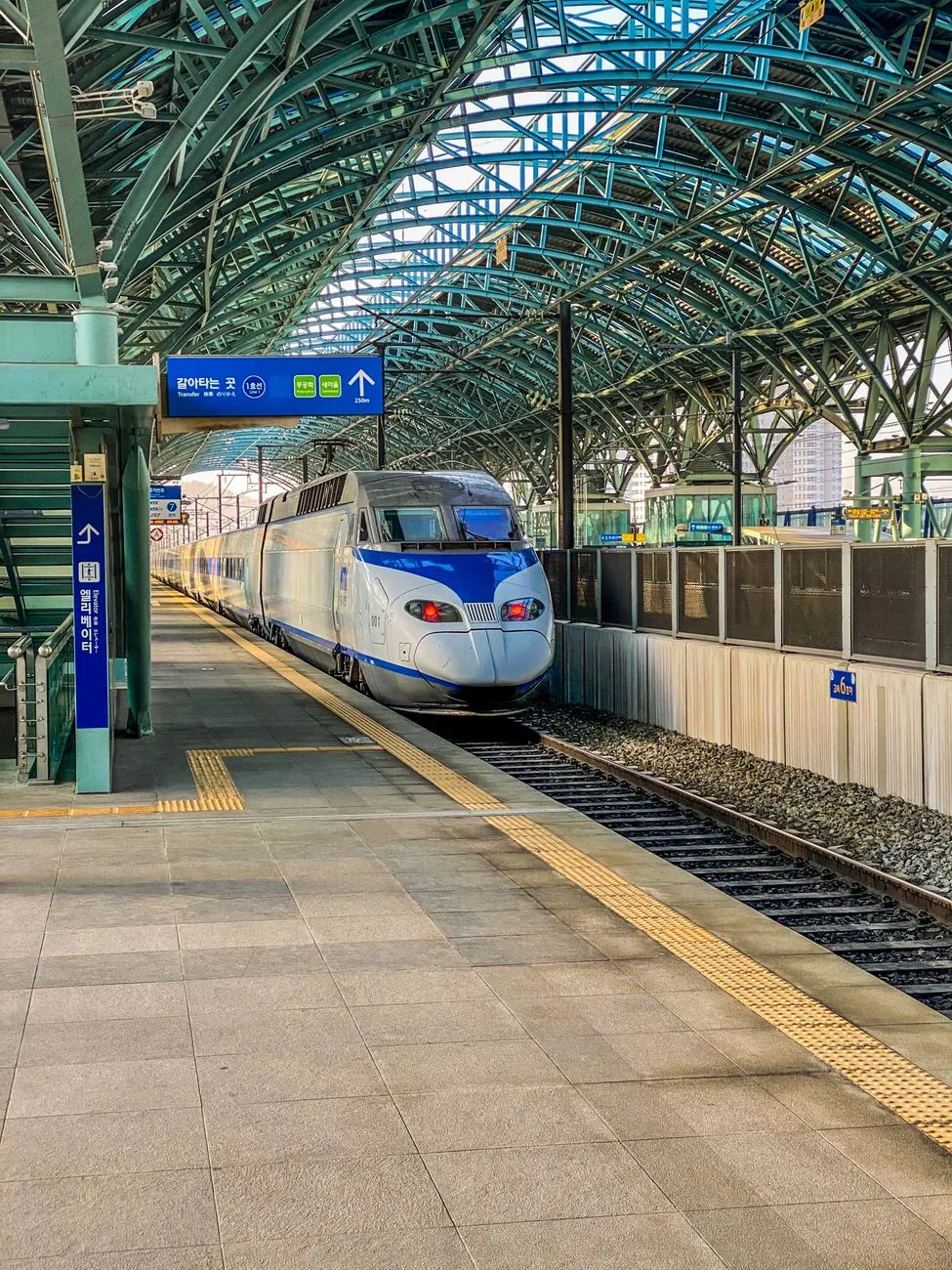
The fastest route is the KTX from Yongsan Station to Gwangju Songjeong: 2 hours 5 minutes for ₩46,800 as of August 2026, falling to a reported ₩42,000 on 1 September 2026. The express bus from Central City Terminal to U-Square costs about ₩29,300 in 우등 class and takes 3 hours 20 minutes.
Four things decide this trip:
- Fares on this corridor change on 1 September 2026, when Korail absorbs SRT operations and the SRT brand is replaced by KTX-산천.
- The KTX does not stop in central Gwangju. It stops at Gwangju Songjeong, 20 minutes from Geumnamno 4-ga on Metro Line 1.
- The bus saves about ₩17,000 and costs about 75 minutes of your day.
- Chuseok falls Thursday 24 to Saturday 26 September 2026, and the Gwangju Biennale runs 5 September to 15 November. Both empty the seat map.
The four ways from Seoul to Gwangju, side by side
This table answers one question: what does each option cost, how long does it take, and where does it leave you?
| Service (Seoul departure) | Fare (KRW, Aug 2026) | Journey | Departures/day | Arrives at |
|---|---|---|---|---|
| KTX from Yongsan | 46,800 | 2h 05m | 29 | Gwangju Songjeong |
| KTX-청룡 from Yongsan | 47,100 | 1h 39m | Limited | Gwangju Songjeong |
| SRT from Suseo | 40,700 | 1h 50m | 20 | Gwangju Songjeong |
| Express bus, 우등 class | 29,300–30,800 | 3h 20m–3h 41m | 97–103 | U-Square |
| ITX-새마을 from Yongsan | 34,300 | about 4h | 5 | Gwangju Station |
| 무궁화호 from Yongsan | 23,000 | 4h 42m | 1 | Gwangju Station |
The real choice is two-way: high-speed rail into Gwangju Songjeong on the western edge of the city, or a bus into a terminal that already sits inside it. The two conventional trains are slower than the bus and dearer than the cheapest bus class, so they only earn a place when Gwangju Station itself is the destination.
Flying is not a working option. Korean Air closed the Gwangju–Gimpo route in March 2016, and although flight aggregators still list a Gimpo connection, the Korea Airports Corporation pages for Gwangju Airport publish no Gimpo schedule. Almost all departures from Gwangju Airport go to Jeju. If you want to confirm before writing off the idea, the airport's information line is 1661-2626, open 06:00 to 23:00 daily.
KTX from Yongsan: 29 departures, and one train that does it in 1:39
Yongsan is the Honam-line high-speed terminus, not Seoul Station. As of 13 August 2026, 29 KTX services a day run Yongsan to Gwangju Songjeong, the first at 05:08 and the last at 22:23, with 31 running back the other way.
The headline 2 hours 5 minutes is an average, and it hides a wide spread. Individual departures on this route range from 1 hour 36 minutes to 3 hours 8 minutes depending on how many intermediate stops the train takes at Cheonan-Asan, Osong, Iksan and Jeongeup. The newer KTX-청룡 sets do it in 1 hour 39 minutes for ₩47,100, which is ₩300 more than a standard KTX ticket for roughly 26 minutes saved. That is the best-value upgrade on the whole corridor.
Gwangju Metropolitan City prints the full Honam-line high-speed timetable on its transport pages, and Korail's own timetable and reservation system is where the seat map lives. Both list the specific train number, which matters more here than the average journey time.
What changes on 1 September 2026
The Korail–SR corporate combination received final approval on 3 August 2026, according to the government policy briefing published on korea.kr. Three things follow from it.
First, fares fall. Korail's briefing put the average KTX reduction at 10%, and Kyunghyang Shinmun and Financial News both reported on 5 and 6 August 2026 that Yongsan to Gwangju Songjeong drops from ₩46,800 to ₩42,000, a cut of ₩4,800. Seoul to Busan was quoted in the same reports as falling from ₩59,800 to ₩54,400.
One caveat worth knowing before you count on the number: the government briefing describes fares being aligned to SRT levels phased over three years and gives no won figures at all, while the newspaper reports present ₩42,000 as effective on 1 September. Korail had not published a post-integration fare table for this route as of 13 August 2026. Book the September ticket and the price at checkout settles it.
Second, capacity rises. Daily high-speed services go from 379 to 402 on weekdays and 431 to 457 at weekends, adding 15,679 seats a day midweek and 17,655 at weekends.
Third, the branding changes. SRT becomes KTX-산천, Suseo departures start earning the KTX 5% mileage on the amount paid, and a through journey that continues onto a conventional train gets 30% off that leg. Booking moved to the unified 코레일+ (Korail+) app, which launched at 09:00 on 3 August 2026; tickets for integrated post-September trains went on sale at 10:00 on 5 August. If you are still installing travel software before the flight, our guide to the Korea travel apps worth having before you land covers what actually works on a foreign phone number.
SRT from Suseo: cheaper today, and closer if you are staying in Gangnam
Suseo to Gwangju Songjeong costs ₩40,700 in standard class and takes about 1 hour 50 minutes, with 20 departures a day and 22 in the return direction. That is ₩6,100 less than the KTX for a slightly quicker trip, which is why anyone based south of the river should check Suseo first. SR publishes its own fare and timetable archive, most recently dated 15 May 2026, and staffs a customer line on 1800-1472.
From 1 September the SRT name disappears from this route. The trains, the platforms at Suseo and the schedule continue; the ticket says KTX-산천 instead.
Express bus to U-Square: buy it for the overnight, not for the fare
The Gwangju bus leaves from Central City Terminal in Seocho-gu, the Honam-line side of the Express Bus Terminal complex, and arrives at U-Square, the combined terminal in Gwangcheon-dong. Between 97 and 103 departures a day run in that direction, the first at 00:45 and the last at 23:50, with the return service starting at 01:30.
Fares depend on the class, and the published figures do not agree. KOBUS does not print a fare table on its public route pages, and the two main timetable aggregators list 고속 at ₩19,800 or ₩20,800, 우등 at ₩29,300 or ₩30,800, and 프리미엄 anywhere from ₩36,100 to ₩48,000. The KOBUS booking portal shows the binding price at checkout, and that is the figure to trust.
The night services are where the bus stops being a budget compromise. 심야우등 is listed at ₩32,200, or ₩35,100 with the late-night surcharge, which is more than the daytime 우등 seat. Nobody takes the 00:45 to save money. They take it because a departure after midnight and an arrival before dawn removes a hotel night from the trip, and at Gwangju room rates that is a clear win. Treat the night bus as a bed with wheels, and the daytime bus as a straight ₩17,000 trade against 75 minutes.
Gwangju Station and Gwangju Songjeong are not the same place
This catches people who book by name. Gwangju Station (광주역) is the downtown station near Buk-gu. Gwangju Songjeong (광주송정역) is the high-speed station 14 km west in Gwangsan-gu. The KTX served Gwangju Station from 2004 until 2015 and no longer does, and the shuttle train that used to link the two stations about 30 times a day via Geungnakgang stopped running on 18 December 2023.
Six conventional trains a day still reach Gwangju Station from Yongsan, the first at 06:24 and the last at 20:03. Five are ITX-새마을 services (trains 1421 to 1429) at ₩34,300 reserved or ₩29,200 standing, taking about four hours. One is a 무궁화호 (train 1461) at ₩23,000 reserved or ₩19,600 standing, taking 4 hours 42 minutes. Child fares run ₩11,500 to ₩17,100 and senior fares ₩16,100 to ₩24,000.
At ₩34,300 for four hours, the ITX loses to the express bus on price and on time. Book it only when your destination genuinely sits near Gwangju Station, or when high-speed seats are gone.
Worked example: Myeongdong to downtown Gwangju, priced both ways
The Seoul-side subway ride costs the same base fare whether you head to Yongsan, Suseo or Central City, so it cancels out of the comparison. What does not cancel out is the last mile in Gwangju.
By KTX, before 1 September 2026: ₩46,800 for the train, plus ₩1,250 for Metro Line 1 from Gwangju Songjeong to Geumnamno 4-ga. Total ₩48,050, about 2 hours 25 minutes of moving time.
By KTX, from 1 September 2026: ₩42,000 plus ₩1,250 = ₩43,250.
By 우등 bus: ₩29,300 to U-Square, plus ₩1,250 from Nongseong station on the same Line 1. Total ₩30,550, about 3 hours 40 minutes.
The gap is ₩17,500 today for 75 minutes saved, which prices your time at ₩14,000 an hour. After the September cut it becomes ₩12,700 for the same 75 minutes, or ₩10,200 an hour. My call: take the train outbound, when the saved 75 minutes is a lunch and a museum, and take the bus back, when it is 75 minutes you were going to spend asleep anyway.
This reasoning breaks on the slow departures. A 3-hour-8-minute Yongsan KTX at ₩46,800 loses to the bus on both counts, so read the specific train number before you assume the fast average applies to your ticket.
One more piece of arithmetic, for visitors weighing a rail pass. A Seoul–Gwangju return at the August 2026 KTX fare is ₩93,600, below the ₩107,800 three-day adult KORAIL PASS price published for 2026. A single round trip does not justify the pass. A second intercity leg does. Pass pricing after the 1 September restructuring had not been published as of 13 August 2026. If Gwangju is one stop on a wider loop, our seven-day Korea trip cost breakdown sets the rail spend against everything else.
Getting from Gwangju Songjeong into the city
Gwangju Metro Line 1 runs 20 stations from Nokdong to Pyeongdong and calls at Gwangju Songjeong. Geumnamno 4-ga, the downtown stop for Chungjang-ro and the 5·18 Democracy Plaza, is 20 minutes away.
The fare system is flat rate across the whole network, unchanged since 1 August 2016: ₩1,250 by transit card or ₩1,400 for a single ticket for adults, ₩900 by card for ages 13 to 18, ₩500 for children aged 6 to 12, and free travel for passengers aged 65 and over, disabled passengers, veterans and under-6s. Gwangju Rapid Transit Corporation publishes the full fare guide, including a free subway-to-bus transfer within 30 minutes of tapping out and a 50% discount on one 마을버스 transfer. The old 1000 bus that linked the airport and the Songjeong interchange has been discontinued, so the metro is the connection.
If you land at Gwangju Songjeong with time before the next train or a hungry hour after arrival, 1913 송정역시장 is directly opposite the station exit, about a one-minute walk. Most stalls open from around 11:00 to 20:00, with later hours Friday through Sunday, and the market closes on the second and fourth Monday of each month. It is the practical place to eat 육전 or 떡갈비, the boneless pork-and-beef patty version that Gwangju is known for.
Dates that change the answer
Chuseok 2026 falls Thursday 24 to Saturday 26 September, with no substitute holiday, because the substitute rule triggers on a Sunday overlap rather than a Saturday one. In practice the country takes a four-day break through Sunday 27 September, and Honam-line seats are the first to go.
The 16th Gwangju Biennale, titled You Must Change Your Life under artistic director Ho Tzu Nyen, runs 5 September to 15 November 2026 at the Biennale Exhibition Hall. The 23rd 추억의 충장축제 takes over Chungjang-ro in Dong-gu from 7 to 11 October 2026. Autumn colour in Jeolla arrives early to mid November by the reckoning of regional travel guides; no dated 2026 foliage forecast from the Korea Forest Service or KMA had been published when this was written.
Gwangju sits well past the three-hour radius that makes a return trip comfortable in a single day, which is why it belongs on an overnight rather than the list of day trips from Seoul.
Questions people ask next
Is the KTX or the bus better for Seoul to Gwangju?
The KTX, for the outbound leg. It costs ₩17,500 more door to door as of August 2026 and saves 75 minutes, and the gap narrows to ₩12,700 once the 1 September fare cut applies. The bus wins for overnight departures and for return legs where the time saved has no use.
Does the KTX go to Gwangju Station?
No. High-speed trains terminate at Gwangju Songjeong in Gwangsan-gu. Gwangju Station has been served only by ITX-새마을 and 무궁화호 services since 2015, and the shuttle train between the two stations ended on 18 December 2023.
How much is the SRT from Suseo to Gwangju?
₩40,700 in standard class as of August 2026, taking about 1 hour 50 minutes, with 20 departures a day. From 1 September 2026 the same service runs under the KTX-산천 name after the Korail–SR integration.
Can I fly from Seoul to Gwangju?
Treat it as unavailable. Korean Air closed the Gwangju–Gimpo route in March 2016, and Korea Airports Corporation publishes no Gimpo schedule for Gwangju Airport. Jeju accounts for the overwhelming majority of departures there.
What happens to tickets bought before the merger?
Trains keep running on the same paths. Tickets for post-integration services went on sale through the 코레일+ app at 10:00 on 5 August 2026, and Suseo departures pick up KTX mileage and connecting-fare discounts from 1 September.
Fares, timetables and holiday crowds all move. Every figure above carries the date it was checked so you can see how old it is rather than guess whether it is wrong.