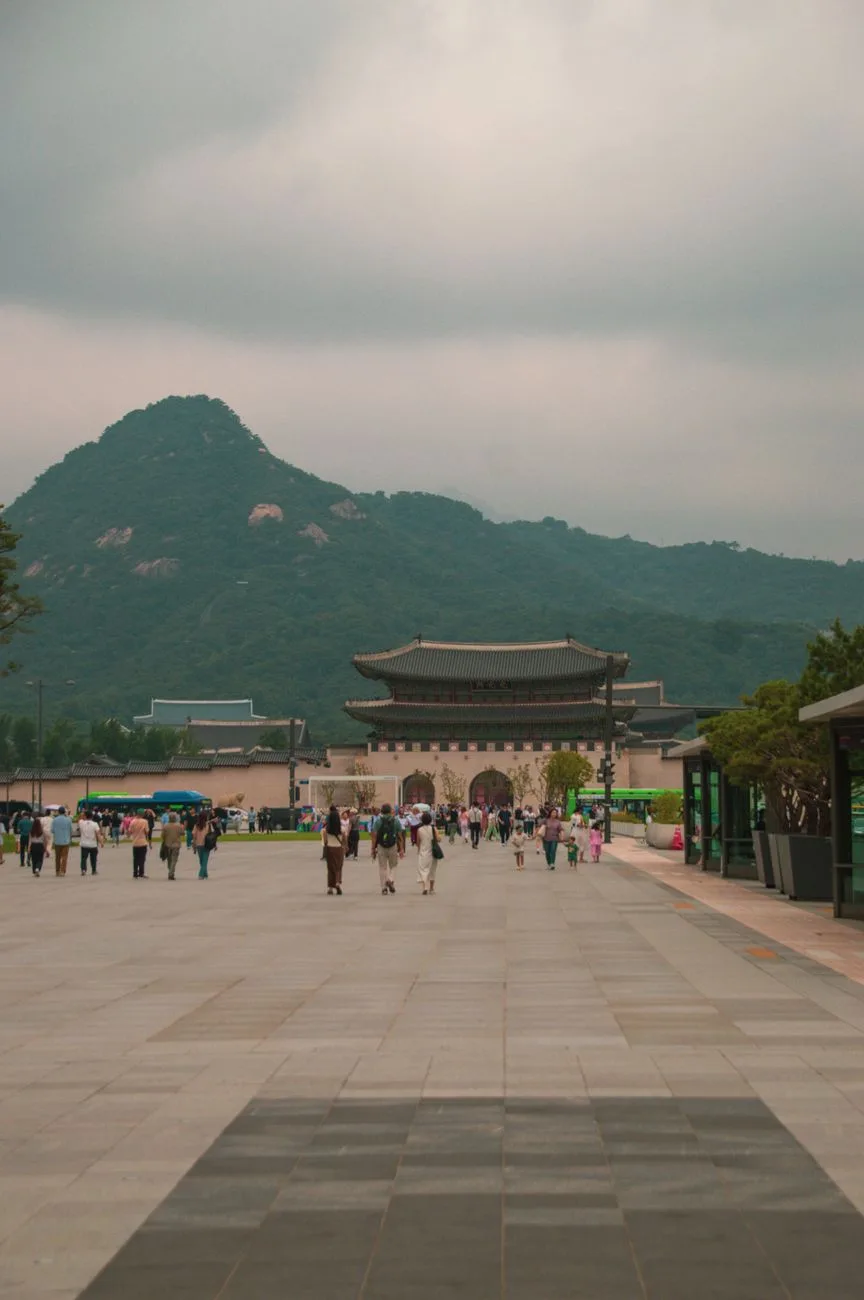
The most photographed lane in Bukchon Hanok Village is closed to visitors from 17:00, and standing on it after that carries a ₩100,000 fine.
Seoul's best photo spots are Gyeongbokgung Palace (₩3,000) at the 09:00 opening, Bukchon Hanok Village between 10:00 and 17:00, Starfield Library at COEX (free), the DDP LED rose garden from sunset, and the Banpo Bridge Rainbow Fountain at 20:00 in season. Four of those five cost nothing.
Four things that decide your day
- Palaces close on Tuesdays, and the Changing of the Royal Guard does not run that day either.
- Bukchon's Red Zone is enforced, with a ₩100,000 fine for tourist entry between 17:00 and 10:00.
- The two paid skyline observatories shoot through glass; the free viewpoints below them often produce the better frame.
- Seoul's admission prices are on the move: palace tickets rise on 1 January 2027.
The ₩100,000 rule in Bukchon, and where to shoot instead after 17:00
Jongno-gu designated Bukchon a Special Management Area and split it into Red, Yellow and Orange Zones according to how badly residents were being disrupted. The Seoul Metropolitan Government's notice on Bukchon visiting restrictions sets the Red Zone as Bukchon-ro 11-gil, about 34,000 m², where tourists are barred from 17:00 until 10:00 the following morning. The guidance period ran from 1 November 2024, and enforcement with a ₩100,000 fine started on 1 March 2025.
Bukchon-ro 11-gil is the descending alley with the tiled rooftops stacked toward Namsan, so this is the exact frame most people arrive for. It is open and free from 10:00 to 17:00. That is a seven-hour window, and it is the single hardest scheduling constraint in Seoul photography.
The rule fails to apply in one case: guests staying in accommodation on that lane, and people shopping in the area, are exempt. If a hanok stay in Bukchon is part of your trip, the evening light on that alley is legally yours. Our guide to choosing a Seoul district for a first visit covers what that trade-off costs in nightly rates.
The chartered-bus ban tightened separately. Buses are barred from Bukchon-ro, Bukchon-ro 5-gil and Changdeokgung 1-gil at all times including weekends, with fines of ₩300,000, ₩400,000 and ₩500,000 for a first, second and third violation. That enforcement began on 1 January 2026, which is why the lanes feel less congested at 10:00 than they did two years ago.
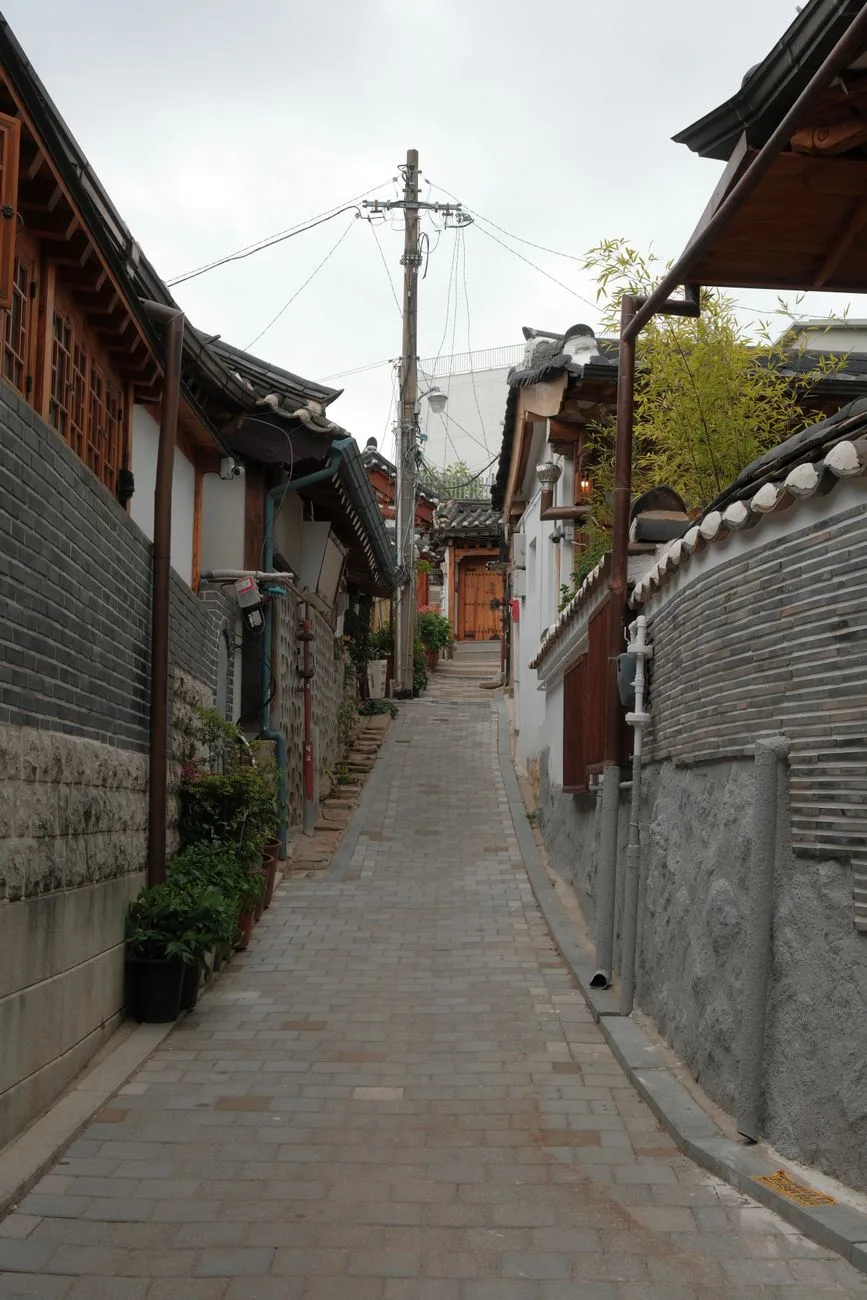
After 17:00, the substitutes are genuinely good. Namsangol Hanok Village is free and open 09:00–21:00 from March to October (09:00–20:00 November to February, closed Mondays), with five relocated hanok around a pond and no residents to disturb. Ihwa Mural Village on the Naksan slope has more than 70 murals and installations from the 2006 "Art in the City" project, and the Seoul Fortress Wall running through Naksan Park above it turns gold about 40 minutes before sunset. Both are free.
People live behind the doors in Bukchon and Ihwa alike. Keep your voice down, do not aim a lens through a window, and stay off private steps. The rules that carry a real penalty in Korea are covered in our piece on Korean etiquette and what breaking it costs.
What a full day of shooting in Seoul actually costs
This table answers one question: what does each location charge, and when does the light work there?
| Spot | Admission (KRW, Aug 2026) | Best light | Nearest station | Book ahead |
|---|---|---|---|---|
| Gyeongbokgung Palace | 3,000 | 09:00 opening | Gyeongbokgung (3) | No |
| Bukchon Hanok Village | 0 | 10:00–17:00 only | Anguk (3) | No |
| Namsangol Hanok Village | 0 | Late afternoon | Chungmuro (3/4) | No |
| Ihwa Mural Village | 0 | Early morning | Hyehwa (4) | No |
| Starfield Library, COEX | 0 | After 20:00 | Samseong (2) | No |
| DDP LED Rose Garden | 0 | Sunset onward | Dongdaemun History & Culture Park (2/4/5) | No |
| Seoullo 7017 | 0 | Blue hour | Seoul Station (1/4) | No |
| Banpo Rainbow Fountain | 0 | 20:00 show | Express Bus Terminal (3/7/9) | No |
| N Seoul Tower observatory | 29,000 | Hour before sunset | Myeongdong (4) plus cable car | Optional |
| Seoul Sky, Lotte World Tower | 31,000 | Hour before sunset | Jamsil (2/8) | Optional |
| Seoul Botanic Park | 5,000 | Midday, greenhouse | Magongnaru (9/AREX) | No |
Nine of the eleven cost under ₩5,000, and eight cost nothing. Photography in Seoul is limited by daylight and opening hours far more than by money.
The worked day. Gyeongbokgung at 09:00 (₩3,000), the Changing of the Royal Guard at 10:00 (free), Bukchon from 11:00 to 14:00 (free), Ihwa Mural Village and the Naksan wall at 16:00 (free), the DDP rose garden at sunset (free), the Banpo fountain at 20:00 (free). Five subway legs at the ₩1,550 T-money base fare come to ₩7,750. Day total: ₩10,750. Add Seoul Sky and it becomes ₩41,750, which is the whole argument about whether altitude is worth it.
The palace pass arithmetic. Buying separately, Gyeongbokgung is ₩3,000, Changdeokgung ₩3,000 with a ₩5,000 supplement for the Secret Garden, and Deoksugung, Changgyeonggung and Jongmyo are ₩1,000 each: ₩14,000 for all five. The Royal Palace Pass is ₩10,000 and covers all of them, including the Secret Garden, within three months. The break-even arrives at three tickets, as long as one of them is the Secret Garden (₩3,000 + ₩3,000 + ₩5,000 = ₩11,000). Two palaces without the Secret Garden, and the pass loses.
The hanbok arithmetic. Anyone in properly worn hanbok enters the palaces free. Rentals near Gyeongbokgung run ₩15,000–40,000 for two to four hours, so renting purely to dodge a ₩3,000 ticket costs you ₩12,000 at best. Rent it for the photographs, which is a reasonable thing to want, and not as a saving. Two details catch people out: the exemption requires a real set, so a jeogori with jeans, a hanbok skirt with a T-shirt, or a one-piece hanbok dress without a jeogori will not get you through the gate free. And shops charge overtime beyond the selection window, around ₩1,000 per 10 minutes for traditional sets and ₩2,000 for themed ones.
Admission is free for everyone at the palaces on Culture Day, the last Wednesday of each month. That is also when the courtyards are at their most crowded, which is a poor trade if you want clean architecture shots.
The Korea Heritage Service has announced that palace and royal tomb admission will rise on 1 January 2027, the first increase since 2005. The new amounts are not set; a public forum is scheduled for November 2026, and a hearing found visitors willing to pay an average of ₩9,730. Treat every palace figure above as a 2026 number.
Shooting the skyline: N Seoul Tower, Seoul Sky, or neither
N Seoul Tower charges ₩29,000 for adults and ₩23,000 for children aged 3–12 at the counter, per N Seoul Tower's own admission page as of August 2026. Online resellers list it lower, and third-party sites quote figures from ₩18,400 to ₩26,000, so buy ahead if the difference matters. The observatory is open every day of the year, 10:00–22:30 on weekdays and 10:00–23:00 at weekends, with entry closing 30 minutes before. Booking a table at n.GRILL or HANCOOK includes observatory admission.
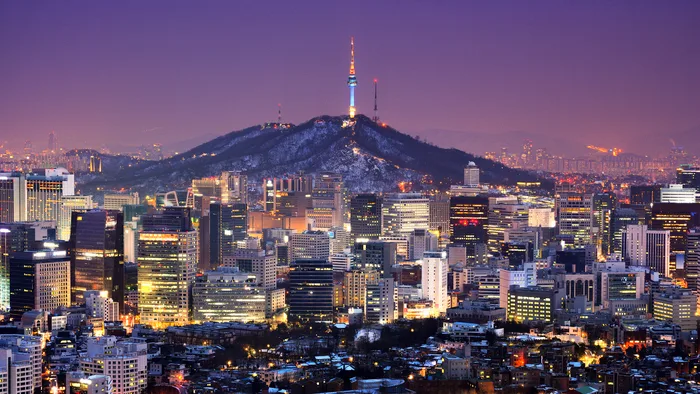
Getting up Namsan adds cost. The Namsan cable car has run since 12 May 1962, climbs 600 m to a station 479 m above sea level in 48-passenger cabins, and operates 10:00–23:00 year-round. The operator does not publish a fare table on its site; Korean guides quoted ₩14,000–15,000 for an adult round trip in 2026, and Jung-gu and Yongsan-gu residents pay ₩7,500. The free alternatives are the Namsan Oreumi slanted elevator, about eight minutes from Myeongdong Station Exit 4 and running 09:00–23:00 (closed Mondays until 14:00 for maintenance), and the shuttle bus marked NAMSAN CABLE CAR from Myeongdong Station Exit 1.
Seoul Sky at Lotte World Tower charges ₩31,000 for adults and ₩27,000 for ages 3–12, per the Korea Tourism Organization's Seoul Sky listing as of August 2026, with one 2026 reseller quoting ₩33,000. The observatory covers floors 117 to 123, the Sky Deck at 478 m holds the Guinness record for the highest glass-floored observatory, and the double-deck Sky Shuttle climbs at 600 m per minute. Hours are 10:30–22:00 Sunday to Thursday and 10:30–23:00 Friday, Saturday and public holidays, with last tickets one hour before closing. The rooftop Sky Bridge Tour at 541 m costs ₩130,000 at the B1 booth or ₩106,000 if bought on the 117th floor, requires age 12+, 140 cm and under 120 kg, and shuts for winter from 30 November to 28 February.
The verdict for photographers: skip both, and if you must pay for height, take Seoul Sky. N Seoul Tower's observatory plus a cable car round trip lands near ₩43,000, while Seoul Sky is ₩31,000 with the lift included and puts N Seoul Tower in your frame rather than under your feet. The free Namsan base plaza, the love-lock terrace and the fortress wall at Naksan Park all give you the tower as a subject, which no observatory can. Both paid decks shoot through thick, curved, reflective glass; press the lens flat to the pane or bring a rubber hood, because reflections ruin more frames up there than weather does.
Interiors and structures that work when the weather does not
Seoul takes 892 mm of rain between June and August, about 63% of its 1,417.9 mm annual total. A July shooting plan without an indoor fallback is a plan to sit in a cafe.
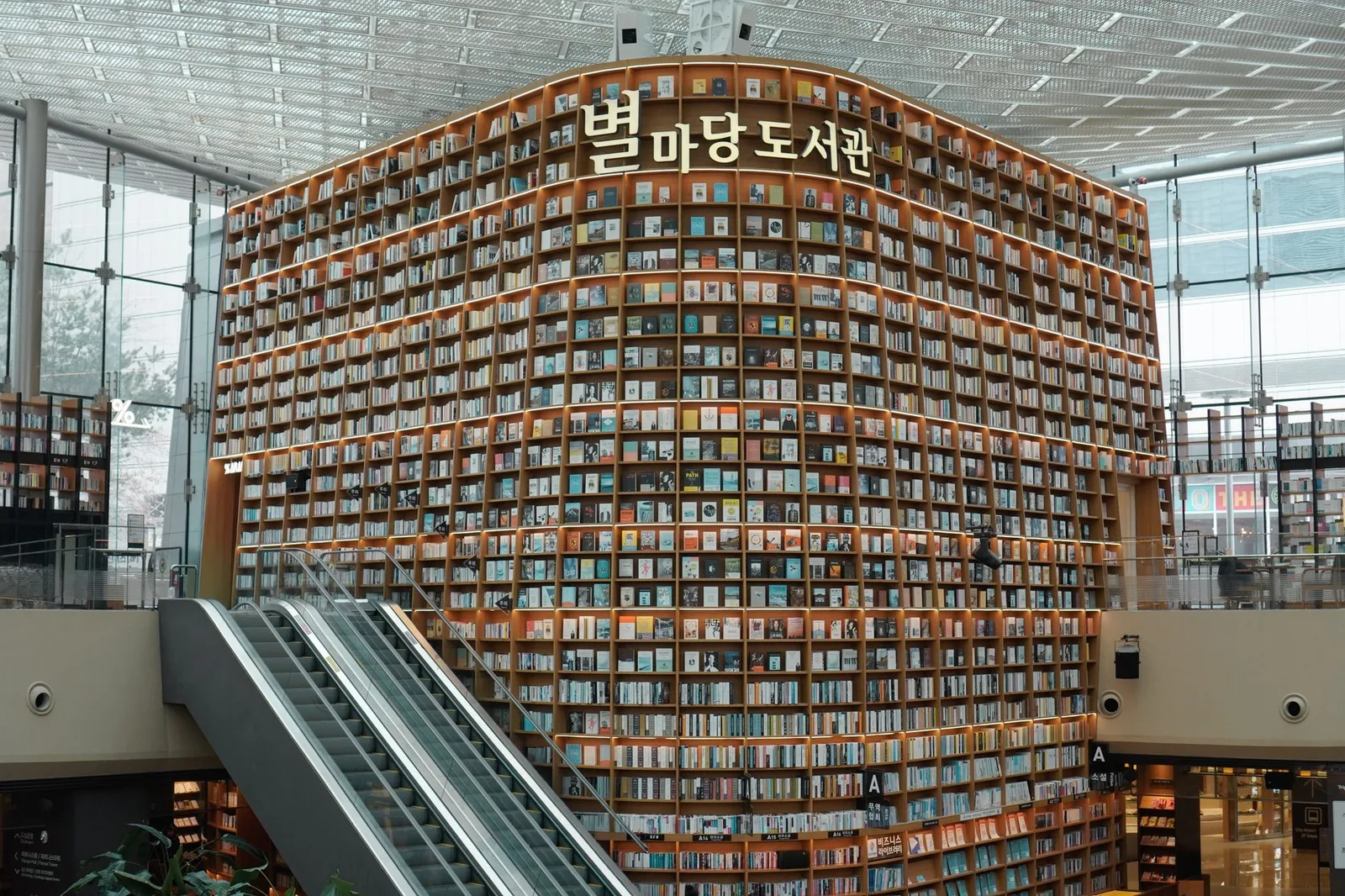
Starfield Library at COEX is free, needs no registration, and opens 10:30–22:00 every day of the year. The shelves stand 13 m high and hold more than 50,000 books and 400 magazine titles, and photography is allowed. Shoot from the upper walkway after 20:00, when the daylight through the atrium has gone and the shelf lighting carries the frame alone.
The DDP LED Rose Garden is a permanent installation of 25,550 LED roses beside the Yigansumun Exhibition Hall that lights automatically at sunset. Zaha Hadid's building behind it is the point: the indoor halls run 10:00–20:00, but the exterior plaza is free and walkable at any hour, and the aluminium panels take reflected light well past midnight.
Seoullo 7017, the elevated garden MVRDV built on a former overpass and opened in May 2017, is free, lit until midnight and open 24 hours. Sources give its length as either 983 m or 1,024 m. It holds 24,000 plants and sits directly over the Seoul Station rail throat, which is the shot: long exposures of trains under a planted deck at blue hour. Oil Tank Culture Park in Mapo-gu, six former oil reservoir tanks converted to exhibition space, opens its tanks 10:00–18:00, with the surrounding park accessible year-round.
For colour under glass, Seoul Botanic Park charges ₩5,000 for adults, ₩3,000 for ages 13–18 and ₩2,000 for ages 6–12, free under 6 and over 65. It runs 09:30–18:00 from March to October with last entry at 17:00, and closes the greenhouse on Mondays. There are around 4,600 plant species and twelve themed world-city gardens, 524 m from Magongnaru Station Exit 3 on Line 9 and the airport express.
Timing: the ceremony, the fountain, and the seasons
The Changing of the Royal Guard at Gwanghwamun runs at 10:00 and 14:00 daily except Tuesdays and is free to watch from the street. Two smaller ceremonies fill the gaps: Gwanghwamun Gate Guard on Duty at 11:00 and 13:00, and the 15-minute Gatekeeper Military Training at 09:30 and 13:30. Guard numbers drop below −10 °C or above 30 °C, and heavy rain or snow moves the duty inside to Heungnyemun Gate.
Gyeongbokgung's own hours move with the season: 09:00–17:00 in January and February, 09:00–18:00 from March to May and again September to October, and 09:00–18:30 in June, July and August, with last admission an hour before closing. It closes Tuesdays.
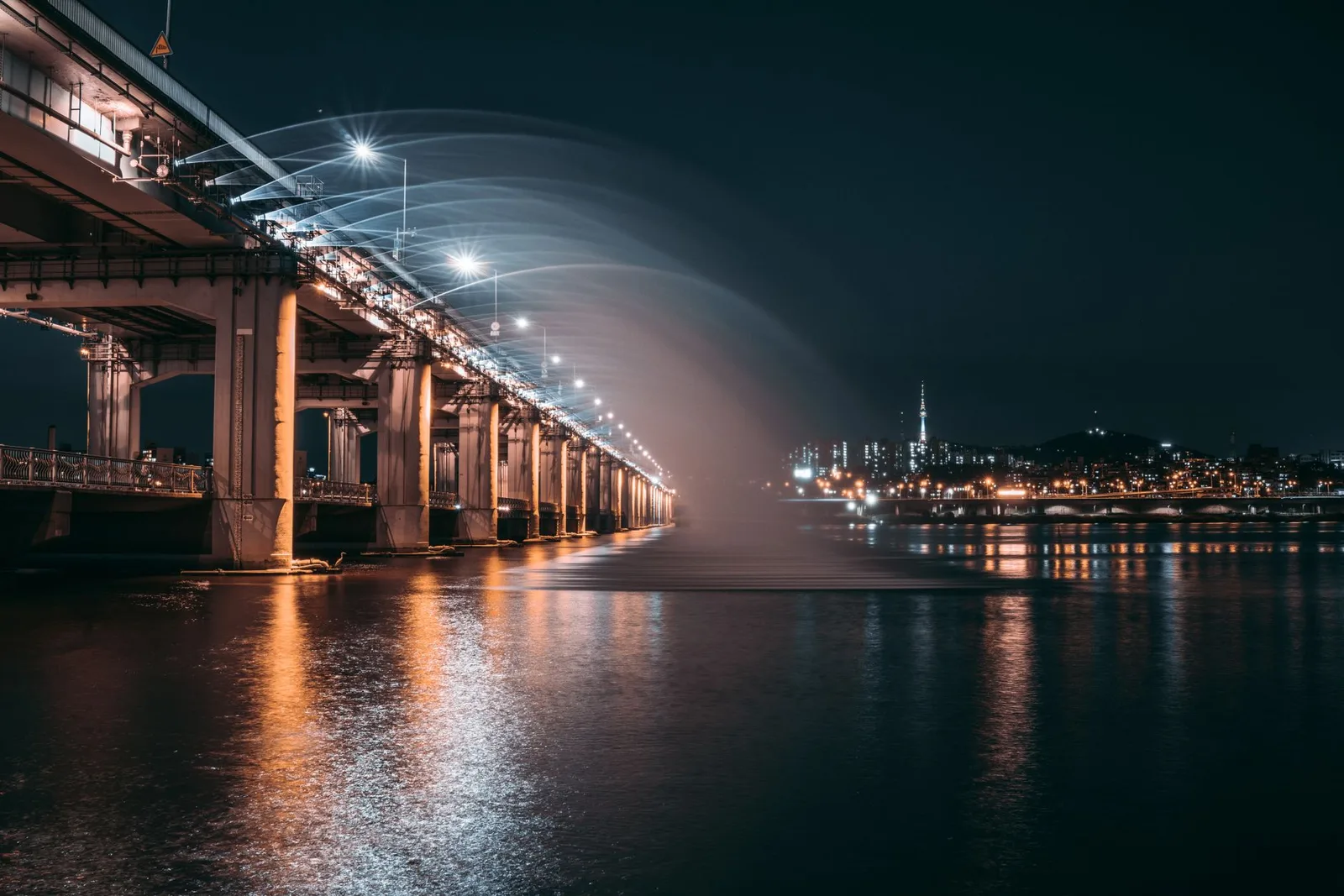
The Banpo Bridge Moonlight Rainbow Fountain is free and runs 20-minute shows at 12:00, 19:30, 20:00, 20:30 and 21:00 from April to June and September to October, with a 21:30 show added in July and August. Seoul's official listing gives the season as April to October; Korean-language Hangang sources put the 2026 opening earlier, on 16 March. Shows stop in rain, strong wind, or when the river water is too cloudy. Walk 1.1 km from Express Bus Terminal Station Exit 8-1, and set up on the south bank facing the bridge, since the lit arcs read as colour only against a dark sky.
For seasons, October into the first half of November is the strongest photographic window in Seoul: dry, clear, and coloured. A private forecaster put Seoul's 2026 urban foliage peak at 5–15 November; the Korea Meteorological Administration publishes its official forecast in early September, and it was not out when this article was written. Spring is finished for 2026: the Korea Tourism Organization's forecast had Seoul's cherry blossoms opening on 4 April and reaching full bloom on 10 April 2026, three to eight days earlier than the long-run average.
Crowds are the other timing input. Korea recorded 10.7 million foreign visitors in the first half of 2026, up 21.3% year on year and well past the pre-pandemic peak. Chuseok falls on Friday 25 September 2026 with the holiday running 24–26 September, so palace courtyards and Hangang parks will be at their fullest that weekend. If you are fitting these locations into a longer trip, our 10-day Seoul itinerary sequences them against the closures, and what to know before visiting Seoul covers the entry paperwork.
FAQ
Is Bukchon Hanok Village free to photograph?
Yes. Entry costs nothing, but the Red Zone on Bukchon-ro 11-gil is closed to tourists from 17:00 to 10:00 the next morning, with a ₩100,000 fine enforced since 1 March 2025. Guests staying in accommodation on that lane are exempt.
Which day of the week should I avoid?
Tuesday. Gyeongbokgung, Changdeokgung and Deoksugung all close, and the Changing of the Royal Guard does not run. Namsangol Hanok Village and Seoul Botanic Park's greenhouse close Mondays instead, so Monday is the day for outdoor and free locations.
What is the cheapest way into Gyeongbokgung?
Admission is ₩3,000 for ages 19–64, free for under 7 and over 64. It is free for anyone in a complete, properly worn hanbok, and free for everyone on Culture Day, the last Wednesday of the month. Prices rise on 1 January 2027.
Do I need to book Seoul Sky or N Seoul Tower in advance?
No. Both sell tickets at the door, though online resellers price below the walk-up rates. Seoul Sky's Fast Pass at ₩62,000 is sold on-site on the day only, and the Sky Bridge rooftop tour is ₩24,000 cheaper bought on the 117th floor than at the B1 booth.
Can I take photos inside Starfield Library?
Yes. It is free, needs no registration and permits photography, open 10:30–22:00 every day including holidays. The 13 m shelves light best after dark, when the atrium daylight has faded.
One caution before you build the route: everything above is general travel information, and the figures carry the date they were checked. Prices at the two towers moved during 2026, and the palace fees change on 1 January 2027.