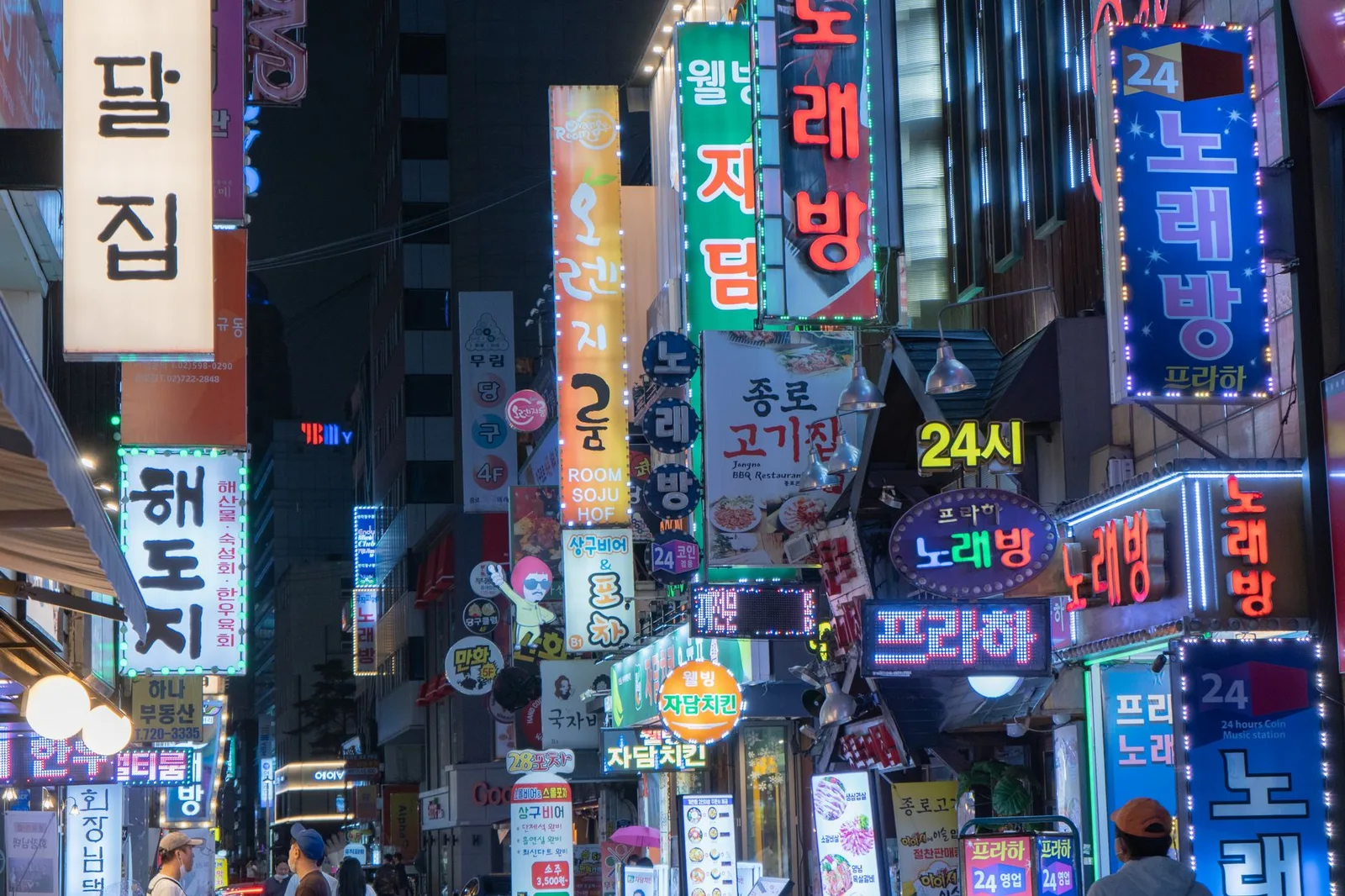
A first trip to Seoul is decided by about six places, and five of them sit inside a four-kilometre band running from Gwanghwamun east to Dongdaemun and south to Namsan. Book a bed outside that band and you pay for it every single morning.
For a first visit of three to five nights, stay in Myeongdong or Jongno. Both put Gyeongbokgung, Bukchon, Namsan, Gwangjang Market and the airport buses within a walk or two subway stops. Hongdae fits travellers whose evenings run past midnight. Gangnam earns a booking only when COEX or Lotte World is on the schedule.
The short version
- Myeongdong: strongest all-round first-time base. Highest foreign footfall in the city, sits inside an officially designated tourist zone, dense with tax-refund-registered shops. Weakest on food value.
- Jongno / Insadong: choose this if palaces, markets and hanok matter more to you than shopping. You can walk to Gyeongbokgung.
- Hongdae: the only major base with a direct airport train, and the easiest place to be out at 1am without a taxi.
- Gangnam: about 14 stops and a transfer from the palaces. Skip it on a first trip unless your schedule is south of the river.
- Budget anchor: STR data reported in October 2025 put the Seoul–Incheon average daily rate near ₩296,000 for September 2025, up 14.6% year on year, at 81.6% occupancy. No agency publishes a rate breakdown by Seoul neighbourhood, so district-by-district "average price" claims you read elsewhere are estimates.
What changes when it is your first time, not your third
Repeat visitors optimise for a neighbourhood they already like. A first trip has almost no freedom in it: the itinerary is close to fixed, and it is fixed in central Seoul. Gyeongbokgung, Bukchon Hanok Village, N Seoul Tower, one traditional market, one shopping street and one night out cover most first visits, and they are geographically clustered.
Two other things are different. You arrive with luggage and jet lag, so night one is not a normal evening: the walk from the station exit to the door matters more than the room does. And you cannot yet read the network by instinct, so a two-line transfer with a 300-metre underground walk costs you more time and more patience than the map suggests.
That is the whole argument for a central base on a short first trip. The broader trade-offs by budget and refund logistics are covered in our district-by-district guide to where to stay in Seoul; this page is about the first visit specifically.
Where first-time visitors actually spend their days
The most useful evidence is not hotel marketing, it is carrier data. The Seoul AI Foundation analysed SK Telecom mobile data and Google Maps reviews for calendar year 2025, published in July 2026. The table below shows the daily average foreign floating population at the five busiest spots, and where you would sleep to be next to each.
| Location | Daily average foreign visitors (2025) | Nearest base |
|---|---|---|
| Myeongdong | 100,910 | Myeongdong |
| N Seoul Tower | 57,370 | Myeongdong |
| Samseong Station & COEX | 46,813 | Gangnam |
| Gangnam Station | 41,210 | Gangnam |
| Hongdae area | 40,213 | Hongdae |
Myeongdong draws more than double the next busiest spot, and foreigners made up 47.1% of everyone standing there. At N Seoul Tower the share reached 55.7%. Two of the top five sit in Gangnam, which is the honest case for the south side: it is not empty of visitors, it is just full of a different kind of visitor, largely business and shopping traffic around COEX.
The growth numbers point the same way as the walking-distance argument. Foreign visitor numbers in 2025 rose fastest at Dongdaemun Design Plaza (+12.1%), Hongdae and Naksan Park (+10.5% each), Gwangjang Market (+10.4%) and Gyeongbokgung Palace (+10.2%). Four of those six are inside the Jongno–Myeongdong core.
Where to stay in Seoul for a first trip: five districts compared
This table answers one question: which base puts your fixed itinerary within reach without a daily river crossing.
| District | Best for | Subway lines at the hub | To Gyeongbokgung | First trip? |
|---|---|---|---|---|
| Myeongdong | Shopping, airport buses, tax refund | 4, plus 2 at Euljiro 1-ga | 30 min walk | Yes |
| Jongno / Insadong | Palaces, markets, hanok stays | 1, 3, 5 | 10–20 min walk | Yes |
| Hongdae | Nightlife, live music, airport train | 2, AREX, Gyeongui–Jungang | 20 min by subway | Optional |
| Dongdaemun | Late shopping, DDP | 1, 4 (DDP: 2, 5) | 15 min by subway | Optional |
| Gangnam | COEX, business, Lotte World | 2, Sinbundang | 35 min by subway | No |
The verdict column assumes a three-to-five-night first visit with a standard sightseeing list. It flips for anyone attending an event at COEX or KSPO Dome, which is the exception discussed below.
Myeongdong
Myeongdong is the default for a reason that has nothing to do with the shops. It sits at the centre of the officially designated Myeong-dong, Namdaemun, Bukchang-dong, Da-dong and Mugyo-dong Special Tourist Zone, which concentrates tourist infrastructure in a few blocks: information centres, airport limousine stops, currency exchange, and the highest density of tax-free-registered stores in the country.
That last point has money attached. Under the Seoul tourist VAT refund rules, a purchase qualifies from ₩15,000, immediate in-store refunds apply below ₩1,000,000 per purchase and ₩5,000,000 across the whole trip, and you must have stayed in Korea under six months with the goods bought within three months of departure. Doing that paperwork within a five-minute walk of your room is materially easier than doing it at an airport counter at 6am.
The honest weakness: Myeongdong's street food and restaurants are priced for people who will not return. Eat elsewhere. Gwangjang Market and the alleys around Euljiro are both close, and our guide to Seoul's best-reviewed Korean restaurants sorts the recommendations that survive scrutiny from the ones that do not.
Jongno and Insadong
Jongno is the choice if your reason for coming is the historic core. Gyeongbokgung admission is ₩3,000 for adult foreign visitors, free for anyone in hanbok, and free for all on Culture Day, the last Wednesday of the month. The palace closes on Tuesdays, which is a scheduling trap rather than a small detail: a Jongno base is wasted if your only palace day falls on one.
Gwangjang Market (광장시장) is at 88 Changgyeonggung-ro, walkable from most Jongno hotels. The two official tourism bodies disagree on its hours: VisitKorea lists the main market 09:00–18:00 and closed Sundays, while Visit Seoul lists 08:30–18:00 daily. Both agree the food street runs late, to around 23:00. Treat 09:00 as the safe arrival time.
Jongno also has the deepest supply of traditional accommodation, if that is why you are here. What a night costs and which alleys are quiet enough to sleep in are covered in our hanok stay guide.
Hongdae
Hongdae has one logistical advantage nobody mentions in the nightlife write-ups: Hongik University Station is served by the AREX line from Incheon, so it is the only major base you can reach from the airport without a transfer or a taxi. The express train does not stop there, but the All-Stop service does.
It is also the base where a late night costs nothing. Seoul's subway stops running around midnight, so a night out in Hongdae from any other district ends in a taxi. Sleeping there removes that expense entirely. The trade-off is noise until about 2am on weekends, and a walk-up building problem: many guesthouses occupy the second to fourth floors with no lift.
Dongdaemun
Dongdaemun works for a specific traveller: someone who shops at night. The wholesale malls run into the early hours, Dongdaemun Design Plaza posted the fastest growth in foreign visitors of anywhere in Seoul in 2025 (+12.1%), and the district has held Special Tourist Zone designation since 2002. Four subway lines converge across two adjacent stations.
Daytime, it is a less pleasant place to walk than Jongno, and the hotel stock skews towards large business properties and small tourist hotels rather than anything charming.
Gangnam
Gangnam is a genuinely good place to stay and the wrong place for a first trip. Almost nothing on a first-time itinerary is south of the Han. Gangnam Station to Anguk is about 14 stops with a transfer at Gyodae, and you make that journey in both directions every day.
Book it when the trip has a southern anchor: an exhibition at COEX, a concert, a business meeting in Samseong, or a family day at Lotte World. Note also that the Sinbundang Line, which runs through Gangnam, is excluded from the Climate Card, so the pass covers less of your daily travel here than it does north of the river.
The four-night transfer test: what the wrong base costs
Here is the arithmetic, with a four-night trip and the standard first-time list: Gyeongbokgung, Bukchon, Namsan, Gwangjang Market, Myeongdong, and one evening in Hongdae.
The Seoul Metropolitan Government raised the base subway fare to ₩1,550 by card on 28 June 2025 (₩1,650 in cash). Numbeo's crowdsourced Seoul figures, updated 22 July 2026, put taxi flagfall at ₩4,800 and ₩825 per kilometre.
Case A, based in Myeongdong. Most days need two rides, because Namsan, Myeongdong and half of Jongno are walkable. That is 8 rides across the trip: 8 × ₩1,550 = ₩12,400. Add the taxi home from Hongdae after the last train, about 7 km: ₩4,800 + (₩825 × 7) = ₩10,575, before the late-night surcharge. Trip total, about ₩23,000.
Case B, based in Gangnam. Every sight on that list is north of the river, so four rides a day is realistic. 16 × ₩1,550 = ₩24,800. The same Hongdae taxi is now about 13 km: ₩4,800 + (₩825 × 13) = ₩15,525. Trip total, about ₩40,300.
The fare gap is only ₩17,300 across four nights. Money is not the argument. Time is: Case B adds one extra north–south crossing per day, near 50 minutes of riding, which is 3 hours 20 minutes over four days.
So here is the decision rule. A Gangnam room that saves ₩50,000 a night saves ₩200,000 over four nights and gives back ₩17,300 in transport, netting about ₩183,000 for 3 hours 20 minutes of extra subway. That prices your sightseeing time at roughly ₩55,000 an hour. On a four-night first trip, decline it. Those hours are a large share of the daylight you came for. On a ten-night trip at a slower pace, the same discount is worth taking, and our 10-day Seoul itinerary is built around the days when the pace drops.
This test fails in one case. If your trip includes an event at COEX or KSPO Dome, or a commute out to Pangyo on the Sinbundang Line, the crossings run the other way and the Gangnam room wins on both counts.
Which transit pass matches your base
The pass question is downstream of the district question, which is why most pass comparisons get it wrong.
The Climate Card Tourist Pass costs ₩5,000 for one day, ₩8,000 for two, ₩10,000 for three and ₩15,000 for five, with VisitKorea additionally listing a seven-day option at ₩20,000 and the physical card itself at ₩3,000. It covers Seoul buses and subway Lines 1–8, Line 9, the Sillim Line and the Ui-Sinseol Line. It does not cover the Sinbundang Line, the GTX, or the airport railroad.
A first-timer buying the three-day pass fresh pays ₩10,000 plus ₩3,000 for the card, so ₩13,000. At ₩1,550 a ride, that is 8.4 rides, meaning the pass wins from the ninth ride onward, about three a day.
Now apply your district. Based in Myeongdong or Jongno you take about two rides a day: 6 rides over three days is ₩9,300, and single fares on a T-money card win by ₩3,700. Based in Gangnam or Hongdae you take about four: 12 rides is ₩18,600, and the pass wins by ₩5,600. The central base saves you money twice, once on fares and once by making the pass unnecessary.
One piece of stale advice to ignore: the 30-day Climate Card was discontinued on 1 October 2026. Only the short-term tourist passes remain, which suits visitors anyway. Broader trip budgeting, including where transport sits against food and accommodation, is broken out in our seven-day Korea cost breakdown.
Every price above carries the date it was checked. Fares and pass prices are set by operators and government and do change; this is general travel information rather than a quote.
Five booking mistakes specific to Seoul
Trusting the district in the hotel name. Dozens of properties carry "Myeongdong" while sitting fifteen minutes up the Namsan slope. Find the station exit number in the listing and measure from there, because Seoul's central hills turn a 900-metre walk with a suitcase into a bad decision.
Booking across a major holiday without checking closures. Chuseok falls on 24–26 September 2026 and Seollal on 16–18 February 2026, per VisitKorea's 2026 public holiday calendar. Palaces, museums and department stores stay open; small family-run restaurants shut, and intercity transport fills weeks ahead.
Ignoring the Tuesday palace closure. If Gyeongbokgung is your headline sight, do not let it land on the one day it is closed.
Filtering by star rating instead of square metres. Korean listings publish room size in square metres. At the occupancy levels Seoul has been running, cheap central rooms are cheap because they are small and often windowless, not because they are a bargain. Read the number, not the stars.
Forgetting the stairs. Guesthouses in Hongdae, Jongno and Ikseon-dong frequently occupy upper floors of walk-up buildings. Ask about the lift before you arrive at 11pm with 23 kg.
Getting from Incheon to your hotel on night one
The AREX Express runs Incheon Airport to Seoul Station for ₩13,000 flat as of August 2026, taking 43 minutes from Terminal 1 and 51 from Terminal 2, with departures every 30 to 40 minutes. The All-Stop service on the same line costs up to ₩5,350 and takes 59 to 66 minutes across 14 stations. Neither is covered by the Climate Card.
Which one you want depends entirely on your district. Hongdae travellers take the All-Stop, because it stops at Hongik University Station and the express does not: cheaper and no transfer. Myeongdong and Jongno travellers take either, arriving at Seoul Station, which is two stops from Myeongdong on Line 4 and two from Jonggak on Line 1. A taxi from Seoul Station to a Myeongdong hotel covers about 2.5 km, roughly ₩6,900 at the rates above, which is worth it with luggage on night one.
Gangnam travellers have the worst arrival of the five: the express deposits you at Seoul Station and you cross the river anyway. If you are landing late and staying south, the airport limousine bus routes serving Gangnam hotels are the better option.
If your flight lands early and check-in is hours away, the first day does not have to be wasted. Our airport day tour guide covers what actually fits before a hotel opens its doors, and the things to do in Seoul list flags what needs booking in advance.
First-time Seoul accommodation questions
Is Myeongdong too touristy for a first trip?
For logistics, no. For dinner, yes. Sleeping in Myeongdong buys you airport buses, refund desks, tourist information and a central position on the subway map at the cost of overpriced restaurants you can simply walk away from. Base there, eat in Euljiro, Jongno or Gwangjang.
Hongdae or Myeongdong for a first-time visitor?
Myeongdong for a first trip of four nights or fewer, because more of your itinerary is within walking distance. Hongdae if you plan to be out most evenings, if you are arriving on a late flight and want the direct AREX All-Stop connection, or if you are travelling on a hostel budget.
Is Gangnam a good area for first-time visitors?
Not for a standard first itinerary. Gangnam Station sits about 14 stops and a transfer from the palace district, and the Sinbundang Line through Gangnam is excluded from the Climate Card. It becomes the right answer when COEX, Lotte World or a Gangnam concert venue is the reason for the trip.
Should you split your stay between two districts?
Not on a first visit under six nights. Changing hotels costs a half-morning in checkout, transit and luggage storage, which is more time than a central base loses in a week of transfers. Past six nights, a split between Jongno and Hongdae works well.
How close to a subway station should the hotel be?
Within about five minutes on foot, and confirm which exit. Seoul stations often have ten or more exits spread across several hundred metres, and central districts are hillier than the map shows. Check the exit number in the listing before you book, then screenshot the walking route while you still have airport wi-fi.