The paper arrival card you filled in on the plane no longer exists. It was abolished on 1 January 2026, and the online form that replaced it will not accept a submission made more than three days before you land.
So, before flying to Seoul in 2026: submit the free e-Arrival Card, mandatory for all foreign nationals since 1 January 2026 and only accepted within three days of arrival. Most Western passports need no K-ETA until the waiver ends on 31 December 2026. Budget about ₩135,000 per person per day, near USD 96, before flights.
Five things that changed for 2026 visitors
- The e-Arrival Card replaced the paper form on 1 January 2026. Free, online, three-day window.
- K-ETA is waived through 31 December 2026 for the nationalities already under the temporary exemption, and applies again from 1 January 2027.
- The subway base fare is ₩1,550, up ₩150 since the first train on 28 June 2025.
- Seoul's 30-day Climate Card becomes the Climate Pass on 1 September 2026. The 1- to 7-day tourist passes continue.
- The VAT immediate-refund ceilings doubled on 1 January 2026, to ₩1,000,000 per transaction and ₩5,000,000 in total.
The two entry documents, and which one you actually need
Korea's Ministry of Justice extended the temporary K-ETA exemption for a further year, covering 1 January 2026 to 31 December 2026, Korea Standard Time, according to the notice published by the Ministry of Foreign Affairs. It applies to nationals of the countries already under the temporary waiver, and the notice names the United States and Guam, Canada, Japan, Australia and Germany among them. It does not publish the full list, and third-party counts of the exempt countries disagree wildly, so confirm your own nationality on the eligibility page at k-eta.go.kr rather than trusting a blog's number.
You can still apply voluntarily. The K-ETA application fee is ₩10,000, around USD 7 to 8, and the stated benefit for exempt travellers is skipping the arrival card entirely. A K-ETA already issued stays valid to its expiry date and is not refunded because of the waiver.
Everyone else does the arrival card online. The official portal is e-arrivalcard.go.kr, the submission is free, and it opens three days before arrival in Korean time. A submission expires 72 hours after you make it, so a form filled in a week early is dead by the time you board. Have the passport, a working email address, the arrival date and flight number, and the address of your first night's accommodation. Departure details are optional. One mobile submission covers up to nine people; the PC version handles up to 1,000, which matters for tour groups.
The form costs nothing. Sites that charge a service fee for it are reselling a government page.
The e-Arrival Card is not a visa and grants no permission to enter. U.S. citizens still enter visa-free for up to 90 days of tourism under the arrangement published by Korea's Ministry of Foreign Affairs, and the card simply digitises the declaration you used to hand over on paper.
What four days in Seoul actually costs
The consumer prices below come from Numbeo's Seoul index, last updated 12 August 2026 and built on 1,016 price entries from 119 contributors over twelve months. That is a thin sample, so read it as a band rather than a quote.
Per person, per day, at a mid-range pace:
- Café coffee and a pastry: ₩8,000 (a cappuccino alone averages ₩5,759)
- Lunch at an inexpensive restaurant: ₩13,000
- Dinner, half of a ₩92,500 mid-range meal for two: ₩46,250
- One street snack, tteokbokki or hotteok: ₩5,000
- Transit, a 3-day Climate Card at ₩10,000 spread across three days: ₩3,333
That totals ₩75,583 a day before a bed. Add a ₩60,000 room from the mid-tier band in our Seoul hotel price breakdown and the day lands at ₩135,583, about USD 96 at the 10 August 2026 rate of roughly ₩1,412 to the dollar. Four days: ₩542,332, close to USD 384, excluding flights and shopping.
The same day drops under ₩70,000 if you sleep in a ₩25,000 guesthouse bunk, eat convenience-store breakfasts and hold lunch to ₩8,000. It climbs past ₩250,000 the moment Korean barbecue and late taxis enter the plan. For a whole week with intercity travel folded in, our 7-day Korea trip cost runs three budgets line by line.
Getting from Incheon Airport into the city
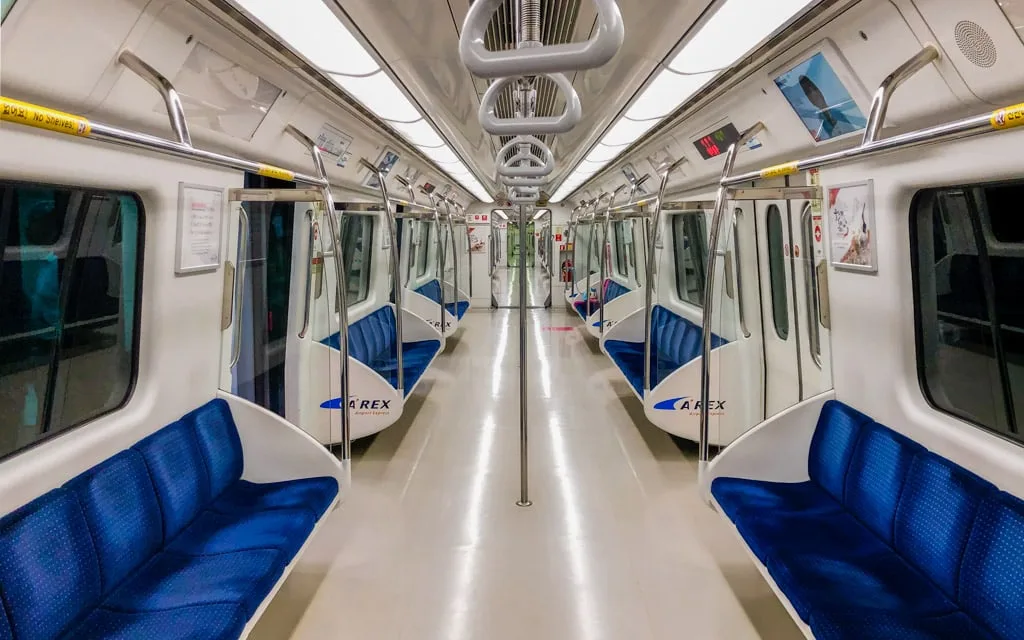
The nonstop AREX Express reaches Seoul Station in 43 minutes from Terminal 1 and 51 minutes from Terminal 2, departing every 30 to 40 minutes. Its fare is the one number in this article I cannot pin down: the operator's own fare pages were returning server errors in August 2026, and published figures split between ₩11,000 and ₩13,000 for an adult one-way. Carry ₩13,000 and expect change.
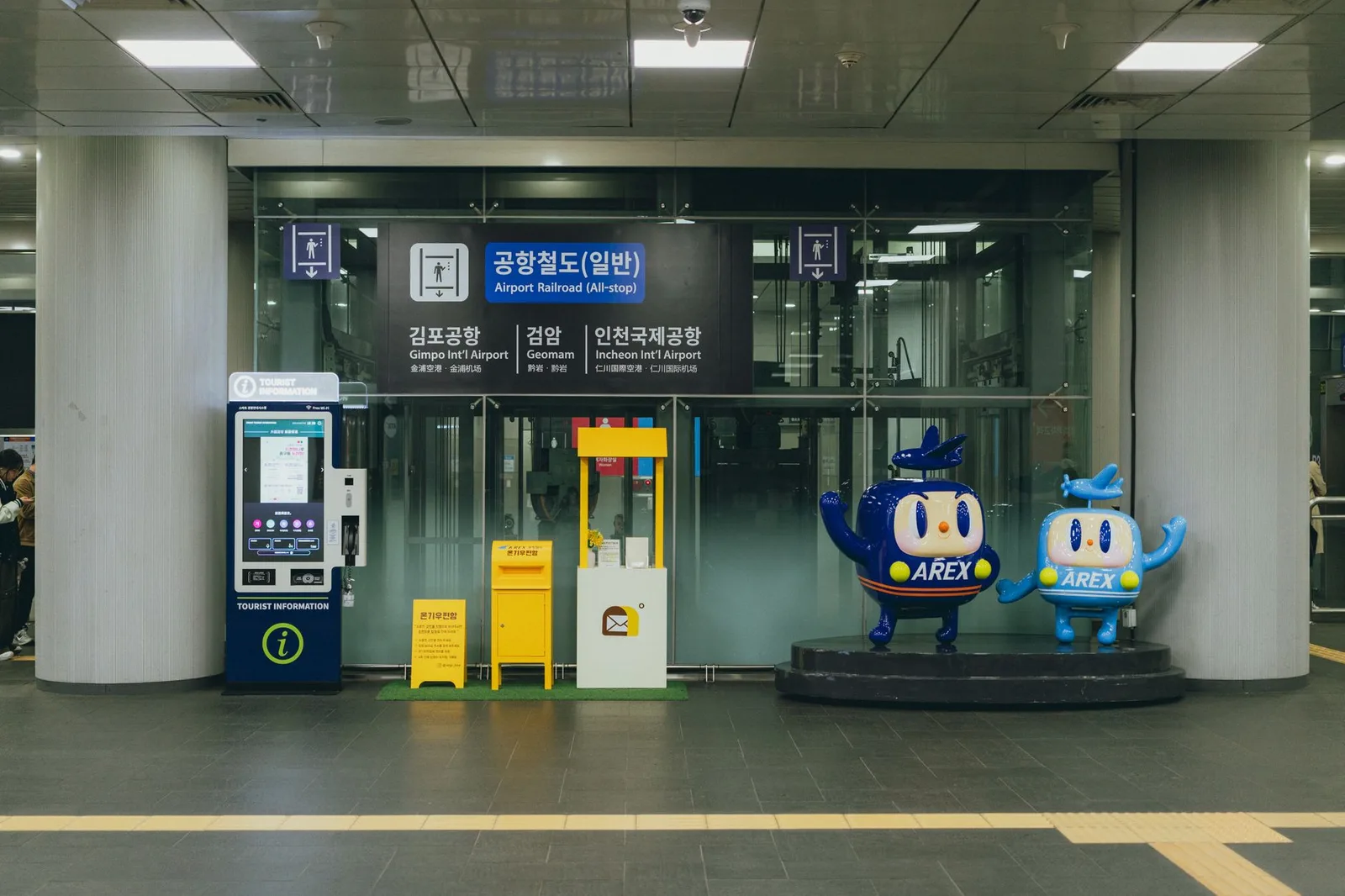
The All Stop train serves all 14 stations and takes 60 to 70 minutes for a fraction of that, on ordinary metro fares plus a supplement for the independent-fare section past Cheongna. Base fares on that section rose on 28 June 2025.
Airport bus 6001 runs to Sinyongsan, Samgakji, Seoul Station, Chungmuro, Myeongdong and Dongdaemun History & Culture Park, roughly every 20 minutes, taking about 81 minutes over 38 stops. First departure from Terminal 2 is 05:40 and the last is 22:50. Published adult fares as of August 2026 sit between ₩15,000 and ₩17,000, and the Incheon airport operator does not post the figure on its own site.
Taxis meter the whole way. Seoul Metropolitan Government's standard taxi rate is ₩4,800 for the first 1.6 km, then ₩100 per 131 m and ₩100 per 30 seconds in slow traffic, in force since 1 February 2023, with expressway tolls on top from Incheon.
Two adults with two large suitcases heading anywhere near Seoul Station should take the Express train; landing after the 22:50 bus, take a taxi and stop calculating. The bus wins only if it stops within a block of your hotel, because dragging luggage through a transfer erases the time you saved.
When the Climate Card beats tapping T-money
Seoul Metropolitan Government publishes short-term Climate Card prices at 1-day ₩5,000 through 7-day ₩20,000, with a separate one-off ₩3,000 fee for the physical card. Against a ₩1,550 subway base fare, here is where each pass turns profitable.
| Pass | Price (KRW) | Break-even journeys | Buy it |
|---|---|---|---|
| 1-day | 5,000 | 4 | Optional |
| 2-day | 8,000 | 6 | Optional |
| 3-day | 10,000 | 7 | Yes |
| 5-day | 15,000 | 10 | Yes |
| 7-day | 20,000 | 13 | Yes |
The table counts journeys, not taps: Seoul's fare system charges once for a trip with free transfers inside the distance band, so a subway-bus-subway chain is one journey, not three. Add the ₩3,000 card fee on a first visit and the 3-day pass really costs ₩13,000, needing nine journeys, three a day. A normal sightseeing day in Seoul produces four to six. The 1-day pass is the marginal one, since a day with three journeys and a lot of walking leaves you ₩350 worse off.
The card covers unlimited subway, city buses, Ttareungi bike share and the Hangang Bus on one charge, excludes the Sinbundang Line, and has accepted international credit cards for short-term passes and mobile purchases since March 2025.
This advice fails at the city line. Suwon, Everland, most of Gyeonggi and the pickup points for many DMZ tours sit outside the pass, and under the changes Seoul announced in July 2026 the short-term passes cover Seoul plus alighting at Incheon International Airport, with the previously included Gyeonggi area dropped. If half your plan comes from our day trips from Seoul list, load a plain T-money card instead and tap per ride.
One more date to note: the 30-day Climate Card is being wound down in favour of the Climate Pass, launching 1 September 2026. Prepaid 30-day cards can be charged until 31 August 2026 and used until 29 September 2026. Tourist passes of one to seven days survive the transition.
T-money cards themselves are sold at GS25, CU, 7-Eleven, FamilyMart and station vending machines, take a small refundable deposit, and return the leftover balance at any convenience store minus a handling fee.
Google Maps still will not navigate you across Seoul
Google Maps in Korea shows you places and public-transport routes. It gives no turn-by-turn walking or driving navigation, because export of precision map data is restricted under the Spatial Data Management Act, a rule with roots in armistice-era security law.
On 27 February 2026 a government review panel convened at the National Geographic Information Institute, with the Ministry of Land, the Ministry of National Defense, the NIS and other agencies participating, conditionally approved the export of 1:5,000 base map data. The scope is narrow: the base map and the road and transport network needed for routing, with contour lines and other militarily sensitive layers excluded, plus conditions on domestic servers, coordinate display and image security processing.
That was an approval with conditions, not a product launch, and no navigation rollout had been announced when this was written in August 2026. Install Naver Map or KakaoMap before you fly, both of which have English settings, and add KakaoT if you plan to hail taxis. All three need data, which is what our Korea SIM card price comparison is for.
Picking dates: heat, holidays and crowds in 2026
Seoul is busier than it was before the pandemic. Korea logged 10.71 million foreign visitors in the first half of 2026, up 21.3% year on year and running at 126.9% of the same period in 2019.
Summer is the season to avoid, and 2026 made the case forcefully. Seoul peaked at 36.9°C with an overnight low of 28.9°C, and nationally Yangsan in South Gyeongsang hit 42.5°C, the worst heat in 122 years of modern observation in Korea. The Korea Meteorological Administration's normals put August's mean at 26.1°C and annual rainfall at 1,417.9 mm, of which June to August carry 892.1 mm, about 63% of the year's total.
Mid-September to early November is the strongest window for a first visit, with central Korea's foliage peaking late October into early November. Treat those foliage dates as private forecasters' estimates: the KMA no longer publishes an official foliage forecast. Spring's alternative is early April in Seoul, with full bloom about a week after the KMA declares opening, which it does when three or more flowers open on one designated observation tree.
These are the public holidays left in 2026, from the Korea Tourism Organization's list of 14 for the year.
| Holiday | Date (2026) | Effect on visitors |
|---|---|---|
| Liberation Day | 15 Aug, observed 17 Aug | Banks and offices closed |
| Chuseok | 24–26 Sep | Small shops closed, transport full |
| National Foundation Day | 3 Oct, observed 5 Oct | Banks and offices closed |
| Hangeul Day | 9 Oct | Banks and offices closed |
| Christmas | 25 Dec | Banks and offices closed |
Chuseok itself falls on Friday 25 September 2026, with the holiday running Thursday to Saturday and into the Sunday. There is no substitute Monday, because the substitute rule triggers only on a Sunday overlap. Museums, palaces and department stores generally stay open through Chuseok; banks, government offices and family-run restaurants do not. Book accommodation and any KTX seat well before that week, and note that Constitution Day returned as a public holiday on 17 July 2026 for the first time since 2008.
The tax refund got bigger in 2026, and it is still not 10%
Under the 2026 revision to Korea's special VAT provision for foreign tourists, the immediate-refund limit at tax-free stores doubled on 1 January 2026: ₩1,000,000 per transaction, up from ₩500,000, and ₩5,000,000 per visitor in total, up from ₩2,500,000. Immediate refund means the tax comes off at the till rather than at the airport.
The minimum qualifying purchase is where published guidance splits, between ₩15,000 and ₩30,000 per store per transaction, and the figure is set in the governing regulation rather than by the shop. Ask the store's tax-free desk before splitting a purchase to clear a threshold, because they work to the current floor daily.
Above the immediate-refund ceilings, you claim at a downtown kiosk or at Incheon Airport, in won, dollars, yen or yuan. What lands in your hand is below the headline 10% VAT, because the refund operator deducts its own processing fee. Separately, the VAT refund on accommodation for foreign tourists is being ended early, with its application period pulled forward to 30 June 2027.
Sort these out in your first hour
Korea runs on 220 V, 60 Hz with type C and F plugs, the round two-pin Europlug and the Schuko. Dual-voltage electronics rated 100 to 240 V need only a plug adapter, never a converter.
Emergency numbers are 112 for police and 119 for fire and ambulance. For anything short of an emergency, the Korea Tourism Organization runs the 1330 Korea Travel Helpline around the clock and free of charge, in Korean, English, Japanese, Chinese, Russian, Vietnamese, Thai, Malay and Indonesian. Dial 1330 inside Korea, or +82-2-1330 from overseas, and it also runs by chat through the VISITKOREA app.
Cards work almost everywhere, including buses and taxis, but Gwangjang Market stalls and older street vendors still prefer cash, so keep ₩30,000 to ₩50,000 in notes. Before you get into the etiquette weeds, our guide to which Korean manners carry an actual fine sorts the legal rules from the social ones.
Fares, thresholds and holiday rules in this article are dated where they are dated, and Korean transit and tax rules move on a fixed annual cycle. This is general travel information, not immigration or tax advice for your specific case.
Questions travellers ask next
Do I need a K-ETA to visit Seoul in 2026?
No, if your nationality is covered by the temporary exemption, which runs from 1 January to 31 December 2026. The waiver ends there, and K-ETA applies again from 1 January 2027 at ₩10,000 per application. Exempt travellers still must submit the e-Arrival Card unless they hold a valid K-ETA.
Is the e-Arrival Card free?
Yes. It costs nothing on the official portal, e-arrivalcard.go.kr, which is the only site that issues it. Submit it within three days of arrival, since a submission expires 72 hours after you make it, and file a new one for every entry.
How many days do I need in Seoul?
Four full days covers the palace district, one market, one nightlife neighbourhood and one museum without a forced march. Beyond five days the returns come from leaving the city, which is why our 10-day Seoul itinerary restructures days six to ten around trips out.
When is Seoul quietest?
Late November through early December, once the autumn colour has gone and before Seoul Winter Festa opens on 14 December 2026. January is colder, averaging −1.9°C, but it is also the driest month at 16.8 mm, so the skies are clear and the palace queues short.
Which neighbourhood should I book for a first trip?
Myeongdong, Jongno and Hongdae solve different problems: transfers, sightseeing distance and nightlife respectively. Our comparison of where to stay in Seoul the first time weighs them by transfer count and nightly price rather than by vibe.