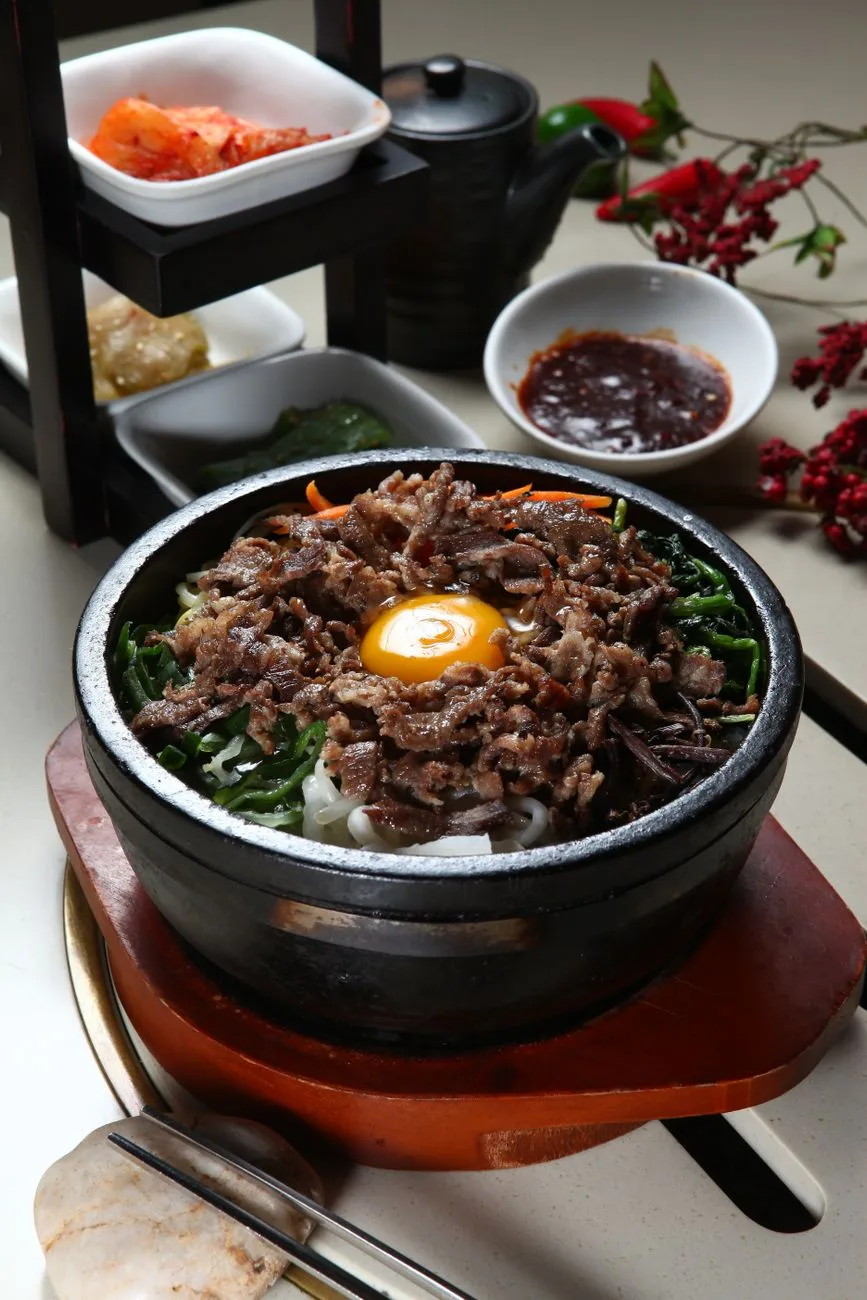
A weeknight bibimbap takes about 25 minutes if you stop cooking each vegetable in its own pan. Blanch spinach and bean sprouts in one pot of water, sauté carrot and zucchini in one skillet, fry an egg, and mix 1 tablespoon gochujang with ½ teaspoon sugar, ¾ teaspoon sesame oil and ¾ teaspoon water per bowl.
The short version
- The hour in most published recipes is not cooking time. It is five vegetables cooked and seasoned separately, in five pans.
- One pot of salted water handles the spinach and the bean sprouts. One skillet handles everything else, cooked mildest to strongest, wiped between.
- The sauce is four ingredients in a fixed ratio, scaled to 1 tablespoon of gochujang per bowl.
- The step never worth cutting is squeezing the blanched spinach dry. Wet greens dilute the sauce into a pink slick at the bottom of the bowl.
The 25-minute method: one pot, one skillet
Quantities below make two bowls. Double everything except the pot of water.
- Start the rice first. 1 cup (about 200 g) uncooked short-grain rice, cooked with slightly less water than the packet says. Korean Bapsang's bibimbap, updated in February 2022, specifies the same drier grain, and the reason is mechanical: dry rice takes the sauce as a coating, wet rice turns it into porridge.
- Boil 2 litres of water with a teaspoon of salt. Drop in 115 g spinach for 45 seconds. Lift it out with tongs into cold water, squeeze it hard in your fist, and season with ½ teaspoon sesame oil, a pinch of salt and ¼ teaspoon minced garlic.
- Reuse that same water for 115 g bean sprouts. Mung bean sprouts need about 3 minutes, soybean sprouts closer to 5. Drain and season them exactly like the spinach.
- One skillet, mildest to strongest, no washing. Julienned carrot with a pinch of salt for 2 minutes. Wipe with kitchen paper. Sliced zucchini for 2 minutes. Wipe. Sliced mushrooms for 3 minutes. Wipe. Then, if you are adding beef, 115 g thinly sliced, over high heat for 2 to 3 minutes.
- Fry the eggs last, sunny side up, while the vegetables sit.
- Assemble: rice in the bowl, vegetables in wedges around the rim, beef and egg in the middle, sesame seeds over the top, sauce on the side rather than on top.
The order in step 4 is the whole trick. Carrot leaves nothing behind, zucchini leaves water, mushrooms leave a little colour, beef leaves fat and marinade. Run it in reverse and you are washing the pan four times.
Where the 25 minutes actually goes
Count it out for two bowls: 8 minutes to wash and cut four vegetables, 5 minutes for the pot (spinach and sprouts, back to back in one water), 12 minutes for the skillet sequence including four wipes, 3 minutes for the eggs. That sums to 28. Squeezing and seasoning the spinach happens while the sprouts boil, which claws back about 3 minutes, so hands-on time lands around 25 minutes. The rice cooks in parallel and never touches the count.
The published versions land at 55 minutes (Korean Bapsang), 1 hour 10 minutes (RecipeTin Eats, updated March 2026) and about 1 hour 16 minutes (Maangchi). The gap is not skill. It is a 20-minute beef marinade, a separate pan per vegetable, and dried shiitake that need soaking.
The gochujang sauce ratio, scaled to one bowl
Korean Bapsang's sauce is 4 tablespoons gochujang : 2 teaspoons sugar : 1 tablespoon sesame oil : 1 tablespoon water, for four servings. Divide by four and you get a per-bowl ratio worth memorising:
- 1 tbsp gochujang
- ½ tsp sugar
- ¾ tsp toasted sesame oil
- ¾ tsp water
That is 3 teaspoons of gochujang against 2¼ teaspoons of everything else, which is why it stays hot rather than sweet. RecipeTin Eats builds a looser sauce off the same 4 tablespoons of gochujang by adding 2 tablespoons mirin, 2 tablespoons rice vinegar, 1½ teaspoons soy sauce and a grated garlic clove; Maangchi sweetens with honey instead of sugar.
For a weeknight bowl, use the four-ingredient ratio. Add ½ teaspoon of rice vinegar per bowl only if your gochujang is one of the thick, salt-forward brands that sits on the rice in a lump instead of spreading. Serve it beside the bowl and let each person stir in half, taste, then add the rest. Once it is mixed in, it cannot be walked back.
What an easy bibimbap recipe can safely cut
This is the table that decides your evening. Minutes are for a two-bowl batch.
| Step in the traditional method | Minutes saved | Cut it? |
|---|---|---|
| 20-minute beef marinade | 20 | Yes |
| Separate pan per vegetable | 12 | Yes |
| Blanching greens and sprouts in separate water | 4 | Yes |
| Soaking dried shiitake | 30 | Yes |
| Squeezing the blanched spinach dry | 1 | No |
| Cooking the rice drier than usual | 0 | No |
| Fried or raw egg on top | 3 | Optional |
| Gosari (bracken fern), pre-soaked | 25 | Optional |
What the table shows is that almost every minute worth saving is organisational, not culinary. Cutting the marinade costs you nothing if you season the beef in the pan instead: soy sauce, sugar and sesame oil hitting a hot skillet caramelise in seconds rather than penetrating over 20 minutes, and in a bowl mixed with gochujang the difference is small. Cutting the spinach squeeze costs you the sauce. Swap the dried shiitake for fresh and you lose a little depth and half an hour.
Gosari is the one omission a Korean cook will notice. It carries the chewy, faintly smoky note that separates a Jeonju-style bowl from a rice salad, and there is no fast substitute for it.
Where this shortcut fails
Dolsot bibimbap. The crackling layer of rice at the bottom, nurungji, comes from a stone bowl preheated until it hisses, brushed with sesame oil, then held over heat for five to eight minutes after the rice goes in. A 25-minute plan and a nonstick skillet give you a warm bowl, not a crust. If the crust is the point, budget the extra time and buy the stone.
Cooking namul as banchan. If the plan is to eat these vegetables through the week as side dishes, cook and season each one separately and store them in their own containers. The one-skillet sequence blurs their seasoning together, which is fine mixed under gochujang and wrong on a banchan plate.
Feeding six or more. Past about four bowls the single skillet becomes the bottleneck and you start cooking carrots in batches. Two pans running side by side beat the wipe-and-reuse method at that volume.
Protein, and the vegetarian route
Thinly sliced beef is the default because it cooks in the two to three minutes the method allows. Korean Bapsang uses 8 oz for four servings; RecipeTin Eats uses 250 g of tenderloin sliced fine. Ground beef behaves differently: it releases more fat, needs draining, and takes the sauce ratio in a different direction, which is worked through in Ground Beef Bibimbap.
Without meat, the bowl needs a second savoury element or it reads flat. Firm tofu cubed and pan-fried in the same skillet after the mushrooms does it in 6 minutes. Maangchi's version leans on soybean sprouts, red bell pepper and zucchini and lands at 620 calories per serving; RecipeTin Eats' beef version reports 689 per serving. A bowl at an inexpensive Seoul restaurant sits around ₩13,000 according to Numbeo's Seoul index retrieved on 12 August 2026, and at home the beef is where the cost concentrates.
No gochujang in the house is the harder problem, because it is not a chilli sauce. The Codex Alimentarius regional standard for gochujang, CXS 294R-2009, adopted through the Codex Committee for Asia in 2009 and raised to a worldwide standard in 2020, defines it as a fermented product of red pepper powder, a soybean ferment and a starch source. Sriracha replaces the heat and none of the fermented depth or the malt sugar. Workable substitute ratios are set out in 4 Tteokbokki Recipes Without Gochujang, and if a half-used tub is the reason you are here, it also goes into kimchi made with gochujang.
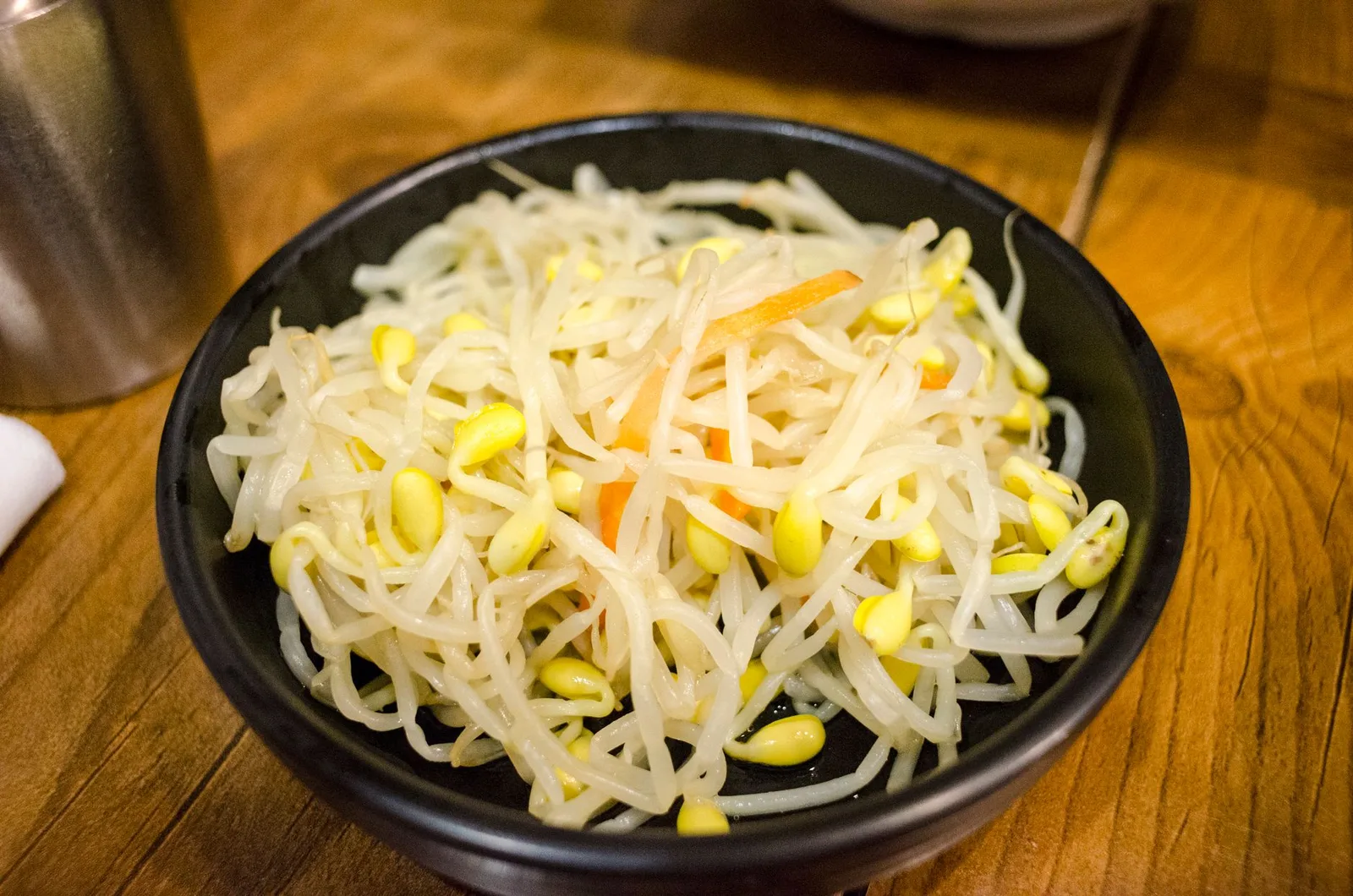
Why the vegetables sit in separate wedges
Bibimbap started as a clearing-out dish. The term goldongjiban appears in Hong Suk-mo's Dongguk Sesigi, first published in 1849, and the earliest known written recipe turns up in the late-19th-century cookbook Siuijeonseo, according to National Geographic's account of the dish's history. Goldongban was eaten on the eve of the lunar new year to empty the pantry before the turn of the year, and "goldong" carries the sense of mixing things up messily.
That origin is permission. There is no canonical vegetable list. Cabbage, bell pepper, cucumber left raw, blanched chard, yesterday's steamed broccoli all belong in the bowl as long as each one is seasoned on its own and laid in its own wedge. The separation is what lets a diner taste the components before the mixing, and it is the only part of the presentation worth protecting.
Jeonju is the city the dish is identified with, and it was named a UNESCO Creative City of Gastronomy in May 2012, the first Korean city and the fourth city worldwide to hold that designation. The city has run a Jeonju Bibimbap Festival every October since 2007. The official Korea Tourism Organization listing still shows the 24 to 26 October 2025 edition at Jeonju World Cup Stadium with free admission; the 2026 dates were not published on either the KTO or Jeonju city festival calendars as of 13 August 2026.
Questions people ask next
Can I use leftover cold rice?
Yes, but reheat it first. Sprinkle a tablespoon of water over the rice, cover, and microwave for 90 seconds. Cold rice makes gochujang clump into red beads that never distribute, and the seasoned vegetables go cold on contact.
Do I need a stone bowl for bibimbap?
No. The stone bowl produces the toasted rice crust and keeps the bowl hot to the last bite; a ceramic bowl produces neither and changes nothing else. Warm the ceramic bowl with hot tap water for 30 seconds before assembling and the dish holds heat well enough for a weeknight.
How many calories is a bowl of bibimbap?
Two published recipes put a beef-and-egg serving at 620 (Maangchi) and 689 (RecipeTin Eats). The two levers are rice volume and sesame oil, which appears in every namul as well as in the sauce. Halving the rice and seasoning three vegetables instead of five moves the number more than dropping the egg does.
Which vegetables work if I have none of the standard ones?
Anything mild that cooks through in under three minutes: napa or green cabbage, bell pepper, snow peas, courgette. Cucumber goes in raw, salted for five minutes and patted dry. Avoid anything strongly bitter or heavily brined, which fights the gochujang instead of sitting under it.
How should I store the components?
Refrigerate each seasoned vegetable separately and assemble at the table. Cooked namul holds three to four days refrigerated, the standard window for cooked leftovers, while an assembled and dressed bowl goes soggy within hours. Reheat only the rice; the vegetables are good cold or at room temperature, which is how they are served in Korea anyway.
This is general cooking information. Check ingredient labels if you are managing an allergy, since commercial gochujang is fermented with grain and formulations differ by brand.