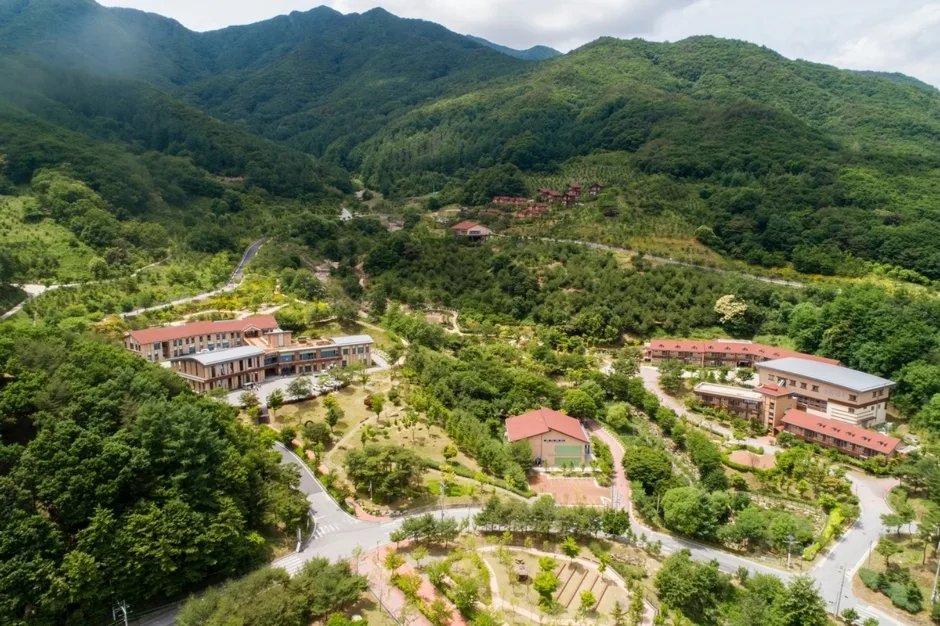
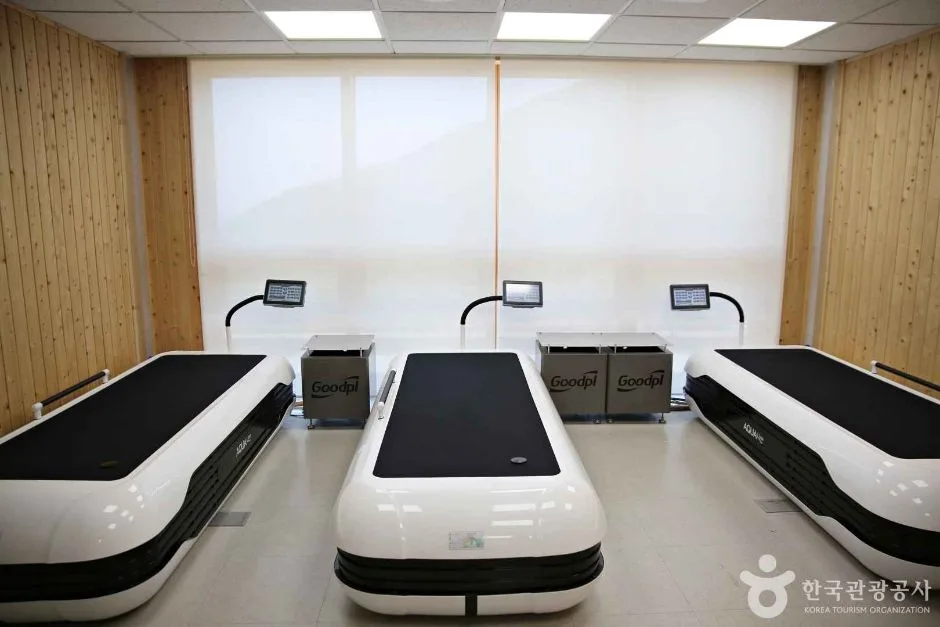
The National Center for Forest Therapy (국립산림치유원, brand name Daseurim) is Korea's largest state-run forest healing complex, at the foot of Sobaeksan in Yeongju, Gyeongsangbuk-do. As of August 2026, rooms run from ₩56,000 on an off-peak weekday to ₩280,000 at peak, and a one-hour forest healing session costs ₩6,000 per person.
Before you open the booking page
- The complex is run by the Korea Forest Welfare Institute, a public agency under the Korea Forest Service, not by a hotel operator. Pricing and refunds follow public-facility rules.
- Programmes are priced separately from the room. A stay with two sessions for two adults lands near ₩154,000 on a weekday (worked out below).
- The building closes to visitors on the first Monday of every month, moving to Tuesday when that Monday is a public holiday.
- No alcohol, no cooking, no pets, and no TVs in the rooms. That is policy, not an oversight.
What the National Center for Forest Therapy actually is
It is a therapy facility with lodging attached, not a resort with a forest view. The Korea Forest Welfare Institute describes it as the largest forest treatment complex in Korea, and the institute itself was set up in April 2016 under the Forest Welfare Promotion Act to run 22 public facilities: two forest healing centers, seven forest education centers, eleven healing forests and one memorial forest.
The legal basis matters because it defines what happens on site. Under Article 2 of the Forestry Culture and Recreation Act (Act No. 7676, enacted 4 August 2005, last amended by Act No. 19487 on 20 June 2023), forest healing means "immune-strengthening and health-promoting activities, which utilize a variety of elements of the forest, including scents and scenic views." The same Act, at Article 11-2, creates the licensed profession of Forest Healing Instructor, so the person leading a session holds a ministerial accreditation rather than a hospitality job title.
The centre opened on 18 October 2016 after a 148 billion won build. Yeongju City puts the total site at 2,889 hectares with a 152-hectare core facility zone, and the complex straddles two counties: the Juchi District in Bonghyeon-myeon, Yeongju, and the Munpil District over the boundary in Yecheon-gun. Nine healing trail courses total about 50 km, which is more walking than any single stay can absorb.
One inconsistency worth knowing before you dial. The Korea Tourism Organization lists the information desk as +82-54-639-3522, while the Korea Forest Welfare Institute publishes 054-639-3400 as the main office line, open weekdays 09:00 to 18:00 with a lunch break from 12:00 to 13:00. Both are official; try the 3400 number for reservations questions.
Hours, closing days and the address
Per the Korea Tourism Organization listing fetched on 14 August 2026, walk-in day visits run 09:00 to 18:00, accommodation check-in is 15:00 and check-out is 11:00. The official booking site widens the arrival window to 15:00–21:00, so a late arrival is workable if you tell the desk. Parking is available on site.
The address is 209 Therapy-ro, Bonghyeon-myeon, Yeongju-si, Gyeongsangbuk-do. Yeongju sits far enough from the capital that this is an overnight commitment, not one of the day trips from Seoul that fit inside the three-hour rule.
What a stay and a session cost in 2026
The table below answers the first question most people have: what does a room actually cost, and how much worse is a Saturday? All figures were read from the official Sooperang fee page on 14 August 2026.
| Building | Room type | Sleeps | Weekday (KRW, Aug 2026) | Weekend/peak (KRW, Aug 2026) |
|---|---|---|---|---|
| JA | Single, Yeongju | 3 | 58,000 | 106,000 |
| JB | Single, Yeongju | 6 | 98,000 | 173,000 |
| JC | Single, Yeongju | 9 | 175,000 | 280,000 |
| SA | Group, Yeongju | 3 | 56,000 | 102,000 |
| SB | Group, Yeongju | 5 | 95,000 | 162,000 |
| MA | Single, Yecheon | 3 | 58,000 | 106,000 |
| MB | Single, Yecheon | 6 | 98,000 | 173,000 |
| MC | Group, Yecheon | 3 | 56,000 | 102,000 |
The pattern the table shows: the weekend rate is close to double the weekday rate on every category, and the Yecheon (Munpil) side is priced identically to the Yeongju (Juchi) side for the same capacity. The official fee schedule defines peak season as 15 July to 24 August each year, and counts Fridays, Saturdays and the eve of a legal holiday as "weekend" for pricing.
Meals are charged per person per meal: 8,000 won for adults aged 13 and over, 5,500 won for children aged 7 to 12 and for pre-schoolers over 36 months, and 3,000 won for under-36-months, waived when the toddler shares with a guardian.
Programme fees are flat regardless of the day of the week, which is the single most useful fact for budgeting.
| Programme | Duration | Individual (KRW, Aug 2026) | Group of 20+ (KRW) |
|---|---|---|---|
| Forest healing | 1 hr | 6,000 | 5,000 |
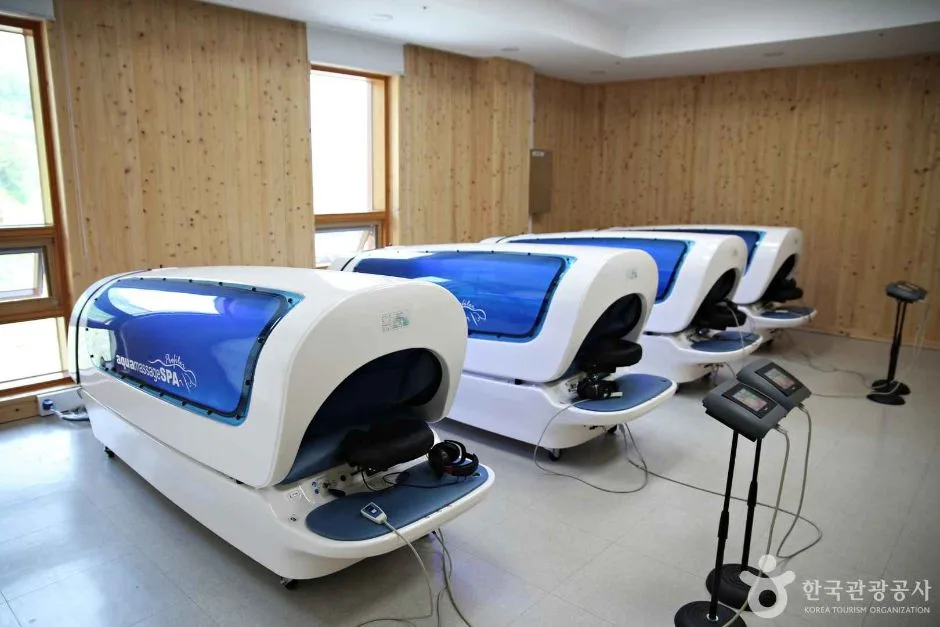
| Water therapy | 2 hrs | 26,000 | 24,000 |
| Healing-equipment experience | 1 hr | 16,000 | 15,000 |
| Tea ceremony | 1 hr | 10,000 | 9,000 |
| Singing-bowl meditation | 1 hr | 11,000 | 10,000 |
Discounts apply to the room, not the programmes: 50% off-peak for guests with a severe disability (10% during peak season), and 30% off-peak for Yeongju and Yecheon residents, large families, pregnant women and other designated groups.
Worked example: two adults, one weekday night
Take the cheapest realistic booking for a couple. A JA single-type room sleeping three, on an off-peak Tuesday, with dinner and breakfast for two and two programmes each.
- JA room, weekday: 58,000
- Dinner, 2 adults × 8,000: 16,000
- Breakfast, 2 adults × 8,000: 16,000
- Water therapy, 2 hrs, 2 × 26,000: 52,000
- Forest healing, 1 hr, 2 × 6,000: 12,000
- Total: 154,000 won, or 77,000 per person.
Run the identical booking on a peak-season Saturday and only one line changes: the room goes from 58,000 to 106,000, pushing the total to 202,000 won, or 101,000 per person. The 48,000 won difference is larger than the cost of both people's water therapy session. If the date is movable at all, moving it off Friday, Saturday and the 15 July to 24 August window buys you the entire programme budget back.
There is a packaged alternative. The Korea Tourism Organization lists a "Daseurim Stay" for two people, one night and two days, at 93,000 won with meals included on overnight stays. Against the à la carte weekday numbers above, room plus two meals each comes to 90,000, so the package is roughly level on a Tuesday and clearly cheaper than a 106,000 weekend room before food. Book the package for weekend dates; build it yourself midweek.
Booking on Sooperang, and the refund ladder
Reservations moved domain. The old daslim.fowi.or.kr address now serves nothing but a change notice; the live portal is sooperang.go.kr, facility ID FT00001. The interface is Korean-only, which is the real barrier for foreign visitors rather than anything on site.
Pay immediately after booking. Two official pages give different payment deadlines: the terms of use say facility fees must be settled by 17:00 the day after booking, while the reservation guide page says payment is due by 22:00 on the reservation date. Settling the balance at the moment of booking satisfies both readings.
The cancellation schedule is stricter in peak season and on weekends, and it answers the question of how late you can pull out without losing money.
| Notice before stay | Peak/weekend refund | Off-peak weekday refund |
|---|---|---|
| 10+ days | 100% | 100% |
| 7 days | 80% | 100% |
| 5 days | 60% | 100% |
| 3 days | 40% | 100% |
| 2 days | 40% | 100% |
| 1 day | 10% | 90% |
| Same day or no-show | 10% | 80% |
What this shows is an asymmetry worth planning around: a midweek off-peak booking is nearly risk-free to cancel, losing 20% even on a no-show, while a peak Saturday booking has already lost 60% of its value five days out. The percentages come from the official terms and cancellation page, and refunds are processed within seven days excluding public holidays.
The Korea Tourism Organization reports that Sooperang opens the following month's inventory at 09:00 on the 15th of each month, with bookings accepted until 15:00 the day before use. That rule is not restated on the Yeongju centre's own reservation pages, so treat the 15th as the sensible date to be at the keyboard rather than a guarantee.
House rules that catch first-time guests
The published rules for the accommodation buildings ban cooking, alcohol and pets, with certified service dogs the only exception. Rooms have no TV. Toiletries and towels are not supplied, and ID is checked at check-in against the booking name.
That combination is deliberate. It also means the trip fails badly for one type of visitor: anyone expecting a hot-spring hotel with a convenience-store run and drinks on the balcony will spend the evening annoyed. The right frame is a two-day health programme with a bed included.
The other failure mode is calendar-based. Turning up on the first Monday of a month means the facility is closed, and unlike a city attraction there is nothing else within walking distance to fall back on.
Yeongju or Jinan: two national forest therapy centers now
Since late 2025 there are two, and searches for the National Center for Forest Therapy return both. The National Jinan Highland Forest Healing Center (국립진안고원산림치유원) is the second, in Jeonbuk State.
| Yeongju (Daseurim) | Jinan Highland | |
|---|---|---|
| Opened | 18 October 2016 | 15 October 2025 |
| Site area | 2,889 ha | 617 ha |
| Trails | 9 courses, about 50 km | 6 courses, 11 km |
| Rooms | Not published | 74 rooms, max 270 people |
| Altitude / setting | Sobaeksan, Baekdudaegan | 650 m, Baegundong Valley |
| Phone | +82-54-639-3400 | 042-719-4000 |
The table makes the choice fairly clean. Yeongju is the larger and more established site, with roughly four and a half times the trail distance and nine years of operating history behind its programme list. Jinan, per the Korea Forest Welfare Institute, was built between 2018 and 2024 on a 617-hectare site at 650 m elevation between Deoktaesan and Seongaksan, with 57 group rooms in Haneul-dong and 17 family rooms in Baram-dong.
Book Yeongju if you want the full programme range and the trail network. Choose Jinan if you are coming from the Honam region or want newer buildings, and accept that a facility under a year old has a programme list and a fee schedule still settling. Jinan's rates are not yet published on the official Sooperang fee page; the Korea Tourism Organization has reported a 44,000 won off-peak weekday rate for a two-person Haneul-dong room, which is worth treating as indicative until the official table appears.
One date to be careful with if you cite it: Jinan began operations on 15 October 2025, but its opening ceremony was held on 6 November 2025, so published "opening dates" differ by three weeks.
What the programmes claim to do, and what that claim is worth
The Korea Forest Welfare Institute publishes a list of expected effects from forest therapy: easing of depressive symptoms, reduced cortisol, lower blood pressure, activated NK cells, and improvement in atopic dermatitis and asthma. Those are the institute's own institutional summaries of the research base, not outcomes promised to an individual guest.
The staffing behind it is regulated. The Korea Forest Service sets two grades of Forest Healing Instructor: Grade 2 requires a relevant bachelor's degree in medicine, health, nursing or forestry, or an associate degree plus two years of related experience, or four years of forest therapy work; Grade 1 requires five further years after Grade 2, or a master's or doctorate in those fields.
One number the centre does not publish: visitor totals. Neither the institute's facility page nor Korea Forest Service statistics give annual or cumulative attendance for the Yeongju site, and no official room count exists either. The 2,000-guest capacity quoted in 2016 news coverage was an opening-day maximum, not a room inventory.
This article is general information about a public facility. Forest therapy sessions here are wellness programmes, not medical treatment, and nothing on the site substitutes for care from a clinician.
Questions people ask before booking
Is entry to the National Center for Forest Therapy free?
No. Day visitors pay per programme, starting at 6,000 won for a one-hour forest healing session as of August 2026, and overnight guests pay the room rate on top. Parking is available and the trails are part of the complex rather than a separately ticketed park.
Do I have to stay overnight to join a programme?
No. Walk-in day use runs 09:00 to 18:00, and the programme fees are the same whether or not you have a room. A day trip built around water therapy (26,000 won, two hours) and a forest healing session (6,000 won) costs 32,000 won per person before food.
Can I bring food, drink or a dog?
No on all three. Cooking and alcohol are prohibited in the accommodation, and pets are not admitted, with certified service dogs the sole exception. Meals are bought on site at 8,000 won per adult.
What is the difference between a healing forest and this centre?
A healing forest (치유의 숲) is a designated forest developed for forest healing under the Forestry Culture and Recreation Act, and there are dozens across the country, eleven of them run by the Korea Forest Welfare Institute. The National Center for Forest Therapy is a full complex with lodging, a water therapy centre, herb gardens and accredited instructors, which is why it carries room rates at all.
When do rooms for next month go on sale?
The Korea Tourism Organization reports the Sooperang system releases the following month's inventory at 09:00 on the 15th, with same-week bookings accepted until 15:00 the day before arrival. Peak-season weekends in the 15 July to 24 August window are the dates that go first, so those are the ones worth chasing on release morning.