A single person renting a studio in Seoul spends roughly ₩1.7–2.6 million a month on rent, food, utilities, transport and phone. At ₩1,400 to the dollar, that is about $1,200–$1,850. Housing sets the range. The number that moves fastest is not a Korean price at all: it is the exchange rate.
The short version
- Working rate used throughout this page: $1 = ₩1,400. Divide any won figure by 1,400, and recheck the live rate at the Bank of Korea before you sign anything.
- A studio in an outer district runs ₩600,000–₩900,000 a month plus a deposit of ₩5–20 million. Central Gangnam or Seongsu roughly doubles the monthly figure.
- The deposit, not the rent, is the real entry barrier for newcomers.
- Payroll takes about 9.4% for the four social insurances before income tax is withheld.
- A ₩4,000,000 gross salary nets around ₩3.4 million, close to $2,430.
What a month in Seoul costs in USD, by budget tier
These three tiers are planning ranges assembled from the component prices in the sections below, not survey averages. Rent is included; the refundable lease deposit is not, because it is capital you get back rather than money you spend.
| Tier | Housing | Monthly total (KRW) | Monthly total (USD @1,400) |
|---|---|---|---|
| Lean | Goshiwon room or a shared flat, outer district | ₩1,000,000–₩1,400,000 | $715–$1,000 |
| Standard | Own studio or officetel, 30–40 min from centre | ₩1,700,000–₩2,600,000 | $1,215–$1,860 |
| Comfortable | One-bedroom or small apartment in Mapo, Seongdong, Yongsan | ₩3,000,000–₩4,200,000 | $2,145–$3,000 |
Statistics Korea publishes actual household spending by city and household size in its Household Income and Expenditure Survey, released through KOSIS. Use it to sanity-check a single category such as food or transport. It will not price your particular lease, because rent varies more by building and street than by district.
The tiers break in two situations. Owning a car adds parking at ₩100,000–₩250,000 a month in most apartment complexes plus annual vehicle tax and insurance. Children add private academy fees, commonly ₩300,000–₩600,000 per subject per month in Seoul, which dwarfs every other line on the budget.
Why the dollar figure changes when nothing in Korea does
The won traded broadly between ₩1,300 and ₩1,480 to the dollar across 2024 and 2025, with the weaker end reached during late-2024 and 2025 volatility. That band alone moves a dollar budget by more than 10%.
Run the arithmetic on a fixed ₩2,000,000 monthly spend:
- At ₩1,300: $1,538
- At ₩1,400: $1,429
- At ₩1,480: $1,351
Same apartment, same groceries, a $187 swing. Anyone comparing Seoul against a home-country salary should price the risk of that swing before treating a dollar figure as fixed. The Bank of Korea publishes exchange rate statistics through its ECOS database, and Korean banks quote the daily market average rate for cash and remittances separately, with a spread on each.
If income arrives in dollars and rent is due in won, a weak won helps. If a Seoul salary funds a dollar-denominated student loan, it hurts.
Rent, deposits, and the jeonse maths nobody explains
Korean residential leases come in two shapes. Wolse pairs a modest refundable deposit (보증금) with monthly rent. Jeonse replaces monthly rent entirely with one very large refundable deposit, historically 50–80% of the property's value, returned in full at the end of the contract.
Typical asking ranges for a one-room or small officetel, based on Korean brokerage listings:
| Area | Monthly rent | Deposit |
|---|---|---|
| Gwanak, Nowon, Eunpyeong | ₩450,000–₩700,000 | ₩5–10 million |
| Mapo, Dongdaemun, Seongdong | ₩700,000–₩1,100,000 | ₩10–20 million |
| Gangnam, Seocho, Yongsan | ₩1,000,000–₩1,700,000 | ₩10–30 million |
Asking prices are not contract prices. The Ministry of Land, Infrastructure and Transport discloses actual registered rental contracts, including deposit and monthly rent by building, at its real transaction price system, rt.molit.go.kr. Checking the building you are about to rent in, before the viewing, is the single highest-value ten minutes in the whole process.
Worked example: is jeonse cheaper than wolse?
Suppose the same studio is offered two ways: ₩10 million deposit plus ₩700,000 a month, or ₩150 million jeonse.
The extra deposit is ₩140 million. It buys out ₩700,000 a month, which is ₩8.4 million a year. That is an implied return of 6.0% on the extra capital (8,400,000 ÷ 140,000,000).
So jeonse wins only if that ₩140 million (about $100,000) would earn less than 6% after tax somewhere else, and only if the deposit is genuinely safe. Korea's Housing Lease Protection Act caps the landlord's conversion rate at the lower of the Bank of Korea base rate plus 2 percentage points, or 10%, so a quoted conversion far above that ceiling is a negotiating point rather than a fixed rule.
The position: for a stay under two years, wolse with a small deposit is the correct default. Jeonse makes sense only for longer stays, with a deposit-return guarantee from the Korea Housing and Urban Guarantee Corporation (HUG) whose premium costs a fraction of a percent of the deposit per year, and after checking the property's registry for prior mortgages. Deposit-return fraud has been a live problem in Korea, and a foreign tenant chasing an unreturned ₩150 million through Korean courts is in an expensive position.
On top of rent, most buildings charge a management fee (관리비) of ₩50,000–₩200,000 a month covering cleaning, security, lift maintenance and sometimes water or internet. Ask what it includes before comparing two listings.
Food: eating out is cheap, groceries are not
The inversion catches most newcomers. A restaurant lunch in Seoul is cheaper than in most large Western cities; buying the ingredients to cook the same thing at home is often not.
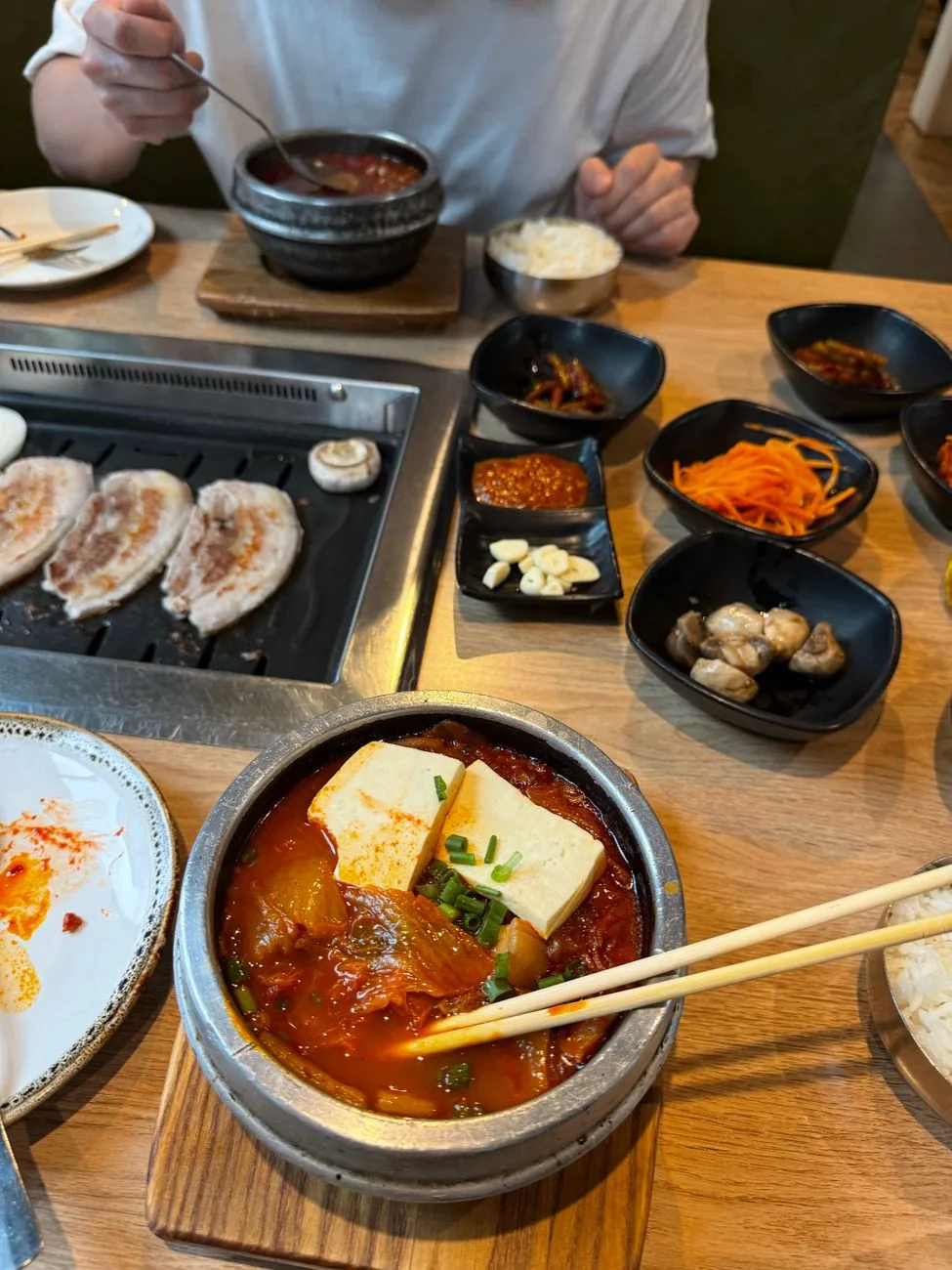
The Korea Consumer Agency tracks restaurant prices for eight standard dishes by district and publishes them at 참가격 (price.go.kr). Seoul averages through 2025 sat approximately here:
| Dish | Approx. Seoul price | USD @1,400 |
|---|---|---|
| Kimbap | ₩3,500 | $2.50 |
| Jjajangmyeon | ₩7,700 | $5.50 |
| Kimchi jjigae set | ₩8,500 | $6.10 |
| Bibimbap | ₩11,000 | $7.85 |
| Naengmyeon | ₩12,000 | $8.60 |
| Samgyetang | ₩17,000 | $12.15 |
Check the site for the current month; these figures rise most years. A chain americano runs ₩4,500–₩5,000 at Starbucks and about ₩1,500–₩2,000 at low-cost chains like Mega Coffee or Compose.
Groceries move the other way. Domestic beef (한우) is a luxury item, and fruit prices in Korea are high by international standards because of limited import channels and small domestic acreage: a few apples or a single melon can cost more than a full restaurant meal. Imported cheese, wine, and Western baking ingredients carry a large premium. Traditional markets such as Mangwon or Gyeongdong beat large marts on produce, and mart apps discount fresh items heavily in the last two hours before closing.
Delivery adds ₩3,000–₩5,000 per order plus a minimum order value, so ordering in twice a week quietly adds ₩40,000 a month.
A realistic single-person food budget: ₩250,000 groceries plus ₩300,000 eating out, or about $390 a month combined.
Transport, phone, and utilities: the fixed costs
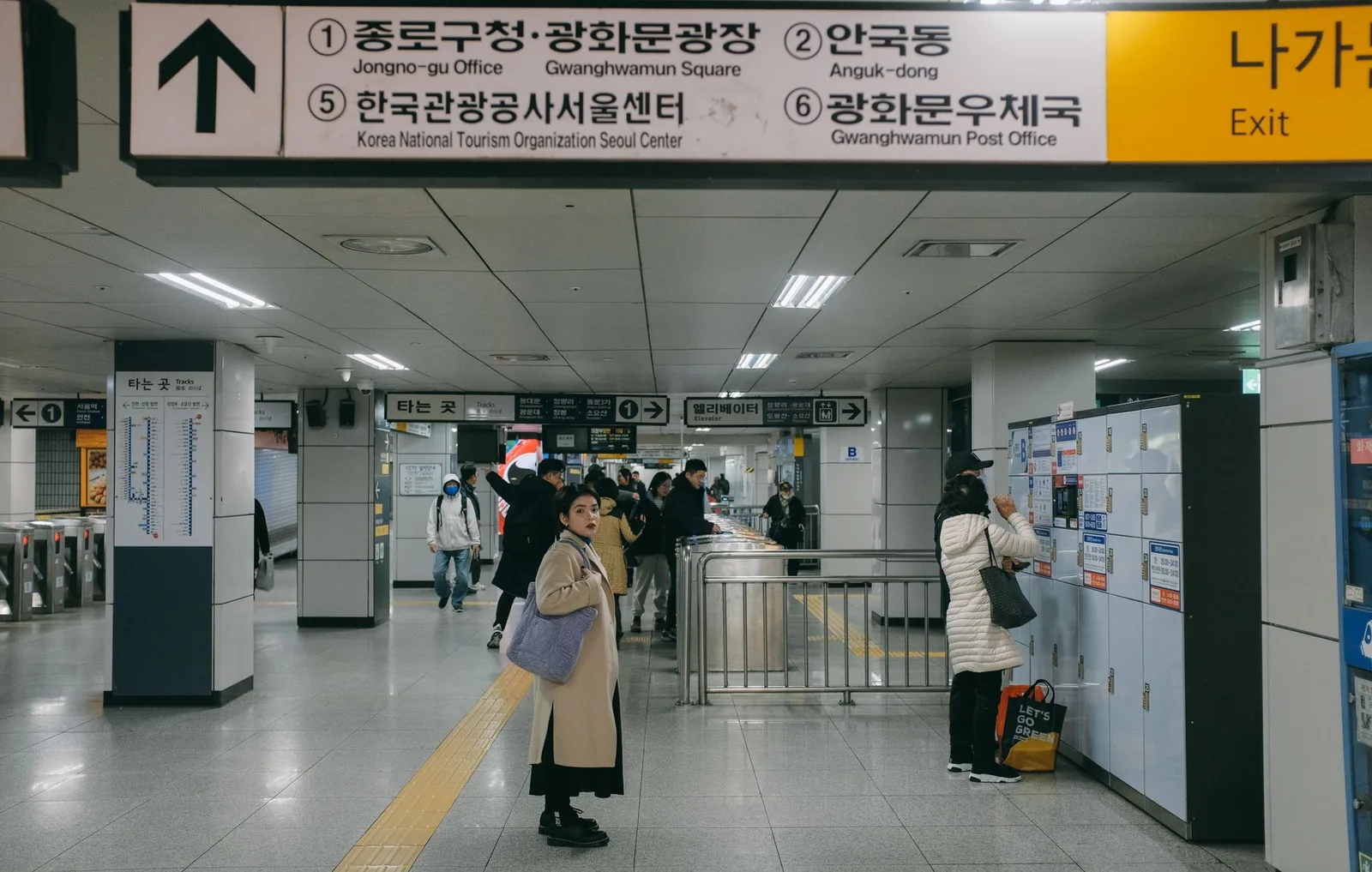
Seoul's base subway fare has been ₩1,400 with a transit card since the October 2023 revision, with distance surcharges beyond 10 km and free transfers between bus and subway within 30 minutes. The base city bus fare is ₩1,500. Seoul has repeatedly deferred the next scheduled increase, so confirm the current fare on seoul.go.kr.
Two passes change the arithmetic:
- 기후동행카드 (Climate Card), launched by the Seoul Metropolitan Government in January 2024, gives unlimited Seoul subway and bus travel for ₩62,000 for 30 days, or ₩65,000 including Ttareungi public bikes, with a lower youth rate. It pays for itself at roughly 44 rides a month, which a five-day commuter passes easily.
- K-패스, run nationally since May 2024 under the Ministry of Land, Infrastructure and Transport, refunds about 20% of transit spending for general users and more for youth and low-income riders, from 15 trips a month up to 60.
They cannot be combined, so pick the Climate Card for a Seoul-only commute and K-Pass if travel crosses into Gyeonggi or Incheon regularly.
Mobile service splits sharply. The three major carriers price postpaid plans at roughly ₩50,000–₩90,000 a month, while MVNO (알뜰폰) resellers running on the same networks offer ₩10,000–₩25,000 plans with generous data. Short-stay visitors have different options entirely, covered in our guide to what a Korean tourist SIM actually costs.
Utilities are seasonal, not flat. Electricity is billed on progressive tiers by KEPCO, so a summer of continuous air conditioning can push a bill past ₩150,000 in a month that would otherwise sit near ₩30,000. City gas does the same in reverse: a floor-heated apartment can run ₩20,000 in September and ₩150,000–₩250,000 in January. Budget the annual total, not the month you move in.
Taxes and social insurance: what leaves a Seoul paycheck
Four statutory insurances come off a salaried employee's pay before income tax. Take a ₩4,000,000 monthly gross salary for a single employee with no dependents:
| Deduction | Rate (employee share) | Monthly |
|---|---|---|
| National Pension | 4.5% | ₩180,000 |
| National Health Insurance | 3.545% | ₩141,800 |
| Long-term care insurance | 12.95% of health premium | ₩18,363 |
| Employment insurance | 0.9% | ₩36,000 |
| Social insurance subtotal | ≈9.4% | ₩376,163 |
| Income tax + local income tax (withheld) | varies with dependents | ≈₩220,000 |
| Net pay | ≈₩3,403,837 ($2,431) |
The health insurance rate has been 7.09% of wages split equally between employer and employee since 2024, and the pension contribution base is capped above a monthly income ceiling, so high earners pay a flat maximum rather than 4.5% of everything. Current rates are published by the National Health Insurance Service and the National Pension Service; verify both before modelling an offer.
Income tax is withheld against the National Tax Service's simplified withholding table and reconciled each February in the year-end settlement (연말정산), which frequently produces a refund. Foreign employees may elect a flat 19% rate (plus the 10% local surtax, so 20.9%) instead of the progressive 6–45% schedule, for a limited number of years from their first working day in Korea. The flat rate forfeits all deductions and credits, so it rarely wins at ordinary salary levels. Run both through the calculators on Hometax before electing it, because the election is hard to unwind.
One trap for non-employees: foreign residents staying six months or more must enrol in National Health Insurance, and those without an employer pay as regional subscribers at a floor pegged to the national average premium, which has sat near ₩150,000 a month in recent years. Students on a D-2 visa have received a substantial reduction on that floor. Freelancers and jobseekers should assume this cost from month one.
What newcomers underestimate
Move-in day costs more than the first month's rent. Expect the brokerage fee (중개보수), capped on a sliding scale by Seoul city ordinance and calculated for monthly leases on the deposit plus one hundred times the monthly rent; a small move at ₩300,000–₩700,000; and basics for an empty officetel. Filing your move-in registration (전입신고) at the district office and getting the fixed date stamp (확정일자) on the lease costs ₩600 and is what secures your deposit's priority claim. Skipping it to save an afternoon is the most expensive mistake on this page.
The other recurring surprises: Chuseok and Seollal gift obligations, a ₩30,000–₩50,000 norm for wedding cash gifts, and the fact that a weekend outside Seoul is a separate budget line. If those trips are frequent, our break-even analysis of the Korea Rail Pass shows when a pass beats point-to-point KTX fares.
Before you sign a lease
- Pull the building's registered lease prices on rt.molit.go.kr and compare against the asking price.
- Check the property registry (등기부등본) for mortgages ranking ahead of your deposit.
- Confirm what the management fee covers, in writing.
- Register your move-in and get the fixed date stamp the day you receive the keys.
Questions people ask before moving to Seoul
How much money should I have saved before moving to Seoul?
Plan for the deposit plus roughly three months of living costs. A ₩10 million deposit ($7,145), a ₩700,000 first month, brokerage and moving fees, and a ₩5 million cushion put the realistic starting figure near ₩17–20 million, or $12,000–$14,300 at ₩1,400.
Can I live in Seoul on $1,000 a month?
Yes, in a goshiwon or a shared flat. Goshiwon rooms in Seoul run roughly ₩350,000–₩600,000 a month with no deposit and often include rice and kimchi. Once you rent a private studio and pay a full deposit, $1,000 stops being realistic in almost every district.
What is the minimum wage in Seoul, in dollars?
Korea's minimum wage applies nationwide, with no Seoul premium. The Minimum Wage Commission set ₩10,320 per hour for 2026. At the standard 209 monthly hours used for full-time pay, that is ₩2,156,880 a month, about $1,540. Confirm the current figure with the Ministry of Employment and Labor.
Is Seoul cheaper than Tokyo or Singapore?
Directionally: rent in Seoul is well below Singapore and Hong Kong for equivalent central space, restaurant meals are broadly comparable to Tokyo, and groceries, particularly fruit, beef and imported goods, are more expensive in Seoul than in Tokyo. City-comparison indexes vary widely in methodology, so treat any single ranking as one input rather than an answer.
Do foreigners have to pay Korean health insurance?
Yes. Since July 2019, foreign residents staying six months or longer are required to enrol in National Health Insurance, either through an employer or as regional subscribers. Enrolment is not optional, and unpaid premiums can affect visa extensions.
This article is general information on prices and rules in Seoul, current to the sources named and dated above. It is not personalised tax, immigration, or financial advice; verify figures with the issuing institution before making a financial commitment.