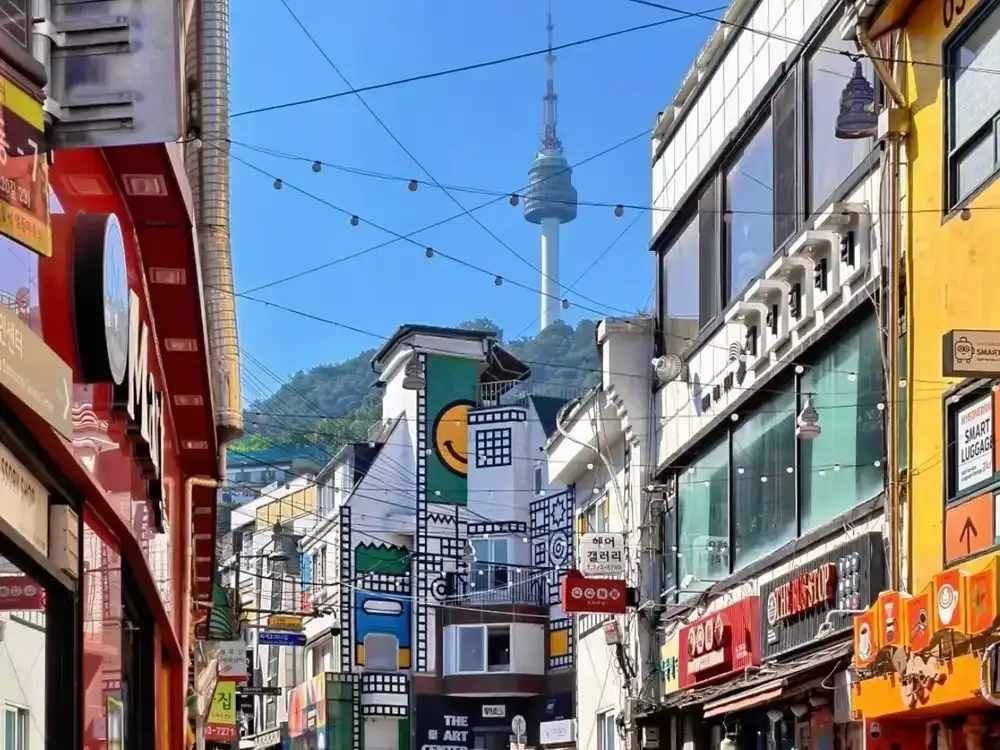
A single person renting a studio in Seoul spends roughly ₩1.6–2.4 million a month once housing is counted, with rent and maintenance fees taking ₩700,000 to ₩1.3 million of that. What moves the total is rarely the district. It is how much cash goes down as a refundable deposit, because in Korea every extra million won of deposit buys a lower monthly rent.
The short version
- Korean leases price housing in two dimensions: a refundable deposit (보증금) and a monthly rent (월세). On most listings the two are negotiable against each other.
- Maintenance fees (관리비) are billed on top of rent and reach ₩100,000–200,000 in a studio officetel. Listing prices hide them.
- A deposit is only as recoverable as the property registry allows. 전입신고 and 확정일자 on day one are what create the tenant's priority claim.
- Agency commission is capped by ordinance and calculated on a converted deposit figure, not on the monthly rent.
- Foreign residents get the same protection under the Housing Lease Protection Act, but through 외국인등록 and 체류지 변경신고 rather than 주민등록.
What the cost of living in Seoul with rent actually includes
Three contract structures cover almost every listing in the city.
전세 (jeonse) is a lease with no monthly rent at all. The tenant hands the landlord a lump sum, commonly 50–80% of the property's value, and gets all of it back at the end of the term. The landlord's return is whatever that money earns while it sits with them. For a small Seoul apartment the sum runs into the hundreds of millions of won, which is why most newcomers never touch it.
월세 (wolse) pairs a smaller deposit with a monthly payment. A studio might list at 보증금 ₩10,000,000 / 월세 ₩700,000, written in Korean listings as "1000/70" using units of ten thousand won (만원). Almost all short-term and foreigner-friendly housing is 월세.
반전세 (semi-jeonse) sits between them: a large deposit plus a reduced monthly rent. It is not a separate legal category, just a point on the same sliding scale.
That scale is the whole game. A landlord asking 1000/70 will often quote 3000/60 or 5000/50 for the same unit. Same apartment, same neighbours, radically different cash-flow profile.
What Seoul rent costs by housing type
The ranges below reflect listing prices seen across Seoul as of early 2026 and vary sharply by district, building age, and distance to a subway line. Verify anything you plan to budget against the Ministry of Land, Infrastructure and Transport's 실거래가 공개시스템 (rt.molit.go.kr), which publishes actual registered lease transactions rather than asking prices.
| Housing type | Deposit | Monthly rent | Maintenance fee | Who it suits |
|---|---|---|---|---|
| 고시원 (goshiwon) | ₩0–500,000 | ₩350,000–600,000 | Included | Arrivals with no cash buffer, stays under 3 months |
| Share house | ~1 month's rent | ₩450,000–750,000 | Included | Students, anyone avoiding a 2-year commitment |
| 원룸 in a villa (low-rise) | ₩5–20 million | ₩450,000–750,000 | ₩50,000–100,000 | Best value per square metre; older buildings |
| Studio officetel | ₩10–20 million | ₩700,000–1,200,000 | ₩100,000–200,000 | Central districts, security, newer fittings |
| Two-room 월세 (villa or apartment) | ₩20–50 million | ₩900,000–1,600,000 | ₩100,000–250,000 | Couples, anyone working from home |
| Small apartment 전세 | ₩200–500 million | ₩0 | ₩150,000–300,000 | Long-term residents with capital or a 전세자금대출 |
A goshiwon room is a bed, a desk, and often a shared bathroom. It exists because it clears the deposit hurdle entirely, and for a first month in the country while flat-hunting, that is worth more than the square metres.
The deposit-to-rent trade-off: run the number before you sign
Here is the calculation almost nobody does, and it is the single most valuable thing on this page.
When an agent offers you two versions of the same unit, work out the implied annual conversion rate:
(monthly rent reduction × 12) ÷ (extra deposit)
Worked example. A Mapo-gu studio is offered two ways:
- Option A: deposit ₩10,000,000, rent ₩700,000
- Option B: deposit ₩50,000,000, rent ₩500,000
The extra deposit is ₩40,000,000. The monthly saving is ₩200,000, or ₩2,400,000 a year. Divide: 2,400,000 ÷ 40,000,000 = 6.0% a year.
Now the comparison. If that ₩40 million is sitting in a Korean savings account earning 3%, moving it into the deposit effectively doubles what it earns, and Option B wins. If you would have to borrow it through a 전세자금대출 at 4%, you pay 4% to save 6%, and Option B still wins. If the money is committed elsewhere at 8%, or you simply do not have it, Option A wins and the higher rent is the correct price for liquidity.
For a market benchmark, 한국부동산원 publishes a monthly 전월세전환율 for Seoul at reb.or.kr. It has run in the mid-single digits in recent years. An agent offering you a conversion at 9% is pricing your cash badly; one offering 4% is handing you cheap housing if you can fund the deposit.
Where this math fails. The 6% is not a risk-free return. It is a 6% return conditional on getting the deposit back, and the bigger the deposit, the more of your net worth is exposed to one landlord and one building's debt position. If the 등기부등본 shows a mortgage (근저당권) that, added to your deposit, approaches the property's market value, the extra ₩40 million is not earning 6%. It is buying concentrated credit risk in exchange for ₩200,000 a month. In that case take Option A and keep the cash.
It also fails on short stays. Break a lease at month eight and you generally cannot demand the deposit back on the spot; the practical custom is that the outgoing tenant finds a replacement and pays the agency fee. A large deposit becomes a large sum you cannot move.
The costs that are not the rent
관리비 (maintenance fee)
Billed separately every month, and the most common budgeting mistake. In a villa it covers cleaning, corridor lighting and rubbish, at ₩50,000–100,000. In an officetel it can cover security, lift maintenance, an internet line, and sometimes water, and lands at ₩100,000–200,000. Ask what the fee includes and what the last three months actually were, since some buildings roll heating into it during winter.
Utilities
Electricity, gas and water in a well-insulated newer studio might total ₩60,000–100,000 in spring. In an old villa with single glazing, the January gas bill alone can pass ₩150,000. Seoul winters are the reason to ask about insulation and window type before you ask about the view.
Agency commission (중개보수)
Capped by law, not negotiable upward. The cap is applied to a converted deposit figure, calculated as:
보증금 + (monthly rent × 100)
If that total comes to less than ₩50,000,000, the multiplier drops to 70 instead of 100.
For the 1000/70 studio above: 10,000,000 + (700,000 × 100) = ₩80,000,000. At the 0.3% bracket that ordinance applies to leases in that range, the maximum commission is ₩240,000, paid by the tenant, with the landlord paying their own side. Bracket rates are set by each metropolitan government's ordinance under the 공인중개사법; confirm Seoul's current table before you pay. Ask for the figure in writing before viewing, not after you have decided.
The deposit's opportunity cost
Most cost-of-living breakdowns ignore this, and it distorts every comparison. A ₩50,000,000 deposit that could have earned 3% elsewhere costs ₩1,500,000 a year, or ₩125,000 a month, in foregone interest. Add that line to the rent when comparing a high-deposit unit against a low-deposit one, otherwise the jeonse-style option always looks artificially cheap.
장기수선충당금
In apartment complexes, the monthly maintenance bill often includes a long-term repair reserve. Under the 공동주택관리법 this is the owner's expense. A tenant who paid it through the monthly bill can claim the accumulated amount back from the landlord at move-out. Over two years it can total several hundred thousand won. Ask the management office to print the statement on your last week.
A realistic monthly total with rent included
Three profiles, in won, for a single person as of early 2026. Non-housing lines are indicative; the line-by-line cost of living in Seoul in USD breaks those down properly.
| Line | Lean (goshiwon / outer district) | Middle (villa 원룸, Mapo) | Comfortable (officetel, Gangnam-adjacent) |
|---|---|---|---|
| Rent | 450,000 | 650,000 | 1,100,000 |
| Maintenance | included | 70,000 | 150,000 |
| Utilities | included | 80,000 | 90,000 |
| Deposit opportunity cost | 0 | 25,000 (₩10m at 3%) | 50,000 (₩20m at 3%) |
| Food and groceries | 450,000 | 650,000 | 900,000 |
| Transport | 62,000 | 62,000 | 100,000 |
| Phone | 30,000 | 40,000 | 60,000 |
| Everything else | 200,000 | 350,000 | 600,000 |
| Total | ~1,192,000 | ~1,927,000 | ~3,050,000 |
The transport line assumes a monthly unlimited pass on Seoul's public network for the first two columns; whether that beats pay-as-you-go depends on how far you commute, which the T-money card versus Climate Card comparison works through.
Notice that the gap between the lean and comfortable columns is ₩1.86 million, and housing plus its deposit cost accounts for ₩840,000 of it. Housing is the lever. Everything else is noise by comparison.
Protecting the deposit, which is the real risk
A wave of deposit-fraud cases involving over-leveraged properties made national news in Korea in 2022 and 2023, and the vocabulary that came out of it is worth knowing. 깡통전세 describes a lease where the deposit plus existing mortgages exceed what the property would fetch in a forced sale.
Four steps, in order, on the day you sign:
- Read the 등기부등본 (property registry extract), available from the Supreme Court's 인터넷등기소 for a few hundred won. Check the owner's name matches the person signing, and check the 근저당권 balance. Deposit plus registered debt should sit comfortably below market value.
- File 전입신고 at the local 주민센터 or through 정부24. This establishes 대항력, the right to stay against a new owner, from the day after you move in.
- Get 확정일자 stamped on the contract at the same office. Combined with 전입신고 and actual occupancy, this creates 우선변제권, a priority claim on auction proceeds ahead of later creditors.
- Consider 전세보증금 반환보증, deposit-return insurance issued by 주택도시보증공사 (HUG), 한국주택금융공사, or SGI서울보증. Premiums are a fraction of a percent of the deposit annually and eligibility depends on the property's debt ratio.
The Housing Lease Protection Act also gives small-deposit tenants a first-priority claim (최우선변제권) on a capped amount ahead of even earlier mortgage holders. Seoul's thresholds were raised in the February 2023 amendment to the enforcement decree; because these figures change, read the current text of the 주택임대차보호법 시행령 at 국가법령정보센터 rather than relying on any secondary summary, including this one.
Foreign residents: the Immigration Act provides that 외국인등록 and 체류지 변경신고 stand in for 주민등록 and 전입신고 for the purposes of the Housing Lease Protection Act. Report the address change within 15 days of moving, at an immigration office or the local 주민센터; guidance is at Hi Korea. Skipping it does not just risk a fine, it leaves the deposit unprotected.
Lease rules that change what you pay
Three provisions of the 주택임대차보호법 have direct budget consequences.
A two-year floor. Even if the contract says one year, the tenant may insist on two. The tenant can also hold the landlord to the shorter term written down. The asymmetry favours the tenant.
Renewal and the 5% cap. The 계약갱신요구권 introduced in 2020 lets a tenant demand one renewal, extending occupancy to four years, and caps the increase at 5% on that renewal. A landlord can refuse only on specified grounds, the main one being that the owner or their immediate family will live there.
A ceiling on conversions. When a landlord converts an existing jeonse into monthly rent mid-lease, Article 7-2 caps the rate at the lower of 10% a year or the Bank of Korea base rate plus a margin set by presidential decree. This applies to conversions within a running contract, not to how a brand-new lease is priced, which is a distinction agents sometimes blur. The base rate is published by the Bank of Korea.
These rules have been the subject of ongoing legislative debate in Korea. Confirm the operative text before relying on any of them in a negotiation.
Before you sign: the five-minute check
Pull the 등기부등본 and add the deposit to the registered mortgage balance. Ask for three months of 관리비 statements. Ask the agent to quote the commission in won and to show the ordinance bracket. Compute the implied conversion rate on every deposit/rent variant offered. Then decide.
The rule of thumb that survives most situations: if the implied conversion rate exceeds what your money earns elsewhere and the registry is clean, take the larger deposit. If either condition fails, pay the higher rent and keep your cash liquid.
Frequently asked questions
Can a foreigner sign a jeonse contract in Seoul?
Yes. There is no nationality restriction on signing a lease, and the Housing Lease Protection Act applies to foreign tenants who complete 외국인등록 and 체류지 변경신고. The practical obstacle is funding: 전세자금대출 products from Korean banks have eligibility conditions tied to visa status, income and residency length, and terms differ by bank. Ask the bank directly rather than the agent.
How much deposit do I need for a normal Seoul studio?
Most 월세 studio listings sit between ₩5,000,000 and ₩20,000,000 in deposit. Below that, goshiwon and share houses take a month's rent or nothing at all. Landlords frequently accept a lower deposit in exchange for higher monthly rent, so a small deposit is a price negotiation rather than a hard barrier.
Is 관리비 included in the advertised rent?
No. Korean listings quote deposit and monthly rent, with 관리비 shown separately or not at all. Treat the advertised rent as roughly 80–90% of your true housing cost in a villa and closer to 85% in an officetel, then confirm the actual figure from past bills.
What happens to my deposit if the landlord sells the building?
If 전입신고 was filed and occupancy began before the transfer, 대항력 means the new owner inherits the lease and the obligation to return the deposit. Without that registration, the claim against the new owner is far weaker. This is the single reason the day-one paperwork matters more than any other step in the process.
Does living outside central Seoul actually save much?
On rent, yes: outer districts and Gyeonggi-do cities on subway lines run meaningfully below Gangnam or Mapo for the same floor space. The saving shrinks once a longer commute pushes you onto a monthly transport pass and adds an hour a day. The break-even is usually reached faster than people expect, so price the commute before signing for distance.
This article is general information about how Korean rental contracts and costs work, not legal, tax, or financial advice for your situation. Figures move with the market and with legislation; verify current rules at 국가법령정보센터 and current prices at the 국토교통부 실거래가 공개시스템 before committing money.