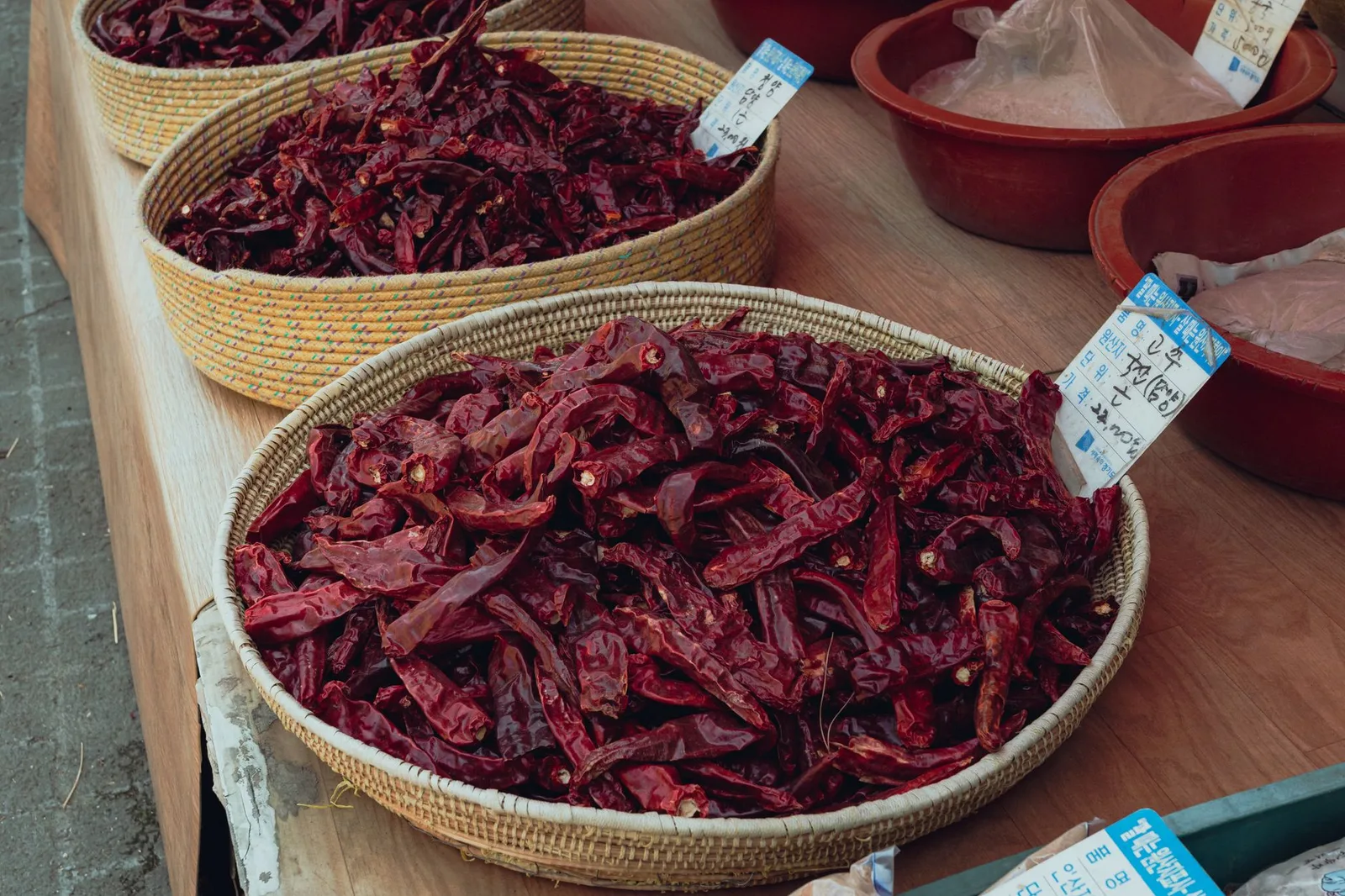
Fish sauce does two jobs in kimchi: it salts, and it supplies glutamate. Both can be replaced. Use Korean soup soy sauce (guk-ganjang) at 13–30 ml per kilogram of napa cabbage, plus 100–180 ml of dried-kelp broth, with grated pear for the sugars the bacteria feed on. Fermentation then runs on the standard schedule.
Four things that change once the jeotgal comes out:
- The umami comes from fermented soybean and kelp instead of anchovy or salted shrimp, so it reads cleaner and less funky.
- Salt has to be tracked deliberately, because guk-ganjang carries salt that plain fish sauce would otherwise have contributed.
- The paste needs a real sugar source (pear, apple, sometimes pumpkin) to keep the lactic acid bacteria fed.
- Nothing about the timeline shifts: 48 hours warm, then cold storage.
What fish sauce is doing, and what has to take its place
Most Korean household kimchi is built on jeotgal, salted seafood fermented until the protein breaks down into free amino acids. Anchovy sauce (myeolchi-aekjeot) and salted shrimp (saeu-jeot) are the two common forms. They contribute salt, glutamate, and a background savouriness that is difficult to hear when it is present and very obvious when it is missing.
Remove them and three gaps open at once. Salt, which is a safety variable, not a taste preference. Glutamate, which is what makes kimchi taste like food rather than like pickled cabbage. And a small amount of free sugar and protein that the lactic acid bacteria consume early in fermentation.
The international standard is on the side of the substitution. The Codex Alimentarius standard for kimchi, CXS 223-2001, defines the product as Chinese cabbage seasoned with red pepper powder, garlic, ginger and salt, and lists fruits and seafood as optional ingredients. Kimchi without fish sauce is not a workaround. It is inside the definition.
Substitutes that work, and how much of each
This table answers the practical question: what goes in, per kilogram of cabbage, once the fish sauce is gone.
| Replacement | Per 1 kg cabbage | What it restores | Vegan |
|---|---|---|---|
| Soup soy sauce (guk-ganjang) | 13–30 ml | Salt and fermented glutamate | Yes |
| Dried kelp (dashima) broth | 100–180 ml | Marine glutamate, liquid for the paste | Yes |
| Grated Korean pear or apple | 50–75 g | Sugars for the bacteria, sweetness | Yes |
| Glutinous rice flour porridge | 1 tsp flour | Starch to bind paste to leaves | Yes |
| Canned pumpkin purée | 50 ml | Body and mild sweetness | Yes |
The table shows that no single ingredient replaces jeotgal. Two do the heavy lifting together, and the fruit is doing a job most people misread as flavouring.
Use guk-ganjang, not regular soy sauce. Korean soup soy sauce is saltier, lighter in colour, and made without the wheat that gives ordinary ganjang its sweetness and dark stain. Substituting jin-ganjang one for one turns the cabbage brown and pushes the taste toward braised food. If guk-ganjang is unavailable, a thin miso or doenjang whisked into the kelp broth gets closer than dark soy sauce does, though it clouds the brine.
Boil the kelp gently. Dashima simmered hard or held past about ten minutes goes slippery and bitter, and that bitterness survives fermentation.
A kimchi recipe without fish sauce, scaled per kilogram of cabbage
Two experienced Korean recipe developers publish vegan versions with meaningfully different ratios. Holly Ford of Beyond Kimchee builds a fruit-and-vegetable stock and uses 4 tbsp of guk-ganjang for 2 kg of cabbage. Hyosun of Korean Bapsang uses 2 tbsp of guk-ganjang plus 2 tbsp of plain salt for a cabbage of about 2.3 kg, with a cup of dashima broth and optional pumpkin purée.
Normalised to one kilogram of cabbage, the gap looks larger than it is:
| Element (per 1 kg cabbage) | Beyond Kimchee | Korean Bapsang |
|---|---|---|
| Soup soy sauce (ml) | 30 | 13 |
| Gochugaru (ml) | 80 | 53 |
| Broth or stock (ml) | 180 | 106 |
| Plain salt added to paste | No | Yes |
Most of the soy sauce difference is bookkeeping. One recipe gets its seasoning salt from guk-ganjang alone; the other splits it between guk-ganjang and table salt. The gochugaru gap is real and is a heat-and-colour choice, not a fermentation one.
A concrete build for 2 kg of napa cabbage, scaled from Korean Bapsang's ratios (2.27 kg × 0.88):
- Quarter 2 kg of napa cabbage lengthwise and brine it (see the salting section below).
- Simmer 3–4 pieces of dried dashima in 300 ml water for 8 minutes, remove the kelp, and reserve 210 ml of broth.
- Whisk 1 tbsp glutinous rice flour into the warm broth and cook 2 minutes until it thickens to a thin porridge. Cool completely.
- Add 105 ml (about 7 tbsp) gochugaru, 26 ml (about 1¾ tbsp) guk-ganjang, 1¾ tbsp minced garlic, 1 tsp grated ginger, half a grated Korean pear, and 1¾ tbsp salt.
- Fold in 300 g of Korean radish cut into matchsticks and 3 scallions in 4 cm lengths.
- Rinse the brined cabbage three times, drain 30 minutes, then coat every leaf, working from the stem end.
- Pack into a jar with 3–4 cm of headspace and press down until brine covers the surface.
Expect the finished paste to taste slightly too salty on a spoon. It will not once it is on the cabbage.
Salting: two hours or eight?
Beyond Kimchee brines for 1.5–2 hours with 1.5 cups of Korean coarse sea salt per 2 kg. Korean Bapsang brines for 6–8 hours at room temperature with 1 cup of coarse salt for a slightly larger cabbage. Both are correct, and averaging them produces a batch that is neither.
The University of Georgia Cooperative Extension's science-based guide to safe kimchi fermentation, published 5 August 2025, specifies 2 hours of salting with massaging every 30 minutes, which sits with the short-and-salty route.
The clock is the wrong instrument. Test the thickest part of a stem: bend it, and it should fold to 180 degrees without snapping. Under-brined cabbage stays crunchy but weeps water into the jar for days and dilutes the paste. Over-brined cabbage goes limp and stays salty no matter how many times it is rinsed. For a first batch, take the longer, lower-salt route. It is far more forgiving of a distracted cook than a two-hour brine with 1.5 cups of salt in it.
Fermentation, temperature, and the salt number that matters
Without jeotgal there is less free amino nitrogen in the jar at the start, so the fruit sugars carry more of the early fermentation. That has a practical consequence: doubling the pear to compensate for missing umami makes the batch sour in days rather than weeks.
The schedule from the same UGA publication: 48 hours at room temperature for the initial ferment, 5–7 days for flavour to develop, and a pH drop below 4.6 at around two weeks, the point at which the acidity inhibits the growth of most foodborne pathogens. Store at 41 °F (5 °C) or below.
The salt arithmetic is worth doing once. UGA measured finished kimchi at 498 mg sodium per 100 g. Multiply sodium by 2.54 to get sodium chloride: 498 × 2.54 ≈ 1,265 mg salt per 100 g, or 1.3% salt by mass. Codex CXS 223-2001 sets the range at 1.0–4.0%. A correctly made batch lands near the bottom of that band, because almost all of the brining salt rinses away and only the paste salt stays. That is the reason under-salting the paste to make a milder kimchi is the one substitution not worth attempting: below about 1%, the product is outside the standard and the fermentation loses its brake.
Temperature changes the culture, not just the pace. A 2024 study in Heliyon03205-5) found that fermenting at 10–15 °C rather than 4 °C significantly increased lactic acid bacteria diversity, raising Lactiplantibacillus plantarum and Latilactobacillus sakei, and increased total metabolites including lactic and succinic acid. Home cooks should still hold at 5 °C or below for storage safety; the finding explains why a batch left in a cool pantry for an extra day tastes rounder than one moved straight to the coldest shelf.
Vegan kimchi and temple kimchi are not the same thing
Most vegan kimchi recipes, including both above, use garlic and scallions freely. Korean Buddhist temple cuisine does not. Korean temple food excludes the five pungent vegetables, the osinchae: garlic, green onion, leek, chives and scallion, on the grounds that they disturb meditative calm.
A temple-style kimchi therefore drops garlic and scallion entirely and leans on radish, ginger, mustard greens and a thicker rice porridge for body. It tastes noticeably lighter and less sharp, and it ferments more slowly without garlic's contribution. If the reason for skipping fish sauce is Buddhist practice rather than diet or allergy, the garlic has to go too.
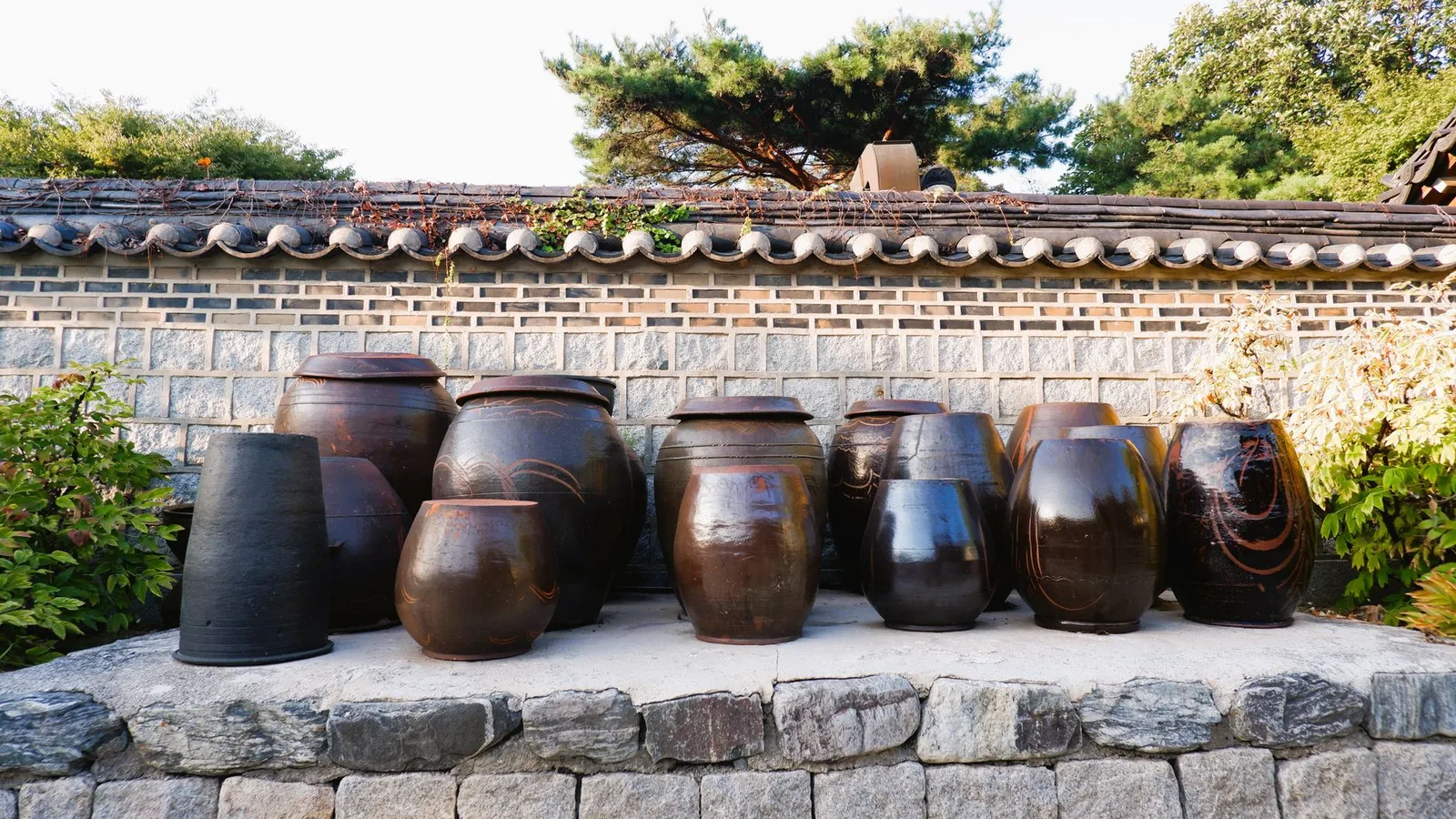
The broader tradition is not marginal: kimjang, making and sharing kimchi was inscribed on the UNESCO Representative List of the Intangible Cultural Heritage of Humanity in December 2013, and it covers households, temples and community kitchens alike.
Where a fish-sauce-free batch goes wrong
- Dark soy sauce instead of guk-ganjang. Brown kimchi with a braised, sweet edge. The colour never recovers.
- Too much fruit. Pear and apple are fermentation fuel. Doubling them for umami produces a fizzy, over-sour jar within a week.
- Under-salting the paste. Aiming for mildness pushes the finished product below the 1.0% Codex floor and removes the acidity brake.
- Kelp boiled too long. Slippery, bitter broth. Eight minutes at a bare simmer, then take it out.
- Trusting the brand rather than the label. Salted shrimp appears in commercial kimchi far more often than fish sauce does, and it is easy to miss in an ingredient list.
One case where this advice does not hold: if the reason for avoiding fish sauce is a shellfish allergy rather than diet, a fermented soybean substitute is fine but shared production lines are not, and a homemade batch is the only fully controlled option.
Buying it instead: what to read on the label
Commercial no-fish-sauce kimchi exists. Jongga sells a sliced cabbage vegan kimchi in a 300 g jar, described by the manufacturer as made without shrimp, anchovy or fish sauce, with a 1.2 kg size also listed in the US. Jongga does not publish a US retail price or a third-party certification body on that product page, so the manufacturer's own statement is the claim on offer.
Scan any other jar for four Korean terms rendered in English: anchovy extract, fish sauce, salted shrimp, and oyster. "Vegetarian" on the front of a Korean-market jar is not a regulated claim in the way "vegan" is in some export markets.
Questions people ask next
Can I use soy sauce instead of fish sauce in kimchi?
Yes, if it is Korean soup soy sauce (guk-ganjang) at 13–30 ml per kilogram of cabbage. Regular dark soy sauce works chemically but darkens the cabbage and adds a wheat sweetness that reads wrong. Pair either with a dried-kelp broth; soy sauce alone leaves the batch flat.
Does kimchi without fish sauce taste noticeably different?
Yes, and mostly in the finish. It is cleaner and less pungent, with the radish and gochugaru more forward. The difference narrows after two weeks of cold fermentation, when the lactic acid dominates in both versions.
How long does vegan kimchi keep?
On the same timeline as any other kimchi: 1–2 days at room temperature to start, then refrigerated at 5 °C or below, where it keeps fermenting for months and steadily sours. A sour batch is not spoiled. It is the correct ingredient for fried rice, jjigae, or a bowl of bibimbap.
Can I use miso or gochujang for the umami instead?
Miso or doenjang thinned into kelp broth works and is the closest fallback where guk-ganjang is unavailable, at the cost of a cloudier brine. Gochujang is the wrong tool: its sugar and starch content pushes fermentation fast and its heat is already covered by the gochugaru.
Is it still real kimchi?
By the Codex definition, yes, since seafood is listed as an optional ingredient. Fully plant-based kimchi has been made in Korean temple kitchens for centuries.
Start the brine tonight, salt to the bend test rather than the clock, and taste the jar on day three before deciding whether it goes cold. This is general cooking and food-safety information, not personalised advice; anyone managing a shellfish or soy allergy should treat ingredient sourcing as the controlling variable.