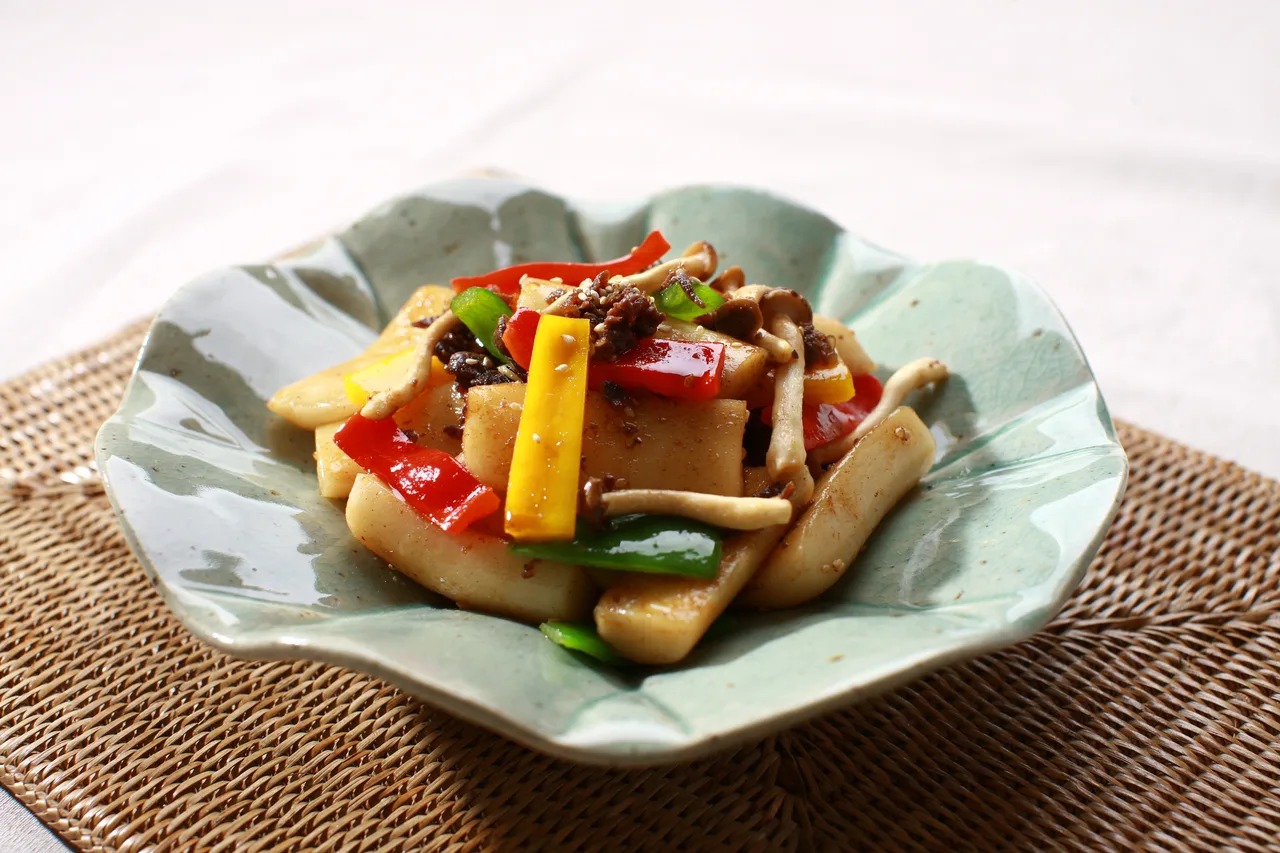
Non-spicy tteokbokki has a proper name: gungjung tteokbokki (궁중떡볶이), the soy-sauce version. Rice cakes are stir-fried with thinly sliced beef, shiitake mushrooms, onion and bell pepper in soy sauce, a little sugar and sesame oil. No gochujang, no chilli flakes. Prep and cooking together run about 15 to 20 minutes.
The short version
- Gungjung tteokbokki, also called ganjang tteokbokki (간장떡볶이), is the mild soy-sauce dish. The red gochujang one came centuries later.
- Sauce target: 1.2 tsp soy sauce, 0.5 tsp sugar or honey and 0.3 tsp sesame oil per 100 g of rice cakes. For 500 g of tteok that works out to 2 Tbsp soy sauce, 2½ tsp sweetener and 1½ tsp sesame oil.
- It is a stir-fry, not a simmer. Almost no liquid goes into the pan, which is the single biggest difference from the spicy method.
- Rice cakes get softened before they hit the pan: 10 to 15 minutes in warm water, a 30-second parboil, or a 2-minute boil for firmer tteok.
- Pulling gochujang out of a spicy recipe removes body as well as heat, so the replacement sauce has to be reduced further or it stays watery.
What non-spicy tteokbokki is called, and where it came from
The soy-sauce version is the older one. The earliest written record of tteokbokki appears in 《시의전서》 (Siuijeonseo), a Korean cookbook from the 1800s, which describes rice cakes stir-fried with beef, soy sauce, scallions, pine nuts and sesame oil. Not a chilli in the list. "Gungjung" means royal court, and the dish is associated with Joseon-era banquet cooking.
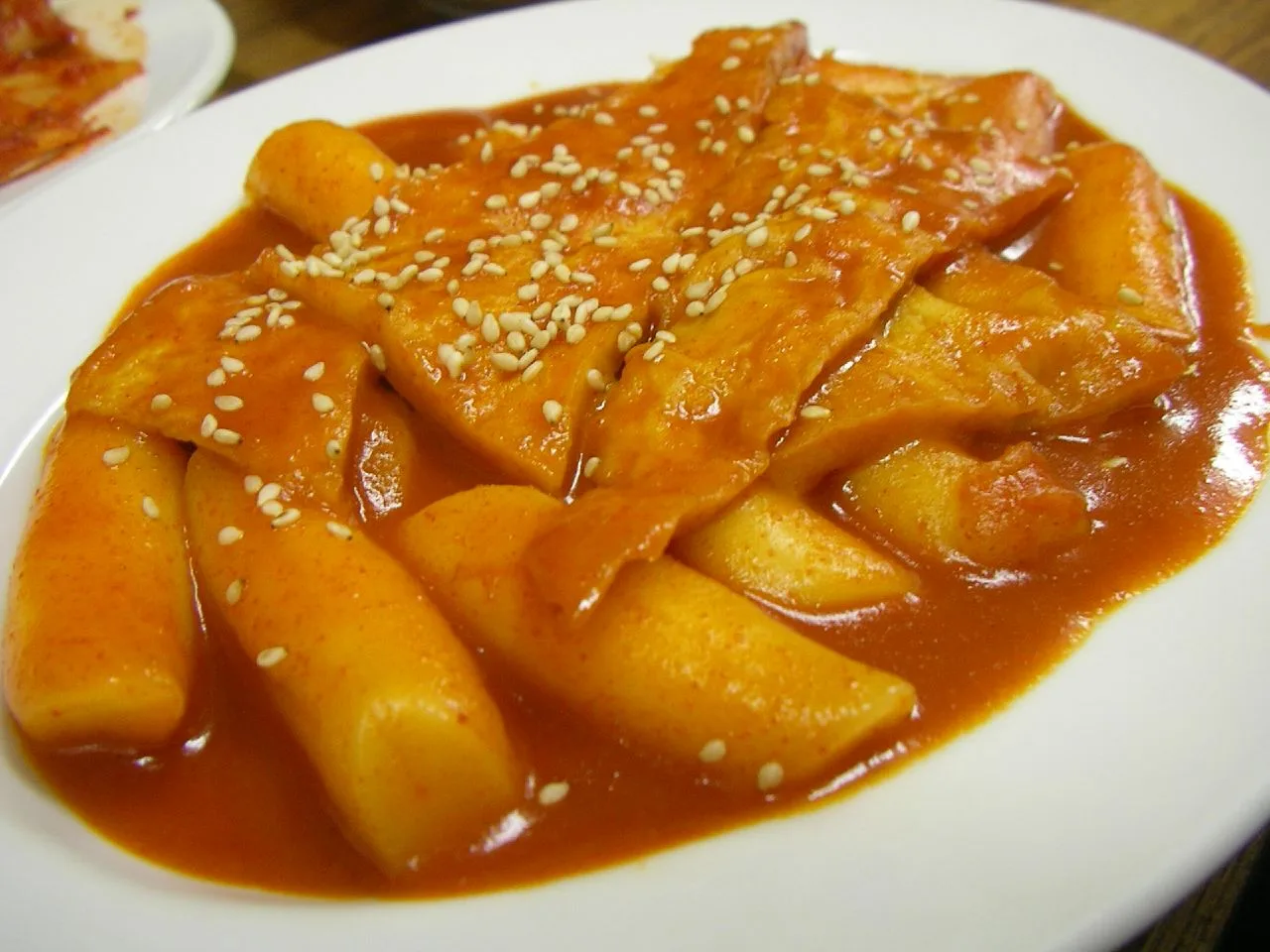
The red version is a post-war invention. Ma Bok-rim began selling gochujang-based tteokbokki in Sindang-dong in 1953, swapping expensive beef for fish cake and cooking it over briquette fire. That alley became Sindang-dong's tteokbokki street, now recognised by the Seoul Metropolitan Government as a Seoul Future Heritage site. Seventy-odd years of that being the default is why most English-language recipes assume tteokbokki is spicy by definition.
The rice cakes themselves are a growing category in Korea: the rice-cake segment covering tteokguk and tteokbokki tteok rose from ₩1.19 trillion in 2021 to ₩1.44 trillion in 2024, per the rice-processed-foods industry survey reported by Nongmin Sinmun in January 2026.
Ingredients for soy-sauce tteokbokki
Two well-known versions of this recipe use different volumes, and it is worth seeing both rather than a blended average.
My Korean Kitchen's gungjung tteokbokki serves two: 300 g Korean rice cakes, 100 g thinly sliced rib eye, 100 g shiitake mushrooms, half a small onion, and a quarter each of red, yellow and green bell pepper. The beef marinade is 1 Tbsp soy sauce, 1 tsp mirin, ½ tsp minced garlic, ¼ tsp black pepper and 1 tsp sesame oil. The seasoning sauce is 1½ Tbsp soy sauce, 1 tsp brown sugar, ½ tsp sesame oil and ¼ tsp minced garlic.
Beyond Kimchee's version serves four: 1 lb of tteokbokki tteok cut to about 2-inch lengths, ⅓ lb thinly sliced sirloin or rib eye, half a small onion, half each of a red and green bell pepper, three or four shiitake, 1 Tbsp oil plus 1 Tbsp butter, and 2 tsp toasted sesame seeds. Its sauce is 1½ Tbsp soy sauce, 1 Tbsp honey and 2 tsp sesame oil, with the beef marinated in 2 tsp soy sauce, 1 tsp garlic, 1 tsp sugar and ¼ tsp black pepper.
The beef is doing structural work here, the same way it does in a ground beef bibimbap: it is the savoury depth that gochujang would otherwise supply. Ask a Korean butcher counter for bulgogi-cut or shabu-cut beef, the paper-thin slices sold for Korean barbecue and hot pot. Cutting your own from a chilled rib eye works if the meat is half-frozen first.
The sauce ratio, and how to scale it to any weight of rice cake
Recipes are written for a fixed pack size, and rice cake packs are not a fixed size. Converting each sauce to a per-100 g figure shows how far apart the two versions actually sit.
My Korean Kitchen uses 1½ Tbsp of soy sauce, which is 4.5 tsp, for 300 g of tteok: 4.5 ÷ 3 = 1.5 tsp of soy sauce per 100 g, with 1 tsp of sugar spread over the same 300 g, or 0.33 tsp per 100 g. Beyond Kimchee uses the same 4.5 tsp of soy sauce for 1 lb, which is 454 g: 4.5 ÷ 4.54 = 0.99 tsp per 100 g, with 1 Tbsp of honey (3 tsp) giving 0.66 tsp per 100 g. One is half again as salty; the other is twice as sweet.
This table answers the question of which seasoning level you are actually signing up for.
| Recipe | Rice cakes (g) | Soy sauce per 100 g (tsp) | Sweetener per 100 g (tsp) | Sesame oil per 100 g (tsp) |
|---|---|---|---|---|
| My Korean Kitchen | 300 | 1.5 | 0.33 (brown sugar) | 0.17 |
| Beyond Kimchee | 454 | 1.0 | 0.66 (honey) | 0.44 |
| Target used here | any | 1.2 | 0.5 | 0.3 |
The middle column is the one to memorise. Landing between the two published versions gives a sauce that is clearly seasoned without turning salty as it reduces.
Run the arithmetic on a standard 500 g supermarket pack: 500 ÷ 100 = 5 units, so 5 × 1.2 = 6 tsp of soy sauce, which is exactly 2 Tbsp; 5 × 0.5 = 2½ tsp of sugar or honey; 5 × 0.3 = 1½ tsp of sesame oil. For a 300 g pack it comes to 3.6 tsp of soy sauce (1 Tbsp plus ¾ tsp), 1½ tsp of sweetener and just under 1 tsp of sesame oil.
One correction to apply: if the beef is marinated in soy sauce as well, that salt ends up in the same pan. Subtract 1 tsp of soy sauce from the sauce for every 1 Tbsp used in the marinade.
Method: soy-sauce tteokbokki step by step
- Soften the rice cakes. Fresh, soft tteok goes straight in. Refrigerated or vacuum-packed tteok needs 10 to 15 minutes in warm water or a 30-second parboil, per My Korean Kitchen; Beyond Kimchee boils its tteok for 2 minutes, drains it, and tosses it with 1 Tbsp of oil so the pieces do not weld together. Firmer or thicker tteok wants the longer boil.
- Marinate the beef for about 10 minutes while the rice cakes soak.
- Mix the sauce in a bowl first. Sugar dropped into a hot dry pan scorches before it dissolves.
- Sear the beef in a hot pan with a little neutral oil, 1 to 2 minutes, until it loses its raw colour.
- Add onion, shiitake and bell pepper and stir-fry about 2 minutes. The peppers should stay bright and slightly firm.
- Add the rice cakes and the sauce, and toss 2 to 3 minutes until every piece is glossy and the sauce has mostly clung to the tteok rather than pooling.
- Finish off the heat with sesame oil, toasted sesame seeds, and a knob of butter if you are following the Beyond Kimchee version. Sesame oil added at the start burns and turns bitter.
Active cooking time is 5 minutes in one version and 10 in the other. The difference is the pan and the volume, not the technique.
Turning a spicy tteokbokki recipe into a mild one
A straight swap of soy sauce for gochujang does not work, because gochujang is contributing four things at once: heat, salt, sweetness and thickness. Removing 2 Tbsp of gochujang leaves the sauce thin, and no amount of extra soy sauce fixes that. Compensate by cutting the stock, adding 1 Tbsp of soy sauce plus 1 tsp of sugar per 2 Tbsp of gochujang removed, and reducing the liquid until it coats the back of a spoon.
This is also why "mild" packaged tteokbokki sauce is not the same as non-spicy. Korean products are graded on the GHU scale, the Gochujang Hot taste Unit, measured from capsaicin content: under 30 GHU is mildly hot, 30 to 45 slightly hot, 45 to 75 medium hot, 75 to 100 very hot, and above 100 extremely hot, as reported by The Korea Times in 2010. The bottom band still contains capsaicin. For a child who reacts to any chilli at all, the soy-sauce recipe is the only reliable route.
Mild tteokbokki styles, compared
Four common variants get recommended to people avoiding heat, and only two of them actually deliver it.
| Style | Sauce base | Heat | Contains gochujang | Kid-friendly |
|---|---|---|---|---|
| Gungjung tteokbokki (궁중떡볶이) | Soy sauce, beef, sesame | None | No | Yes |
| Jjajang tteokbokki (짜장떡볶이) | Chunjang black bean paste | None | No | Yes |
| Rose tteokbokki (로제떡볶이) | Cream and tomato with chilli paste | Mild to medium | Yes | Optional |
| Cheese tteokbokki (치즈떡볶이) | Gochujang under melted cheese | Reduced | Yes | No |
What the table shows is that cheese and cream dilute capsaicin rather than removing it. Dairy fat genuinely blunts the burn, which is why rose tteokbokki reads as gentle to most adults, and it is still built on gochujang. The two zero-heat options are the soy-sauce version and the black-bean version.
Five things that go wrong
The most common failure is treating it like the spicy recipe. Red tteokbokki simmers in anchovy stock, so soft rice cakes are guaranteed. The soy version has barely any liquid, which means the tteok has to arrive in the pan already soft. Under-soaked rice cakes will not rescue themselves.
The 30-second parboil fails outright on frozen tteok. The surface softens while the core stays hard, and there is no simmering liquid to fix it later. Thaw frozen rice cakes fully, then boil for 2 minutes.
Sesame oil goes in at the end, every time. Sugar in the sauce burns on high heat, so keep the pan at medium once the sauce is in. And leftovers harden fast because rice starch retrogrades at fridge temperature; reheat with a splash of water in a covered pan rather than dry in a microwave.
Finding non-spicy tteokbokki in Seoul
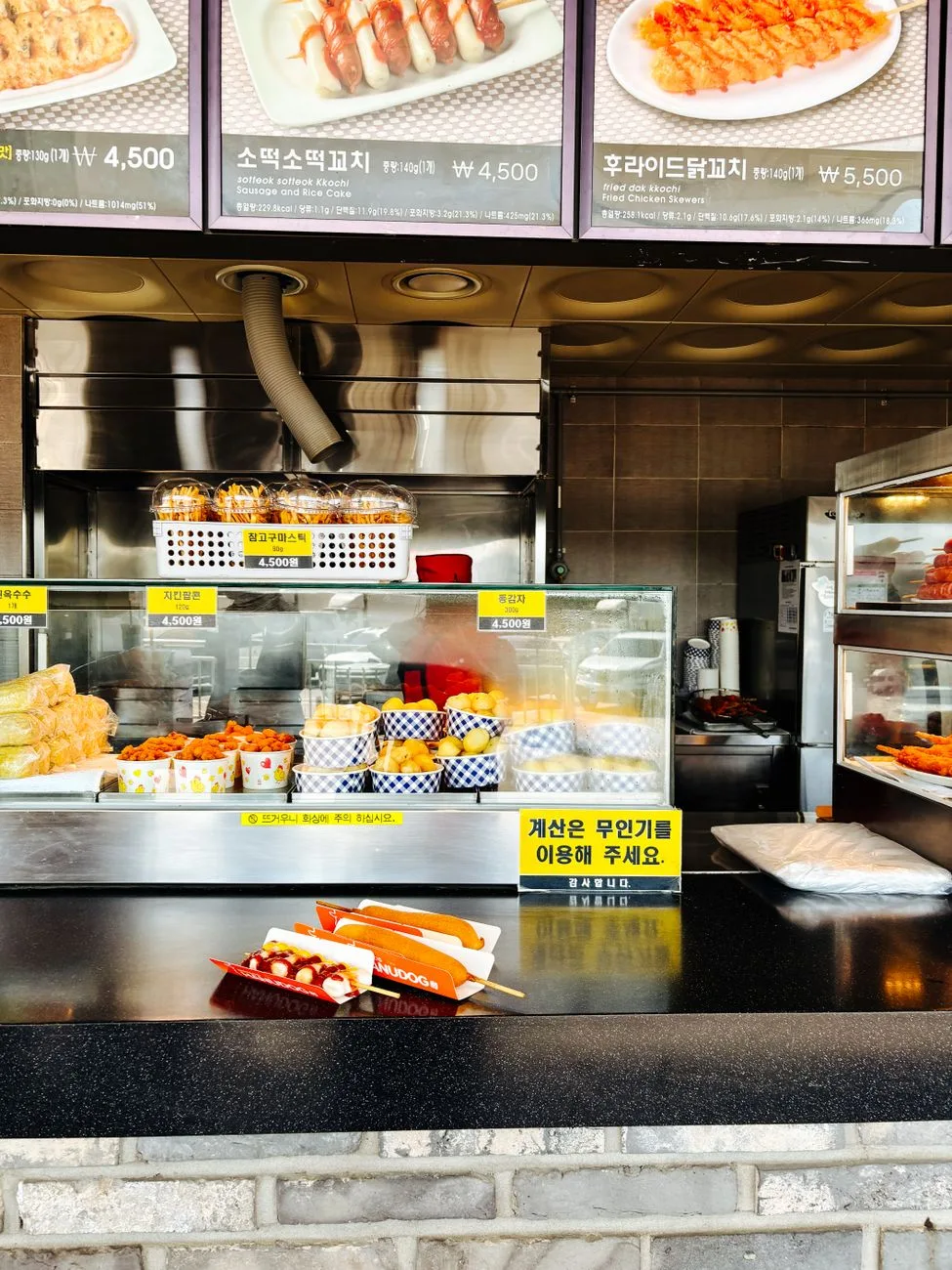
Street stalls are the wrong place to look. Gwangjang Market's Food Alley, open daily 09:00 to 23:00 near Jongno 5-ga Station Exit 8 on Line 1, lists tteokbokki among its signature foods along with gimbap, bindae-tteok and eomuk, and that tteokbokki is the gochujang kind. Sindang-dong's alley is the birthplace of the red version, so it is the last address to try for a mild plate.
Gungjung tteokbokki lives in a different part of Korean dining: hanjeongsik banquet menus, traditional restaurants around Insadong and Bukchon, and home kitchens. Reading the Korean name off a menu is the shortcut, since 궁중떡볶이 and 간장떡볶이 both signal soy sauce, while 국물떡볶이 and 로제떡볶이 do not. Buying a pack of tteok at a market and cooking it in a rented kitchen is faster than hunting for a restaurant that serves it.
Questions people ask next
Is all tteokbokki spicy?
No. Gungjung tteokbokki is seasoned with soy sauce and contains no chilli at all, and it predates the gochujang version by roughly a century, appearing in the 1800s cookbook 《시의전서》. The spicy style has simply dominated since 1953.
What replaces gochujang in a non-spicy tteokbokki recipe?
Soy sauce plus a sweetener, with the liquid reduced further to make up for the lost thickness. Use about 1 Tbsp of soy sauce and 1 tsp of sugar for every 2 Tbsp of gochujang removed. Chunjang (black bean paste) is the other established swap and gives a darker, nuttier result.
Is non-spicy tteokbokki gluten-free?
The sauce is not, unless the soy sauce is. The rice cakes depend on which type you buy: 쌀떡 is made from rice flour, while 밀떡 is wheat-based. Tamari in place of regular soy sauce plus 쌀떡 makes the dish gluten-free, and the pack label states which flour was used.
Can I make it without beef?
Yes. Shiitake mushrooms carry most of the savoury weight already, and doubling them to 200 g for 300 g of rice cakes keeps the dish from tasting flat. Skip the marinade, add the mushrooms first so they release and re-absorb their moisture, and keep the sauce ratio identical.
How do I stop leftover tteokbokki from going hard?
Reheat in a covered pan over low heat with 2 to 3 Tbsp of water per portion, which steams the starch back to soft. Rice cakes stiffen within hours in the fridge, so cook the amount you plan to eat rather than batching it.
The practical next step is the pack in front of you: weigh the rice cakes, divide by 100, and multiply by 1.2 tsp of soy sauce, 0.5 tsp of sweetener and 0.3 tsp of sesame oil.