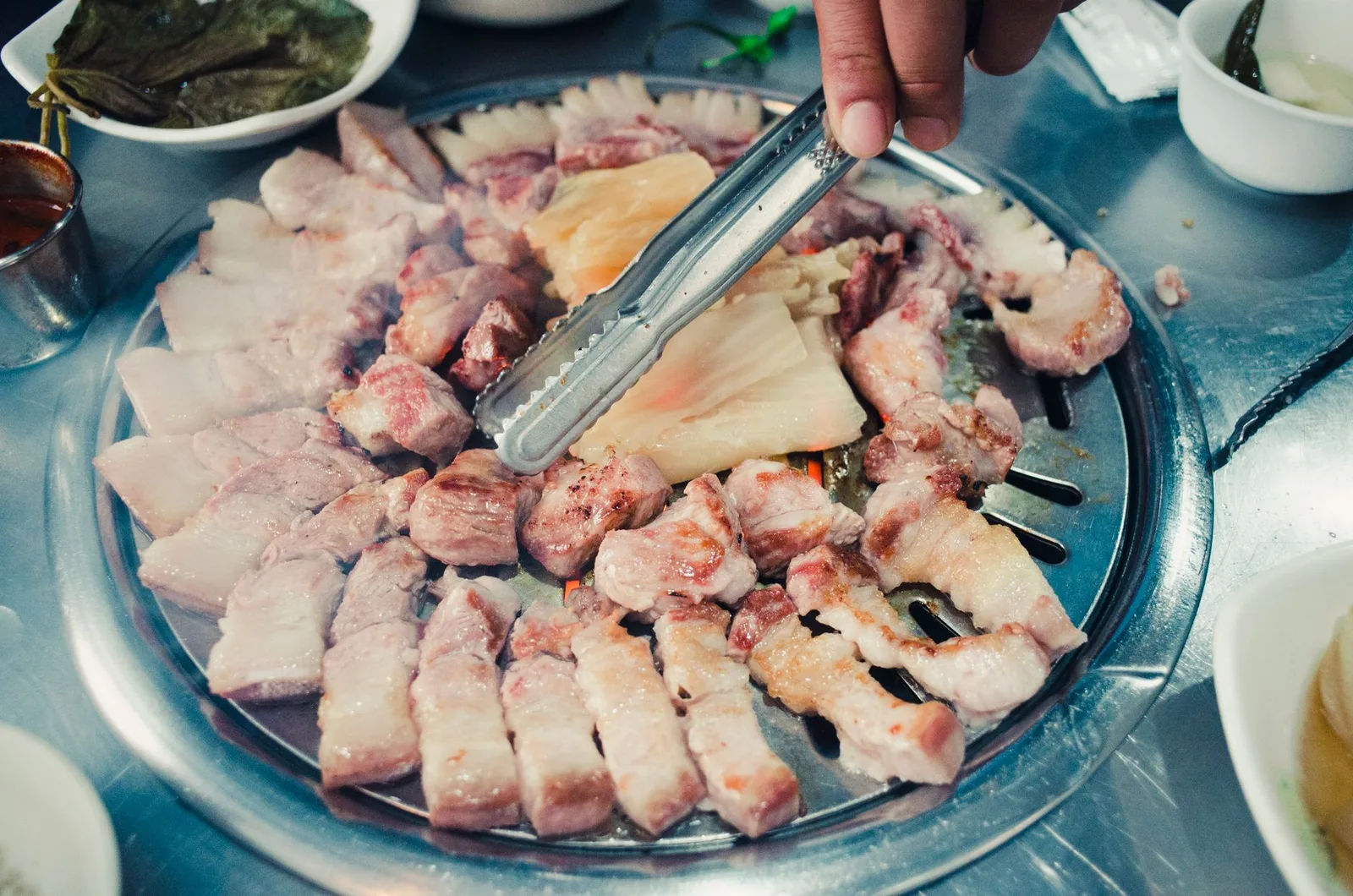
The best Korean BBQ in Seoul depends on which animal you came for. For pork belly and marinated pork ribs, Gongdeok and Sindang deliver the most flavour per won, at roughly ₩18,000–25,000 per person for meat. For hanwoo beef, the three tiers are Majang-dong (cheapest), Sinsa (mid), and Cheongdam (from ₩100,000 a head up).
That single sentence solves most of the confusion, because "Korean BBQ" covers two almost separate cuisines that happen to share a grill. Below is how the menu works, what the bill actually comes to, and the one Seoul neighbourhood where you buy the beef yourself and rent the fire.
The short version
- Pork (삼겹살, 목살, 돼지갈비) is the everyday version and the better choice for a first barbecue meal in Seoul.
- Beef (한우) is priced by 100g at specialist restaurants and can quietly triple your bill.
- Charcoal (참숯) or briquette (연탄) beats a gas plate on flavour; the menu or the shopfront usually says which.
- Most restaurants enforce a two-portion minimum, which is the single biggest problem for solo diners.
- All figures here were the common Seoul menu ranges in early 2026. Individual restaurants change prices without notice.
What "Korean BBQ" actually means in Seoul
The grill is the constant. Everything else splits.
Pork restaurants (고깃집 in the broad sense, 삼겹살집 specifically) sell by the 인분, a portion of roughly 150–200g. The classic cuts are samgyeopsal (pork belly, layered fat), moksal (neck/collar, leaner and more forgiving), and dwaeji galbi (pork ribs, usually marinated in a soy-pear-garlic mix). Salt-only cuts are labelled 생 (fresh) or 소금구이; marinated is 양념.
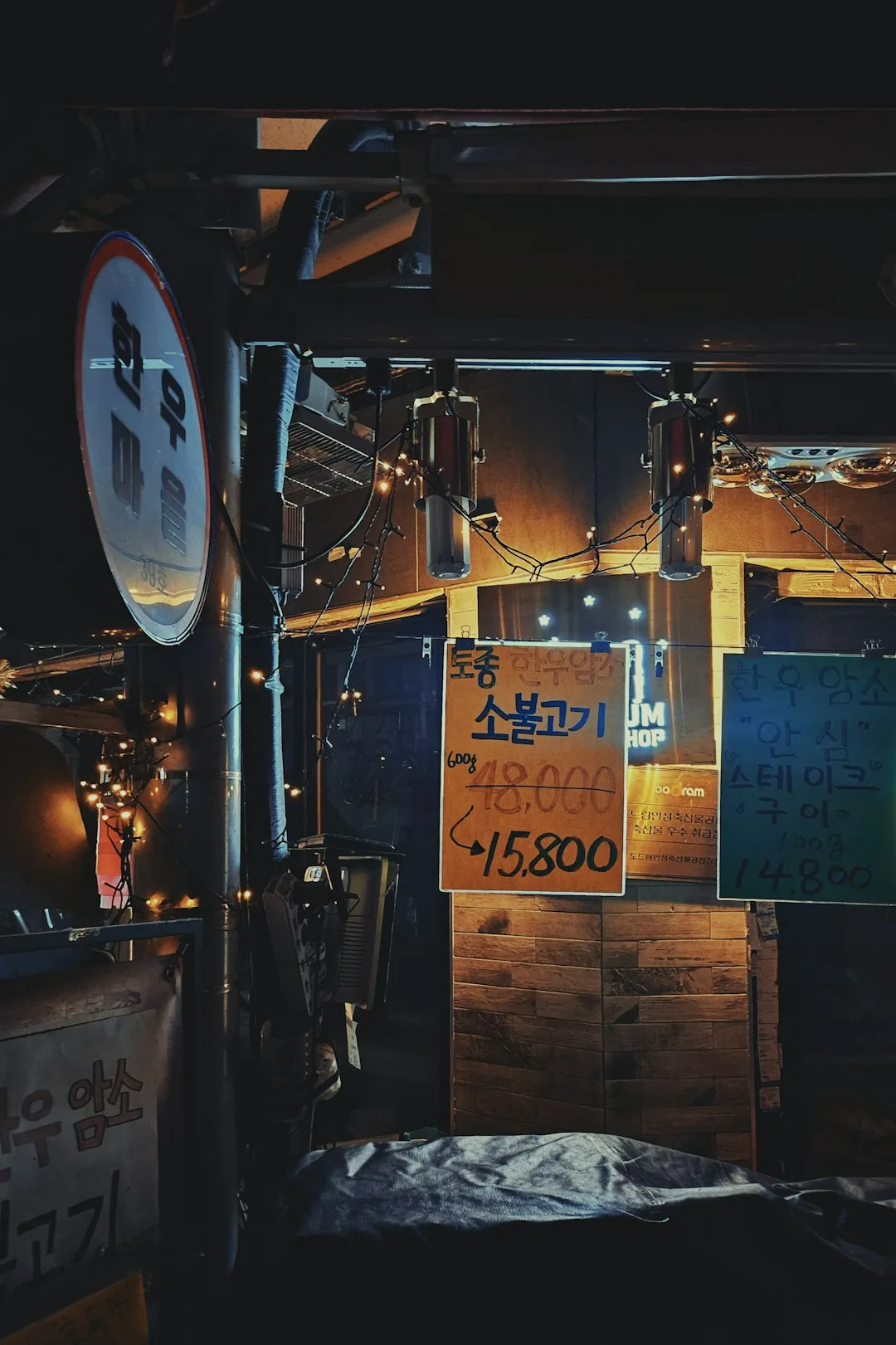
Beef restaurants price by weight, and the weight is small. A 150g order of hanwoo sirloin at a Gangnam specialist can cost more than four full portions of pork belly elsewhere in the city. The standard cuts are deungsim (sirloin), ansim (tenderloin), galbisal (meat off the rib), and chadolbaegi (thin-sliced brisket, the cheap entry point that cooks in about twenty seconds).
Then there is the fuel, which changes the food more than most guides admit. White-oak charcoal throws radiant heat and a little smoke, so the fat renders and crisps at the edges. Coal briquettes, still used at the older pork-rib places, leave a distinct sulphurous char that regulars specifically go for. A gas plate is consistent, cheap to run, and flat-tasting by comparison. Restaurants that go to the trouble of charcoal advertise it, so a shopfront reading 참숯 or 화로구이 is a genuine signal.
How to read a Seoul barbecue menu: cuts, grades, and the 12-digit number
Korean beef grading is not marketing. The Korea Institute for Animal Products Quality Evaluation (축산물품질평가원, KAPE) runs the official system, and since the grading revision that took effect on 1 December 2019, the quality grades depend on measured marbling scores: 1++ requires a marbling score of 8 or 9, 1+ requires 6 or 7, and grade 1 requires 4 or 5. A separate yield grade (A, B, C) describes carcass output rather than eating quality, which is why "1++A" is the top label on a menu. Current standards are published on the KAPE site at ekape.or.kr.
A menu boasting "1++" without a number beside it is telling you less than it appears to, since 1++8 and 1++9 are different products at different wholesale costs.
The 12-digit number printed on hanwoo menus is the individual cattle identification number from Korea's livestock traceability system. Entering it at the government's traceability service, mtrace.go.kr, returns the animal's birth date, sex, breed, and slaughter details. Restaurants serving beef are also required to label origin under Korea's origin-labelling rules, enforced by the National Agricultural Products Quality Management Service (국립농산물품질관리원). Imported beef must say so, which is how you spot a place selling US or Australian chuck under vaguely Korean-sounding branding.
One more label worth knowing: the Ministry of Food and Drug Safety runs a voluntary restaurant hygiene grading scheme (음식점 위생등급제) with three tiers — 매우 우수, 우수, 좋음 — displayed as a sticker at the door and searchable through 식품안전나라 at foodsafetykorea.go.kr. Absence of a sticker means nothing bad; presence means the kitchen was inspected and passed.
Best Korean BBQ neighbourhoods in Seoul, by budget and meat
| Area (nearest station) | What it's known for | Meat cost per person | Best for |
|---|---|---|---|
| Gongdeok (Gongdeok, Lines 5/6) | Pork rib and pork belly alley, briquette grills, decades-old shops | ₩16,000–24,000 | First barbecue meal, groups, late nights |
| Sindang / Yaksu (Sindang, Lines 2/6) | Thick-cut premium pork, long queues at the famous shops | ₩22,000–32,000 | Pork done seriously |
| Majang-dong (Majang, Line 5) | Buy beef at the butcher, grill it upstairs | ₩25,000–45,000 for hanwoo | Beef on a budget |
| Sinsa / Apgujeong (Sinsa, Line 3) | Mid-to-high hanwoo, cleaner rooms, English menus more common | ₩50,000–90,000 | A beef meal without Cheongdam pricing |
| Cheongdam (Apgujeong Rodeo, Suin-Bundang) | Course-style hanwoo, staff grill for you, reservations essential | ₩120,000 and up | Special occasion |
| Hongdae / Sinchon (Hongik Univ., Line 2) | Student pricing, unlimited-refill pork | ₩12,000–18,000 | Cheap and loud |
| Itaewon (Itaewon, Line 6) | English service, beef-only and halal-certified options near Seoul Central Masjid | Varies widely | Non-pork diets, no-Korean groups |
If you have exactly one barbecue meal in Seoul, spend it on pork. A ₩22,000 portion of thick-cut belly over charcoal is close to the ceiling of what that dish can be, whereas ₩22,000 of hanwoo is a taste, not a meal. Save beef for a trip where it's the point of the evening. Where you base yourself changes which of these is a ten-minute walk versus a forty-minute ride, so it's worth reading alongside a look at the best neighbourhoods to stay in Seoul.
What a Seoul barbecue meal actually costs: two worked examples
Menu prices hide the extras. Meat is one line; the bill has four or five.
Two people at a Gongdeok pork place
- 2 portions samgyeopsal at ₩19,000 = ₩38,000
- 1 portion marinated pork ribs = ₩18,000
- 2 bowls of rice at ₩2,000 = ₩4,000
- Naengmyeon to finish (half portion) = ₩6,000
- 2 bottles of soju at ₩5,000 = ₩10,000
- Total ≈ ₩76,000, or ₩38,000 per person
Banchan, lettuce, ssamjang, and grilled garlic come free and are refilled on request. Korea has no tipping and no separate service charge.
Two people at a Sinsa hanwoo restaurant
- 300g sirloin at ₩28,000 per 100g = ₩84,000
- 150g brisket = ₩22,000
- Soybean-paste stew set = ₩12,000
- 2 beers = ₩12,000
- Total ≈ ₩130,000, or ₩65,000 per person
That second bill is conservative. Order tenderloin or a 1++9 grade and 300g alone passes ₩120,000.
For a reference point that isn't one restaurant's menu, the Korea Consumer Agency's price-tracking service 참가격 publishes a monthly Seoul average for 200g of samgyeopsal alongside seven other eating-out staples; it had moved to roughly the ₩20,000 mark by 2025. Check the current month at price.go.kr rather than trusting a figure in any article, including this one. If you're comparing eating out against cooking at home, our breakdown of Seoul's monthly costs including rent puts grocery pricing beside restaurant pricing.
Majang-dong: buy the beef yourself, then rent the grill
This is the part most visitors never hear about, and it is the cheapest legitimate route to good hanwoo in Seoul.
Majang-dong in Seongdong-gu is the city's largest livestock market, a dense grid of butcher shops one stop from Wangsimni on Line 5. The system works in two steps:
- Choose a butcher and buy your beef by weight, telling them the cut and grade. Retail counters here sell hanwoo at a fraction of restaurant markup because you are buying from the wholesaler's floor.
- Carry it to one of the restaurants directly above or beside the shops, where you pay a per-person table charge (상차림비) for the grill, charcoal, banchan, rice, and stew. In early 2026 that charge ran around ₩5,000–7,000 per person at most shops, sometimes more if you bring your own drinks.
Confirm the table charge and whether outside alcohol is allowed before sitting down, because it varies shop to shop and is not always posted in English. Many butchers will tell you which restaurant upstairs they work with.
This route fails on Sundays. A large share of the butcher stalls close Sunday and on major holidays, which strands anyone who shows up expecting the full market. Weekday afternoons are the reliable window. Getting there is a straightforward subway ride; if you haven't sorted a card yet, compare T-money against the Climate Card before your first day of travel.
Booking, timing, and the mistakes that ruin the meal
The famous pork places in Sindang and Yongsan take reservations through Korean apps or run same-day waitlists that open in the morning and fill within minutes. Cheongdam beef restaurants often require a card-held booking days ahead and will charge for a no-show. Everywhere else, walking in before 6pm or after 9pm avoids the wait entirely.
A few specifics that catch people out:
- Two-portion minimums. Most grill restaurants will not fire a table for a single order. Solo diners should look for shops advertising 1인분 or eat the stew instead.
- Marinated meat burns. The sugar and pear in galbi marinade caramelise fast; ask staff to swap the grill plate (판 갈아주세요) once it blackens.
- Unlimited-refill pork is thin pork. ₩15,000 무한리필 shops serve frozen shaved belly, which is a different food from a hand-cut 1.5cm slab. Fine for volume, wrong for a once-a-trip meal.
- Your clothes will smell. Older briquette rooms have weak extraction. Leave the wool coat at the hotel.
- Order the finisher. Cold naengmyeon or a soybean-paste stew with rice at the end is standard practice, and skipping it is how tourists end up still hungry after ₩40,000 of meat.
At higher-end beef restaurants a member of staff grills at your table, turning and trimming and telling you when each piece is ready. At a neighbourhood pork place you do it yourself, and the tongs belong to whoever is youngest.
Slot the meal into an evening where you're already nearby rather than crossing the city for it; the day-by-day structure in our 5-day Seoul itinerary shows which nights land near which grill districts.
FAQ
Is Korean BBQ in Seoul expensive?
Pork is not; beef can be. A satisfying pork belly dinner with drinks lands around ₩35,000–40,000 per person, while hanwoo at a specialist restaurant starts near ₩60,000 and has no real ceiling. There is no tipping and no service charge in Korea, so the menu total plus drinks is the bill.
Do I need a reservation for Korean BBQ in Seoul?
Only for the well-known names. Sindang's premium pork shops and Cheongdam's hanwoo rooms need booking or an early-morning waitlist entry; ordinary neighbourhood grills in Gongdeok, Hongdae, or Jongno take walk-ins, especially before 6pm.
Can one person eat Korean BBQ in Seoul?
It's possible but restricted, because most restaurants require a minimum of two portions to open a grill. Shops that explicitly advertise 1인분 exist, and Majang-dong butchers will sell any weight, though the upstairs table charge still applies per head.
How do I tell real hanwoo from imported beef?
By the labels the restaurant is legally required to display: origin (원산지), the cut, and for hanwoo a 12-digit cattle identification number you can look up on the government traceability site mtrace.go.kr. A quality grade written as 1++, 1+, or 1 refers to the KAPE marbling standard, and the best menus print the marbling score number too.
Is there non-pork or halal Korean BBQ in Seoul?
Yes. Beef-only restaurants are common across Gangnam and Majang-dong, and the area around Seoul Central Masjid in Itaewon has halal-certified Korean grill restaurants. Confirm certification directly with the restaurant, since certifications lapse and are not always current on aggregator listings.
If you want the shortest path from reading this to eating: pick a charcoal pork place near where you're sleeping, go at 5:30pm on a weekday, order two portions of thick-cut belly and one of marinated ribs, and finish with naengmyeon.
General information for planning purposes. Prices, grading standards, and restaurant certifications change; verify current figures with the official sources named above.