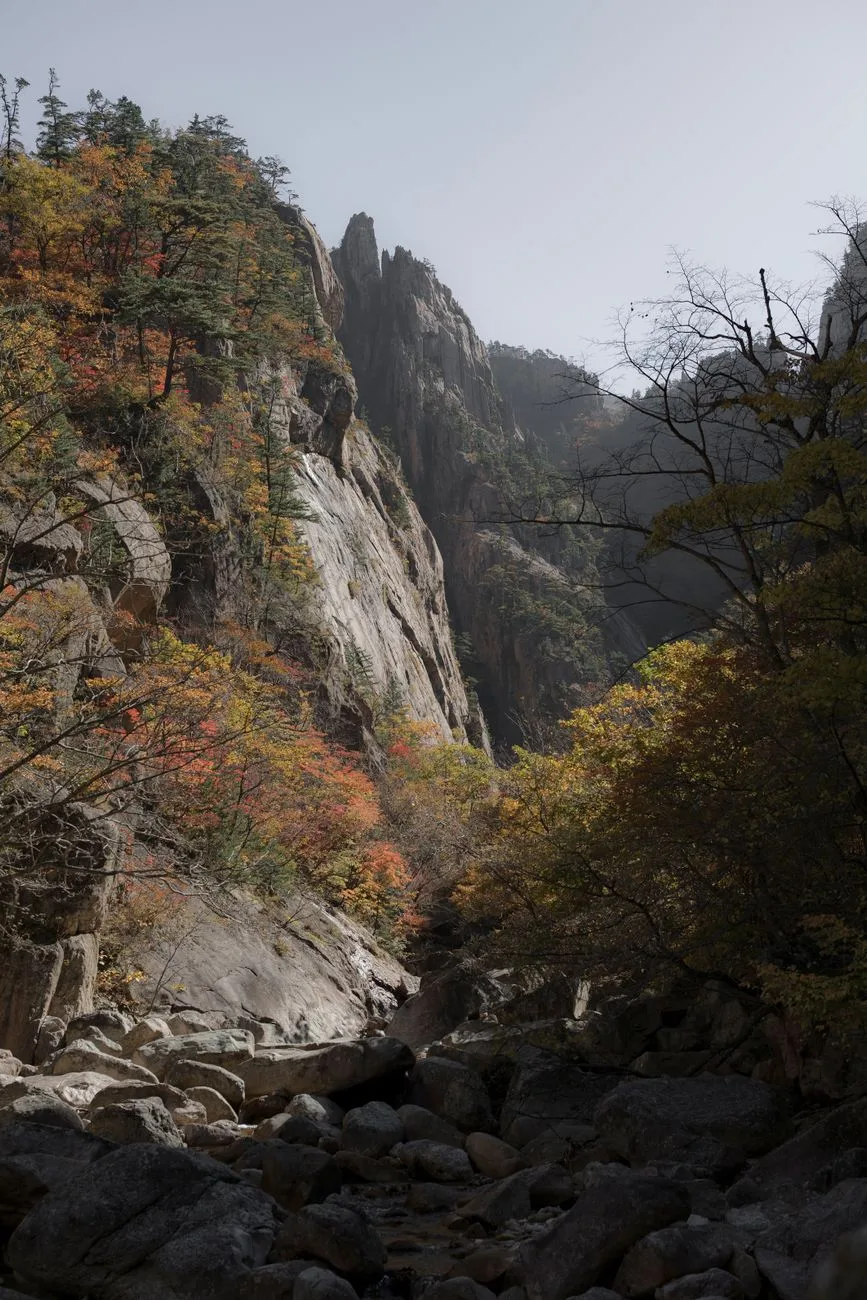
Autumn in Korea runs from late September to late November, and the colour moves in one direction: down. It starts on the Seoraksan ridgeline in the northeast, works south and downhill, and finishes with street ginkgo in Seoul and Busan. Mountain maples peak around mid-October in Gangwon and early November in Jeolla.
That single sentence is what most trip plans get wrong. Travellers book a fixed week and hope the leaves cooperate. The better method is to pick the scenery first, then let the foliage line tell you which week and which province.
The short version
- Foliage is a moving target, not a date. Korea's forecasts define first colour as roughly 20% of a mountain turned, and peak as roughly 80%.
- Altitude beats latitude over short distances. A summit can be at peak two weeks before the car park at its base.
- Chuseok shifts every year. It fell on 6 October in 2025 and falls on 25 September in 2026, which completely changes which week is crowded.
- September is still summer. Daytime highs in Seoul stay near the mid-20s °C, and typhoon influence has not ended.
- November is the underrated month for city travel: ginkgo tunnels, thin crowds, and lower room rates before the ski season.
How Korea's foliage forecast works, and why it moves
Korean foliage reporting uses two thresholds that are worth knowing before reading any forecast map. 첫단풍 (first colour) marks the point when about 20% of a mountain's trees have turned. 절정 (peak) is when about 80% have. A mountain listed as "first colour, 5 October" is not a mountain worth photographing on 5 October. Peak arrives one to two weeks later.
The biological trigger is temperature, not the calendar. Leaves begin turning when daily minimum temperatures drop toward roughly 5°C, which is why a warm, wet September pushes the whole season back by a week or more and a sharp early cold snap pulls it forward. Recent seasons across Korea have trended later than the long-run averages, in line with rising autumn temperatures documented by the Korea Meteorological Administration. Treat every published window as a bracket, then confirm against current-year updates from KMA and the Korea National Park Service, which posts live conditions for each national park.
Two rules of thumb do most of the work:
- Vertical drop. Colour descends a mountain over roughly two weeks. If the summit is peaking, the valley trail is a fortnight behind it.
- Southward drift. The line moves from Gangwon toward Jeolla and Gyeongsang over about three to four weeks, then finishes in city street trees, which are the last to turn anywhere.
Region-by-region peak colour calendar
The windows below reflect typical recent-season patterns rather than guaranteed dates. Check the current year before booking anything non-refundable.
| Destination | First colour (~20%) | Peak (~80%) | Why go |
|---|---|---|---|
| Seoraksan, Gangwon | late Sept – early Oct | mid–late Oct | Korea's earliest and most dramatic foliage; granite peaks |
| Odaesan / Chiaksan, Gangwon | early Oct | mid–late Oct | Gentler trails, fewer crowds than Seorak |
| Bukhansan, Seoul | mid Oct | late Oct – early Nov | Foliage without leaving the capital, by subway and bus |
| Songnisan, Chungbuk | mid Oct | late Oct | Beopjusa temple grounds under maples |
| Juwangsan, Gyeongbuk | mid Oct | late Oct – early Nov | Gorge walk, reflections on Jusanji pond |
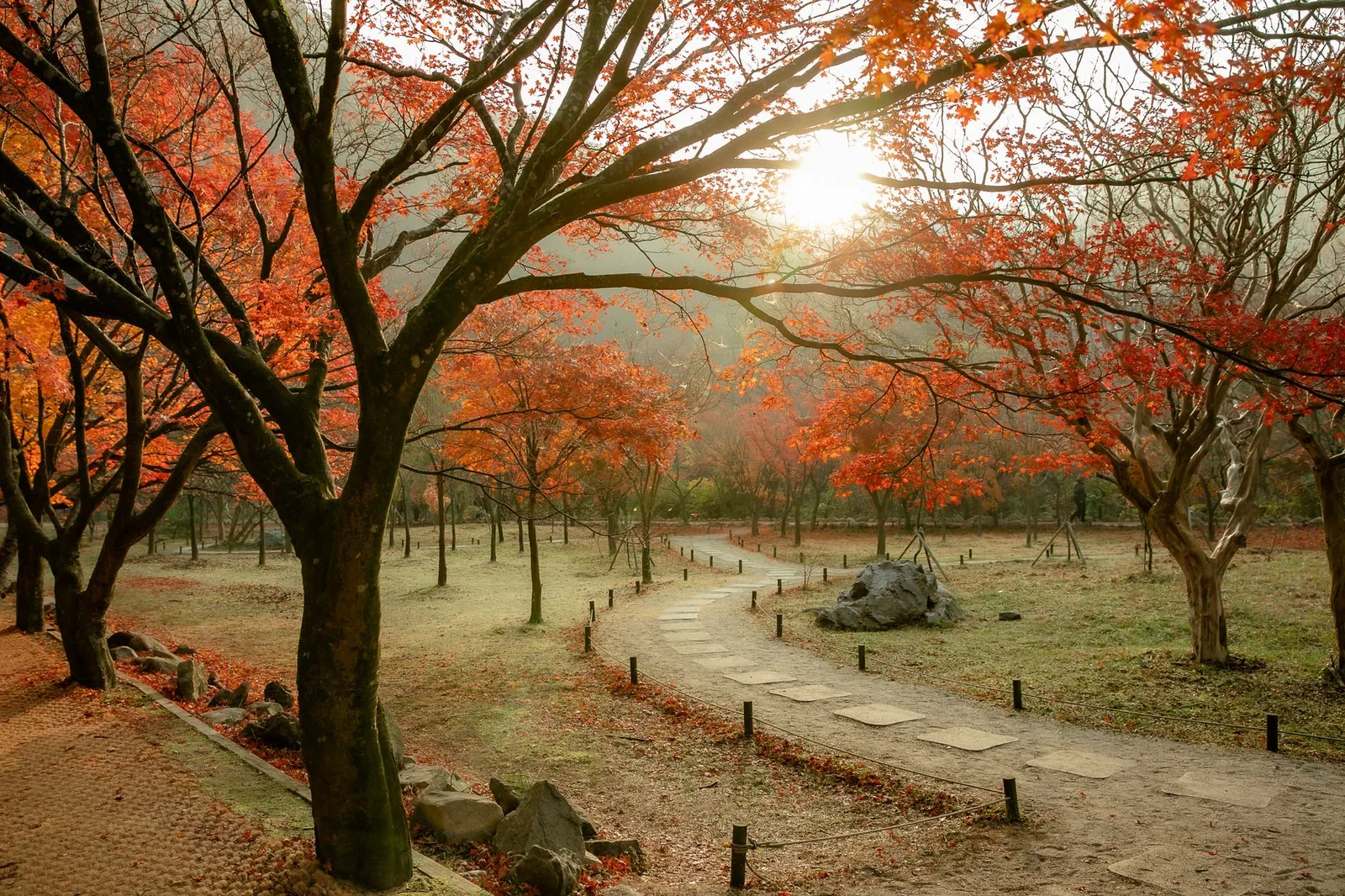
| Naejangsan, Jeonbuk | late Oct | early–mid Nov | The famous maple tunnel; Korea's classic finale |
| Jirisan, Jeonnam/Gyeongnam | mid Oct (summit) | late Oct – early Nov | Long ridge walks, Piagol valley |
| Hallasan, Jeju | mid Oct | late Oct | Volcanic scenery; summit trails need advance booking |
| Seoul & Busan street trees | late Oct | early–mid Nov | Ginkgo and zelkova avenues, no hiking required |
One consequence of this table: a single trip cannot catch peak everywhere. A mid-October visitor should point north and up. An early-November visitor should point south and stay low.
Chuseok and the autumn holiday calendar
Chuseok, the harvest holiday, follows the lunar calendar and slides by roughly eleven days a year, with an occasional nineteen-day jump when a leap month intervenes. It landed on 6 October in 2025, which stacked the holiday directly against National Foundation Day on 3 October and Hangeul Day on 9 October and buried the first ten days of October in domestic travel. In 2026 it falls on 25 September, which pulls the crush earlier and leaves peak foliage week comparatively clear.
What actually happens during Chuseok:
- Intercity buses, KTX tickets and rental cars sell out weeks ahead as millions travel to family hometowns.
- Expressways run at a crawl on the day before and the day after.
- Many small restaurants, markets and family-run shops close for two or three days, especially outside Seoul.
- Palaces, museums and major attractions mostly stay open, and some offer free or special admission during the holiday.
Seoul is often quieter than usual on Chuseok day itself, because the city empties outward. The pain is in the movement, not the destination. If your dates overlap the holiday, book rail seats the moment reservations open through Korail, or plan a stationary city itinerary and travel between regions before or after the peak days. The Korea Tourism Organization publishes holiday opening information each year.
What September, October and November actually feel like
Autumn is Korea's driest, clearest stretch, but the temperature swing across the three months is larger than most visitors expect. Approximate climate normals for Seoul, per KMA records, run something like this:
| Month | Seoul daytime high | Seoul overnight low | Character |
|---|---|---|---|
| September | around 26°C | around 18°C | Still summer; humid, residual typhoon risk |
| October | around 20°C | around 11°C | The sweet spot; dry, blue skies, big day-night gap |
| November | around 12°C | around 3°C | Coat weather; late foliage, early frost inland |
The number that catches people out is the diurnal range. A pleasant 20°C afternoon in Gyeongju becomes 8°C after dark, and a mountain ridge at 1,500 m can sit 8 to 10°C below the valley with wind on top of that. Layers are not optional at altitude.
September also still belongs to typhoon season. Storm tracks reaching the peninsula in early autumn can cancel ferries to Jeju and Ulleungdo and shut mountain trails for a day or two. For a fuller month-by-month picture, see our Korea weather guide by month, and for how autumn compares with the other seasons, our season-by-season guide to visiting Korea.
Pack: a light down or fleece layer, a windproof shell, real walking shoes, and one warm hat if mountains are on the plan. Skip the heavy winter coat unless you are travelling into late November.
Autumn scenery that is not maple leaves
Foliage gets the attention, but three other autumn landscapes are easier to reach and less contested.
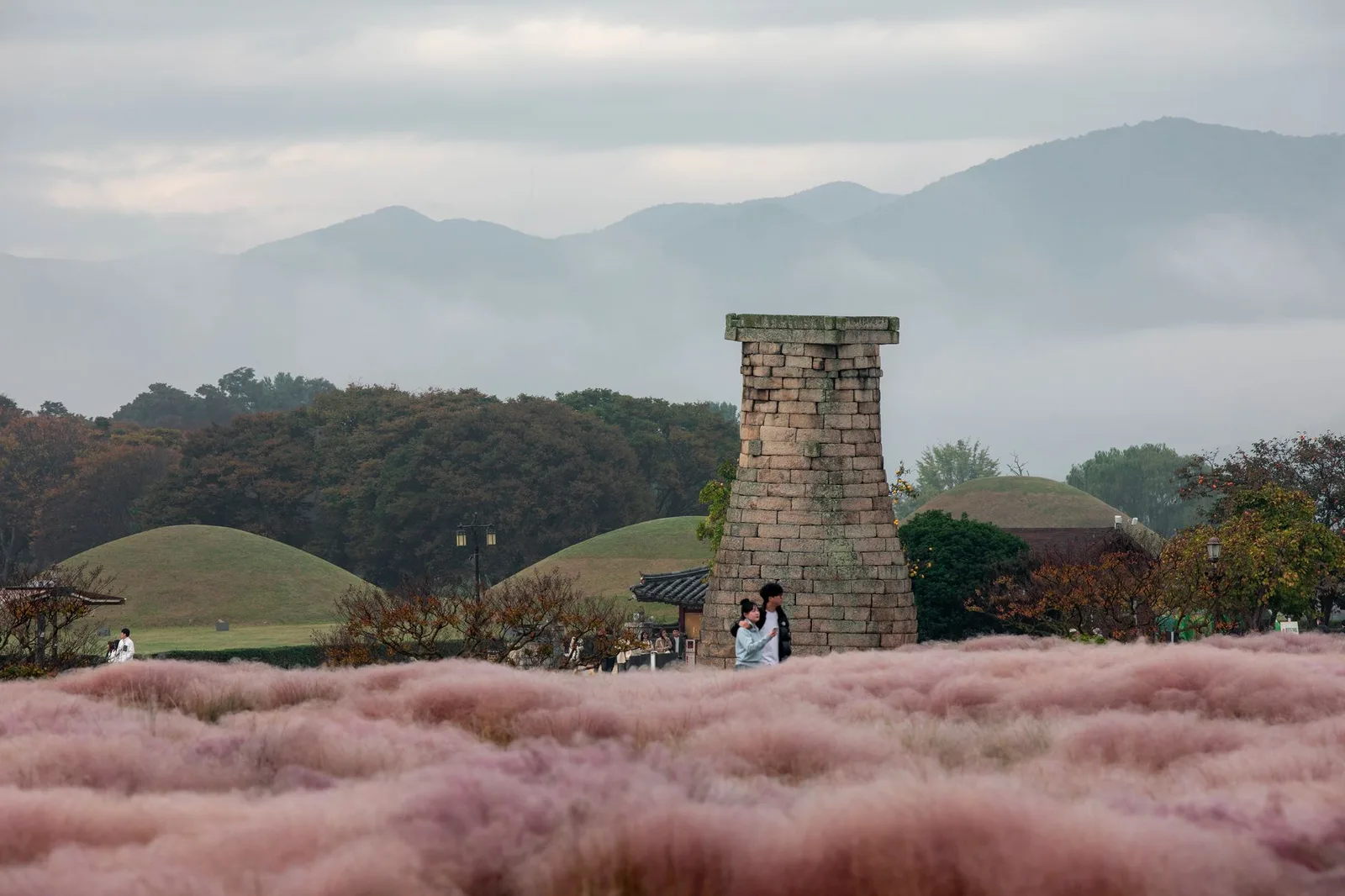
Pink muhly grass peaks roughly mid-October and grows in planted fields rather than forests. The photographed sites include the grounds near Cheomseongdae in Gyeongju and several coastal parks. It fades fast once frost arrives.
Silver grass (eulalia) turns whole hillsides pale gold in October, most famously on the highland plateaux of Gangwon and on Jeju's oreum. It photographs best in late afternoon backlight.
Reed fields peak later, from late October into November. Suncheonman Bay in Jeollanam-do is the benchmark: boardwalks through tidal reed beds, with migratory birds arriving as the season turns.
Autumn is also festival season. The Busan International Film Festival runs in early October, the Andong International Mask Dance Festival falls around late September to early October, and Jinju's lantern festival lights the Namgang River in October. Dates shift annually, so confirm on each festival's official site before building an itinerary around one.
A worked ten-day October itinerary that follows the colour line
This is the logic, not a fixed schedule. Substitute your own arrival date and shift everything with it.
Assume arrival on 10 October.
- Days 1–2, Seoul. Foliage is not ready in the city yet, so spend the time on palaces, markets and neighbourhoods while jet lag clears. Our Seoul neighbourhood guide by travel style covers where to base yourself.
- Days 3–4, Seoraksan. Express bus or intercity coach to Sokcho, two hours-plus from Seoul. This is the window when Seorak's upper slopes hit peak. Start at the park gate before 08:00; the cable car queue and the Sokcho-bound buses both collapse after mid-morning on October weekends.
- Days 5–6, Gyeongju or Andong. Move south by KTX. Mid-October here means pink muhly, temple grounds and mild weather, with mountain colour just beginning.
- Days 7–8, Busan. Coast, seafood and the film festival aftermath. Street trees are still green; that is fine, this leg is not about leaves.
- Days 9–10, Naejangsan or Jeonju. By 18–19 October Naejangsan is entering first colour and the crowds have not fully arrived. If your trip ran a week later, this is where peak would be waiting.
If the itinerary involves three or more long-distance legs, run the numbers on rail passes before buying point-to-point tickets; our Korea Rail Pass break-even analysis shows where the line falls.
Mistakes that spoil an autumn trip
- Booking Seoraksan for a peak Saturday. The park sees enormous domestic day-trip volume on October weekends. Tuesday to Thursday is a different mountain.
- Reading "first colour" as "peak". The 20% threshold is a forecast milestone, not a viewing recommendation.
- Expecting maples on Jeju. Jeju's autumn is silver grass, oreum and mild coast weather. Hallasan does turn, but summit trails to Baengnokdam require advance reservation through Jeju Province's booking system, and slots for October weekends go quickly.
- Underestimating accommodation pricing. Sokcho, Gyeongju and Jeonju room rates climb sharply on peak-foliage weekends and around Chuseok. Book those nights first and fill in the flexible ones later.
- Dressing for the forecast high. The overnight low is the number that matters when trips start at dawn or end after sunset.
- Assuming trails are always open. The Korea Forest Service and national park offices close sections for fire risk and maintenance in late autumn, and hiking hours shorten as daylight does.
Frequently asked questions
Is October or November better for autumn colours in Korea?
October for mountains, November for cities and the south. Gangwon's peaks peak in mid-to-late October, while Naejangsan, Suncheon's reeds and the ginkgo avenues of Seoul and Busan hold colour into the first half of November.
How much did Chuseok 2025 affect travel?
Chuseok 2025 fell on 6 October, sandwiched between the 3 October and 9 October public holidays, so the first third of the month was heavily booked for domestic travel. In 2026 the holiday moves to 25 September, which separates it from the peak foliage weeks.
Can I see good autumn colour without hiking?
Yes. Seoul's palace grounds, the Cheonggyecheon stream, Gyeongju's Bomun Lake and Jeonju Hanok Village all deliver strong autumn scenery on flat ground, and city street trees turn later than the mountains, extending the season into November.
Does it rain much in Korean autumn?
Autumn is Korea's driest and clearest season after the summer monsoon ends. September retains some typhoon and rain risk; October and November are markedly drier, with frequent high-visibility days that suit photography.
How far ahead should I book for autumn travel?
For peak-foliage weekends and any dates touching Chuseok, secure accommodation and long-distance rail two to three months ahead. Midweek travel in late October and anything in November can be arranged much closer to the date.
This guide covers general travel planning. Foliage windows, festival dates and holiday closures change every year; verify current information with the Korea Meteorological Administration, the Korea National Park Service and the Korea Tourism Organization before committing to non-refundable bookings.